What’s next for Pac-12? Commissioner George Kliavkoff talks ‘grenades’ and instability
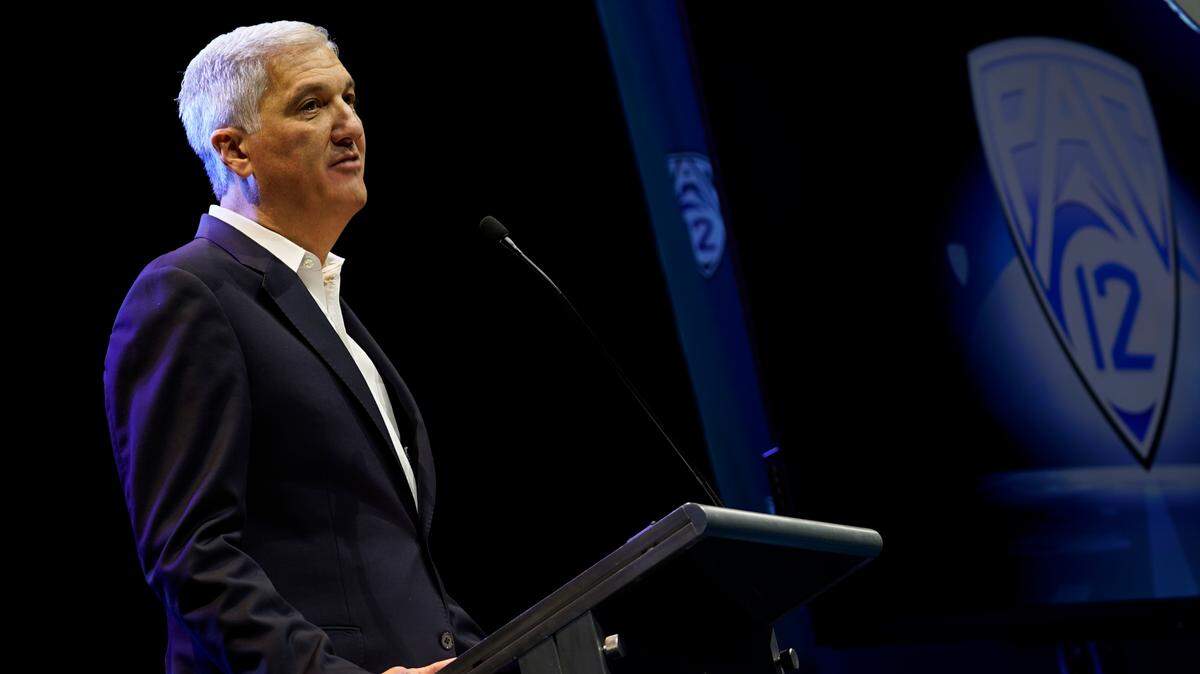
Nearly one month after USC and UCLA shook college football by announcing an imminent departure from the Pac-12 to the Big Ten, Pac-12 commissioner George Kliavkoff took the stage Friday morning in Los Angeles.
Kliavkoff, now in his second year leading the conference, spent nearly 37 minutes addressing the future at the annual Pac-12 Football Media Day.
Where does the conference go from here?
Kliavkoff said in his opening statement he joined the Pac-12 last July because of his belief in the conference’s mission to “develop the next generation of leaders by championing excellence in academics, athletics and the well-being of our student-athletes.”
“While college sports are undergoing unprecedented transformation, that mission has not changed and will never change for the Pac-12,” he said.
From a football perspective, the goals of earning College Football Playoff invitations — Oregon (2014 season) and Washington (2016 season) are currently the only two schools who have been to the CFP since it began — and winning championships also remain unchanged.
What has changed in the past month, though, is now the Pac-12 looks to navigate reaching those goals without two programs that have been pillars in this conference for much of the past century.
Late in the afternoon on June 30, both USC and UCLA announced they would join the Big Ten ahead of the 2024-25 school year, causing another dramatic shift in conference realignment, a year after Oklahoma and Texas made plans to leave the Big 12 for the SEC.
The Pac-12 responded with a statement not long after, which Kliavkoff expanded on Friday in his first public comments since the announcement.
“As a conference, we are of course very disappointed by the decisions by USC and UCLA to leave the Pac-12 and a century of tradition and rivalries after 2024,” he said. “That said, USC and UCLA have been proud members of the Pac-12 for almost a century. Despite their decision, we cherish our relationship with their student-athletes, coaches, staff, faculty, alumni and fans.
“For that reason, I personally have instructed everyone at our conference to make sure that USC and UCLA student-athletes are given every opportunity to compete and succeed for as long as they remain in the Pac-12.”
Kliavkoff did briefly discuss the possibility of the full conference remaining together when asked if the Los Angeles schools could return, specifically addressing UCLA’s situation.
UCLA exiting the conference would leave California as the only remaining UC school in the Pac-12 (Stanford and USC are both private universities), which has drawn criticism from both the state government and UC system and a review later this summer.
“I’d say UCLA is in a really difficult position,” he said. “There are a lot of constituents related to UCLA who are very, very, very unhappy with the decision. Student-athletes, the families of student-athletes, the faculty, the staff, the politicians, the fans, the alumni. There’s a lot of really, really upset people with that decision. There’s a hearing coming up about that decision.
“I can’t give you a percentage chance. I think it’s unlikely. But, if they came back, we’d welcome them back.”
Kliavkoff was also asked about suggestions that USC misled the Pac-12, but said, “I’m not going to talk about that. We’re going to take the high road and not talk about what happened in the past.
“We’re very, very focused on the future. We’re focused and confident in the 10 schools that remain in the Pac-12 being together, growing and succeeding as a group.”
Right now, that group includes Arizona, Arizona State, Cal, Colorado, Oregon, Oregon State, Stanford, Utah, Washington and Washington State.
Still, speculation has swirled since late June about the Pac-12’s future. Can the conference survive without the two schools that represent its biggest media market? If it does, will the Pac-12 remain at 10 teams or look to expand its footprint? Could the Pac-12 merge with other Power Five conferences? Will more schools depart for a new home?
“We’ve had two board meetings a week for the last four weeks,” Kliavkoff said. “Looking my colleagues in the eye, understanding their commitment, that their first priority is making sure that the Pac-12 survives, thrives and grows and is successful. They’re committed to the conference. I think the best thing to do is to ask them about it.”
He said the conference is “bullish about the Pac-12’s future and our opportunities for long-term growth, stability and success” as it looks to move forward.
“Our conference boasts 10 of the most iconic and innovative brands in all of sports, all-around excellence in academics and athletics, and a half dozen of the most valuable markets in this country,” he said.
Kliavkoff also outlined three areas in which the conference has continued to move forward in the past month, including working to “enhance the value of our media rights,” beginning media rights negotiations and “actively exploring expansion opportunities.”
“We are in the enviable position of being next to market after the Big Ten,” he said of the Pac-12’s media rights negotiations. “We already have significant interest from potential partners including both incumbents and new traditional television and most importantly digital media partners.”
Kliavkoff did not give specifics, but did say “it’s highly likely that we will end up with a big digital partner for some of our rights and that our rights will be distributed in a way that’s unique, different and new.”
The process is expected to accelerate after the Big Ten finalizes its media rights deal, and “will likely take months to complete,” he said.
“Even with the loss of our two LA schools, we still believe that after the current cycle of media rights deals, we will be very well positioned among the Power Five from a revenue-per-school standpoint,” Kliavkoff said.
Considering expansion, the Pac-12 will “look at media value, athletic strength, academic and cultural fit, and geography from a recruiting and student-athlete experience standpoint” when evaluating possible additions and has had “significant inbound interest,” Kliavkoff said.
While specific schools were not mentioned, he did also note the importance of the Pac-12 maintaining some sort of presence in Southern California beyond the departure of USC and UCLA, however that might take shape.
“Southern California is really important to us,” he said. “I think there are different ways of approaching staying part of Southern California. We may end up playing a lot of football games in LA.”
Kliavkoff also responded to a question about recent comments from the Big 12 regarding realignment.
“With respect to the Big 12 being open for business, I appreciate that,” he said. “We haven’t decided if we’re going shopping there or not yet.”
He later added his remark “was a reflection of the fact I’ve been spending four weeks trying to defend against grenades that have been lobbed in from every corner of the Big 12 trying to destabilize our remaining conference.
“I understand why they’re doing it, when you look the relative media value between the two conferences. I get it, I get why they’re scared, why they’re trying to destabilize it. I was just tired of that. That’s probably not the most collegial thing I’ve ever said.”
Kliavkoff said the focus remains on what the Pac-12 can control moving forward.
“What we can control is do everything we can to make the Pac-12 healthy and strong and do it together, the 10 of us,” he said. “That’s what I’m focused on.”
Beyond addressing the fallout of USC and UCLA’s decision to exit the conference, Kliavkoff also discussed other prominent topics in college sports, including NIL, and fielded questions from media members alongside senior associate commissioner for football operations Merton Hanks and Stanford athletic director Bernard Muir.
Listen to the full comments below:
This story was originally published July 29, 2022 at 8:50 AM with the headline "What’s next for Pac-12? Commissioner George Kliavkoff talks ‘grenades’ and instability."