
Tri-Cities area Olympic steeplechase runners must be athletic, strong to be successful
Marisa Howard describes the 3,000-meter steeplechase as “almost like a Spartan Race!”
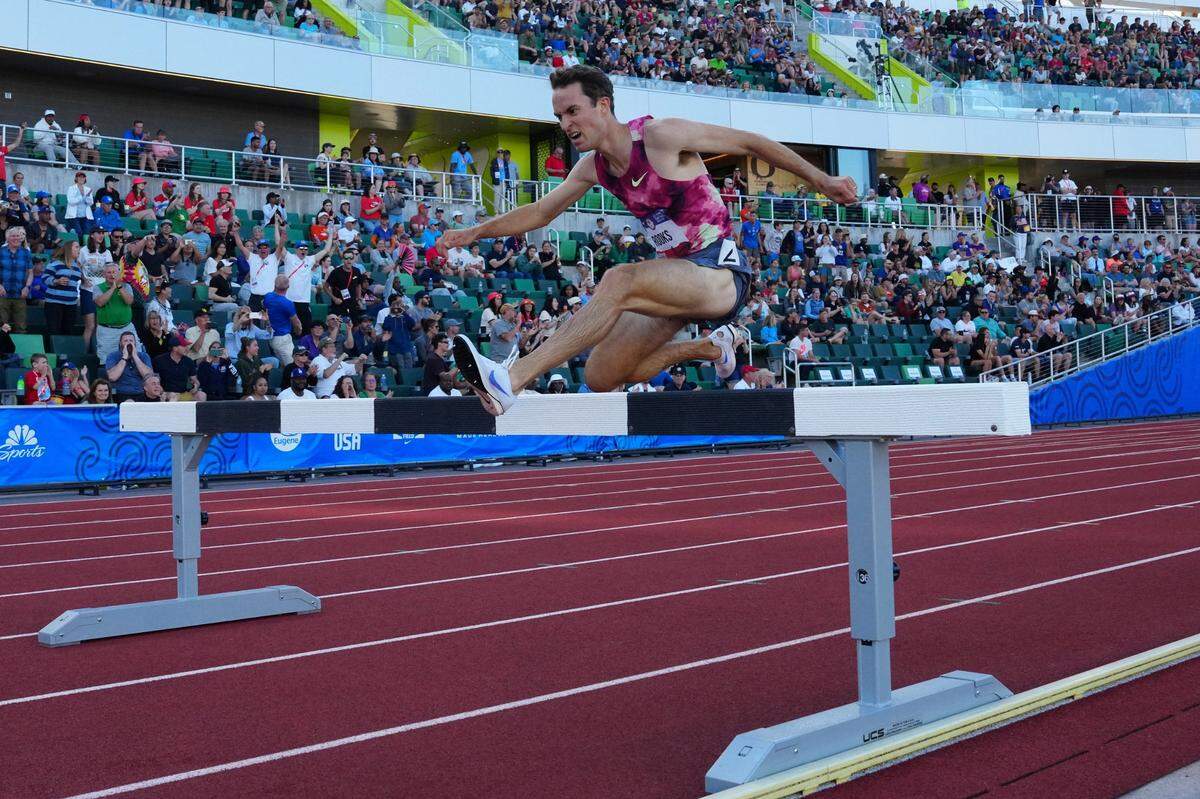
Kenneth Rooks says to run a steeplechase you have to have some fearlessness in you, and you need to embrace the barriers and the water jump.
Both Howard and Rooks are members of the United States’ Olympic Track and Field team competing in the Paris Summer Olympics this weekend into next week.
Howard, a 2010 Pasco High graduate whose maiden name is VanderMalle, will compete in the first round of heat races for women at 1 a.m. (Pacific time) early Sunday morning.
Rooks is a 2018 graduate of College Place High School and a two-time state cross country champion.
His first-round heat race takes place at 10:04 a.m. (Pacific) on Sunday.
So what’s it like running in a 3,000-meter steeplechase race?
Here’s what’s involved: There are four tall and wide hurdles/barriers on the track, and then another barrier that runners must get over and then land in a pool of ankle-deep water.
The 3,000 meters consist of 7.5 laps, which means runners must navigate the hurdles 28 times, and clear the water barrier seven times. Successful runners must keep a constant pace of under 5 minutes a mile.
First things first, a successful steeplechaser has to be in great shape.
“My coach has told me you need to be an athlete first, a runner second, and then a steeplechaser,” said Howard. “Those things have to build on each other. It’s set up like a pyramid. So it takes a certain level of athleticism.”
Rooks agrees.
“To become a steeplechase runner, you have to practice a lot,” Rooks said in a recent interview with the Herald. “You’ve got to work on your hurdle form, and get it to be second nature. There are a lot of runners who don’t want to do it. But I wanted to try it out in college.”
Bruce Blizard — a long-time coach, author and teacher — has nothing but respect for steeplechase runners.
“The steeplechase is THE most physically demanding track event,” said Blizard. “Twenty-eight hurdles and seven water jumps. Steeplechasers usually start out as very good flat track runners and then gravitate to the steeple. The event takes a very athletic runner with above average physical strength.”
He believes both Rooks and Howard have great chances to make the finals in their respective races.
“I think Kenneth Rooks played basketball in high school and he ran the 400 in 50.35 seconds, which is great speed for a high school distance kid,” he said. “Marisa is a bit unusual because she’s shorter than most of the other top women. But she is very strong and is also a great technical hurdler.”
Eric Hisaw is the long-time head track and field coach for both boys and girls at Walla Walla High School.
He’s never coached a steeplechaser, but running is running.
“It’s a distance race and to me it’s like so many others,” said Hisaw. “It comes down to placement in the pack for the last 800 meters, and speed for the last 400 and 200. So many athletes can close well, but can they close well if they’ve been running a race that is really taxing for them and makes them suffer early and for a period of time?”
Strength, says Hisaw, will be a key component.
“Strength to run to required distance. Strength to overcome the pounding of coming over the landing off the hurdle, and when the legs ‘go out from under you,’ you then suffer to clear the hurdle and pit with speed,” said Hisaw. “You have to have great mentality too. (You have to be) composed to run in a pack and clear the barrier with someone right next to you; to run off the water jump and get back to pace to be competitive.
“It’s such a great race to run because it combines speed with strength unlike any other distance race.”
Howard’s plan is focused on staying with the pack, and not making aggressive moves early.
“In some of these races, when you’re in the pack, you have to trust the runners in front of you,” said Howard. “You trust the runner in front of you, and we can get through (the water jump). Coming to the water jump, you find a line where you can see things well. You want to get a good look at things.”
Rooks has a mindset with a checklist during the race.
“About three laps to a mile into the race, there is a checkpoint where I believe I need to be in this position,” said Rooks. “And I may need to make a move. Or I might expect a more experienced runner to make a move. Sometimes it’s simple. Most of the time we try to keep things simple.
“But whatever happens, I can respond possibly to what another runner is doing and respond well. I have to remind myself I’m one of the guys people are trying to beat.”
Blizard says to watch an array of runners and the great variation in their technique.
“The African runners are not always very good hurdlers, but they are unbelievably athletic,” said Blizard. “There are even a few women from Ethiopia and Kenya who will not even touch the barrier as they clear the water jump.”
Tactics, he added, will play a greater role in the steeple than any other event, because the runners need to be very cautious in the early laps.
“Fatigue accumulates very rapidly because of the barriers, so an athlete who uses too much energy too early will find himself or herself in big trouble later,” Blizard continued. “I think Rooks is emerging as one of the best tacticians in the world. Howard’s best attribute is an ability to hang on when the race speeds up, and then she chooses the right time to make a move near the end.”
The bottom line, Blizard concludes, is that there are two local runners competing in the same event in the Olympics.
“And that is exciting,” Blizard said.
Hisaw agrees.
“It is absolutely awesome,” said Hisaw.
This story was originally published August 3, 2024 at 10:44 AM.