
100+ temperature smashes 100-year-old Eastern WA heat record. Next worry is fire
This week’s heat wave in the Tri-Cities brought the hottest recorded temperature in 100 years for one date and tied the record for another date.
The daily heat record for Aug. 14 was tied Monday when the high was 105 in the Tri-Cities.
And Tuesday’s high of 109, smashed a daily record of 104 set just two years ago.
National Weather Service records for the Tri-Cities go back more than 100 years for most dates.
The heat wave is expected to continue through Thursday, with a high of 104 forecast for Wednesday and 103 on Thursday, according to the weather service.
However, the Weather Channel was forecasting a high of 108 on Wednesday, which would be another record breaker, and 107 on Thursday.
The Tri-Cities record high for Aug. 16, which is Wednesday, is 106 and the record high for Aug. 17 is 110.
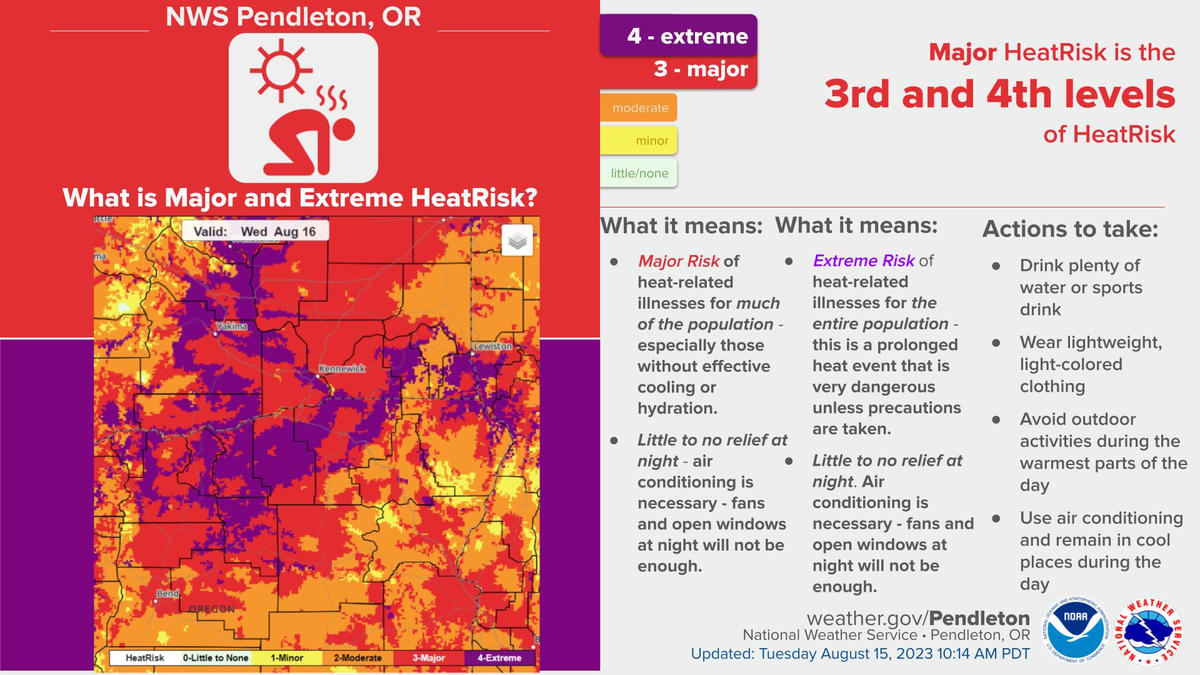
Then the excessive heat warning ends, but not before overlapping with a fire weather watch.
Fire weather watch
The fire weather watch for the Tri-Cities starts at 1 p.m. Thursday and is in effect until 9 p.m. Friday due to wind and low humidity that could contribute to a fire spreading rapidly.
Relative humidity in the lower Columbia Basin could be as low as 14%, according to the weather service. Wind gusts up to 24 mph are forecast for Thursday and Friday.
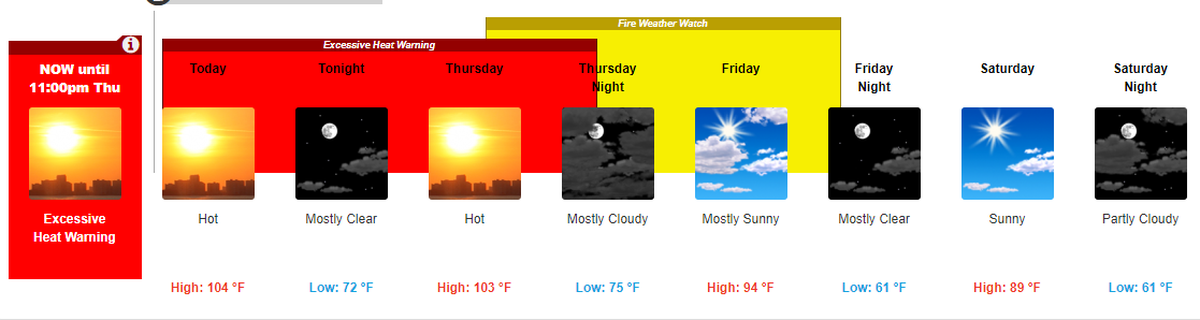
Temperatures are forecast to fall dramatically after the heat wave breaks.
Friday the high should drop to 94 and then highs in the 80s are forecast through Tuesday. The coolest day should be Monday with a high of 84, according to the weather service.
A slight chance of showers is forecast for Sunday through Tuesday.
Highs normally are about 91 for the third week of August in the Tri-Cities, according to weather service data.
Hot weather swimming warning
While temperatures are high and people are finding relief at the Columbia and Snake rivers, the Army Corps of Engineers is urging caution.
The difference between air and water temperature can kill, it said.
Falling into water unexpectedly can cause involuntary gasping, even with water as warm as 77 degrees, according to the National Weather Service.
A sudden fall can also injure or disorientate a person, which can make it more difficult to recover from the incident.
Wearing a life jacket can help limit fatalities, it said. Army Corps data shows that 89 percent of drowning victims are not wearing life jackets.
“A lot of people who drown don’t anticipate being in the water,” said Tom Conning, a spokesman for the Corps. “Another problem is people overestimate their swimming ability in open water — men are especially arrogant about their swimming abilities and strength.”
About 88% of drowning victims are men, according to Corps data.
The Army Corps recreation district that includes the Snake River in Eastern Washington plus some waterways in Idaho had four drownings at its recreation areas in 2022.
The Corps recommends:
- Wearing a life jacket: it will help you survive an unexpected fall into the water and can save your life if you become exhausted.
- Knowing your swimming abilities: swimming in natural waters is different from swimming in a pool, and your swimming ability decreases with age.
- Expecting the unexpected: if you fall or jump into water that is colder than 77 degrees, you can inhale water from involuntary gasping.
- Understanding “boater’s hypnosis”: this can slow your reaction time almost as much as intoxication.
- Eliminating alcohol consumption: Alcohol induces an inner ear condition — caloric labyrinthitis — that can cause disorientation when underwater.
This story was originally published August 16, 2023 at 11:04 AM.