
120+ year Tri-Cities record tied by this week’s sweltering temperatures
Air quality in the Tri-Cities was rated as “very unhealthy” Friday as smoke from multiple fires burning in the Northwest pollutes the air.
A high pressure system has spread smoke across Washington state from fires burning in Canada, northern California, Oregon and Washington, including the Schneider Springs Fire northwest of Naches, according to the National Weather Service.
The smoky air has been keeping temperatures slightly lower than earlier forecast, while the Tri-Cities area is under an excessive heat warning through Saturday.
However, the high Wednesday tied the record of 106 degrees for the date set more than 120 years ago in Kennewick in 1898.
The high Saturday could be as hot as 105, up from the 102 forecast for Friday.
After Sunday, when a high of 102 is forecast, the temperature should drop into the low 90s on Monday and to the upper 80s Tuesday and Wednesday.
The normal average high for August in the Tri-Cities is about 90.
Overnight lows in the Tri-Cities may not drop below the 70s until Monday night, when the low should be in the 60s. By Tuesday and Wednesday night lows should drop to 60 to 61.
Unhealthy Washington air
At midday Friday, air monitors across Eastern Washington were showing ratings of unhealthy, very unhealthy and hazardous.
There was also was some air quality deterioration along the Interstate 5 corridor, with some ratings of unhealthy or unhealthy for sensitive groups.
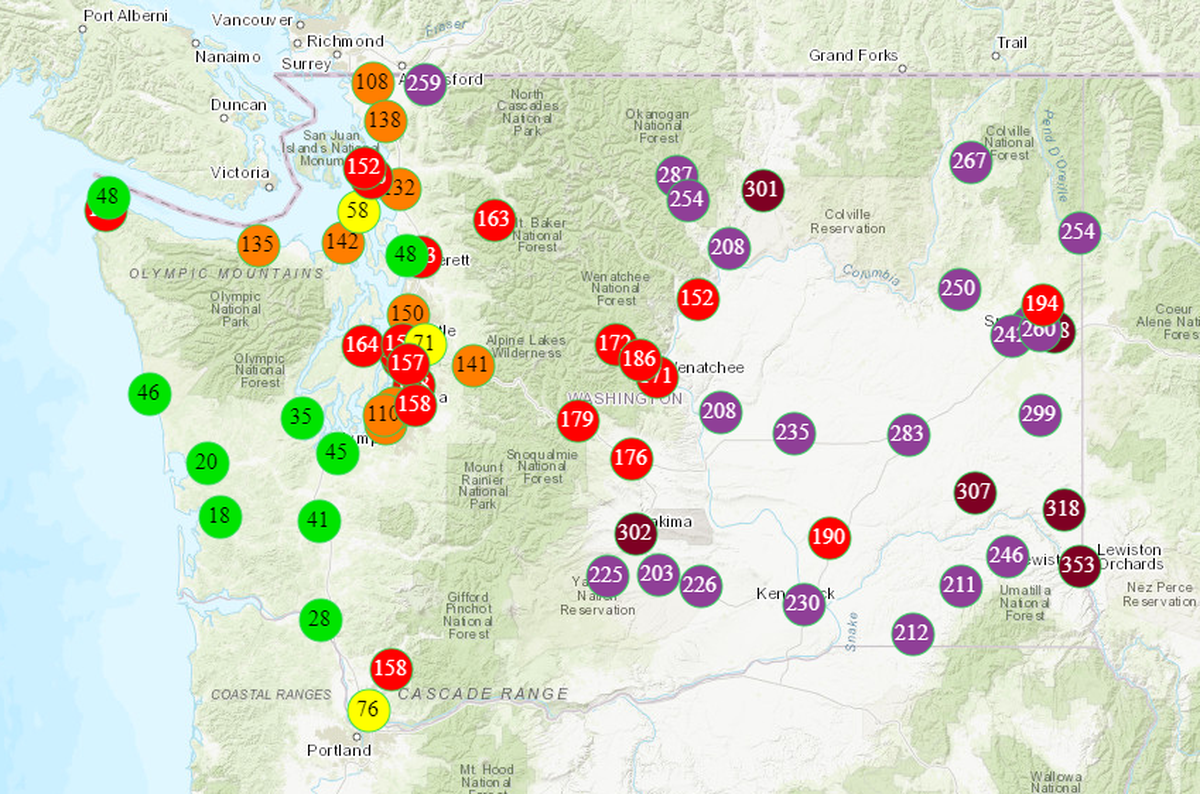
By late Sunday, air quality should be much improved, unless there are new fire starts, according to the Washington state Department of Ecology.
Yakima County may still be smoky then from the Schneider Springs Fire northwest of Naches and the Tri-Cities area could continue to get some of that smoke.
While air is rated as “very unhealthy” everyone should stay indoors and avoid all strenuous activity, according to the Washington state Department of Health.
The poor air quality may be particularly dangerous for children, pregnant women, seniors and smokers, in addition to people with chronic illnesses such as heart disease, respiratory disease, diabetes or a history of stroke.
The smoke can worsen chronic illnesses.
To keep indoor air as clean as possible, windows should be closed, when possible. Air conditioners should be set to “recirculation.”
Avoid vacuuming, using essential oil diffusers, and burning candles or incense.
Masks rated N96 or N100 offer some protection from air pollution, the Benton Clean Air Agency said. However, cloth masks meant to protect against COVID-19 are not effective against smoke particles.
This story was originally published August 13, 2021 at 11:52 AM.