
Update: Tri-Cities air quality drops to ‘very unhealthy’ level. No relief for days
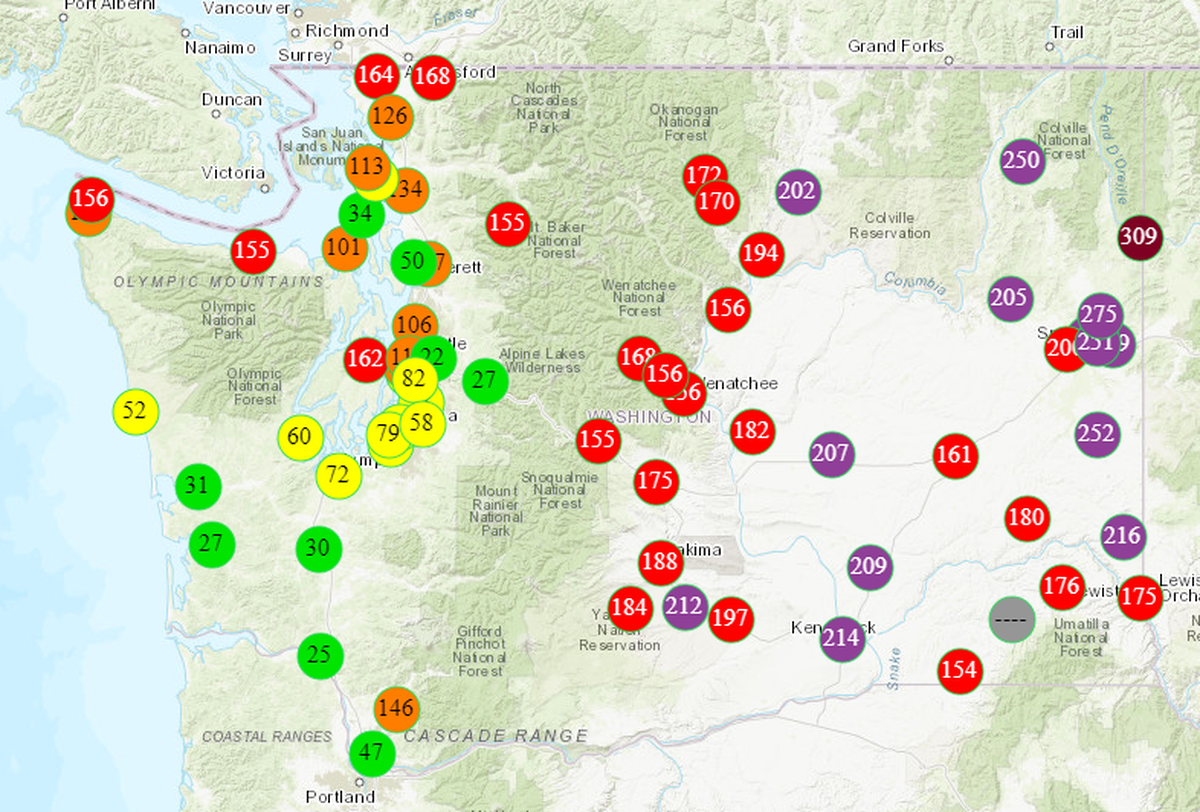
Air quality in the Tri-Cities was rated as “very unhealthy” Thursday afternoon as smoke saturated the air.
Air was rated as “good” at daybreak, but by 8 a.m. it was smoky enough to be considered unhealthy for all people and continued to worsen through the morning, according to the Washington state Department of Ecology.
Most air monitoring stations east of the Washington Cascade range were reporting air quality that was unhealthy or very unhealthy Thursday afternoon.
The exception was Newport, Wash., northeast of Spokane, with an air quality rating of hazardous.
The National Weather Service has issued an air quality alert for the Tri-Cities area, along with much of central and southeast Washington through 10 a.m. Monday.
The Tri-Cities also is under an excessive heat warning through 8 p.m. Saturday. On Wednesday the high reported at the Pasco airport at 5:30 p.m. was 106. Highs Thursday through Saturday are forecast to be has hot as 104 to 105.
Normal average daily highs for the Tri-Cities in August are about 90.
Overnight temperatures will provide little relief from the heat until Monday.
Lows are forecast in the 70s, with the temperature not expected to drop below 76 on Saturday, the warmest forecast in the coming nights.
Smoky air precautions
Everyone should stay indoors and avoid all strenuous activity when air quality is rated as “very unhealthy,” according to the Washington state Department of Health.
Air pollution from smoke can cause burning eyes, a runny nose and aggravate chronic illnesses, said the Benton Clean Air Agency.
As air worsens, more people may have breathing problems.
The poor air quality may be particularly difficult for children, pregnant women, seniors and smokers, in addition to people with chronic illnesses such as heart disease, respiratory disease, diabetes or a history of stroke.
To keep indoor air as clean as possible, windows should be closed, when possible. Air conditioners should be set to “recirculation.”
Avoid vacuuming, using essential oil diffusers, and burning candles or incense.
Masks rated N96 or N100 offer some protection from air pollution, the Benton Clean Air Agency said. However, cloth masks meant to protect against COVID-19 are not effective against smoke particles.
This story was originally published August 12, 2021 at 12:19 PM.