
Sweltering Tri-Cities scorches June heat records. ‘Virtually unheard of’ Northwest highs
The temperature Tuesday in the Tri-Cities could tie the all-time record high for the state of Washington, creating dangerous conditions for those without air conditioning.
On Sunday a new record high for the Tri-Cities for the month of June was set.
The National Weather Service forecast a high of 114 for Monday, increasing to 117 on Tuesday, the expected peak of the current heat wave. The forecast highs are at the center of a range and highs could be a couple of degrees higher or cooler.
The Weather Channel is predicting that Tri-Cities temperatures will peak at a high of 118 on Tuesday at the Tri-Cities Airport in Pasco.
The all-time high recorded in Washington state is 118, recorded most recently at Burbank east of Pasco on Aug. 5, 1961.
Relief from the heat will be slow in coming.
The weather service predicts that highs will remain above 110 through Wednesday and then drop to 107 Thursday and 104 Friday through Sunday, July 4.
The Weather Channel, which has a two-week forecast, predicts high temperatures will remain in the triple digits through Tuesday, July 6, and then range from 98 to 101 through July 12.
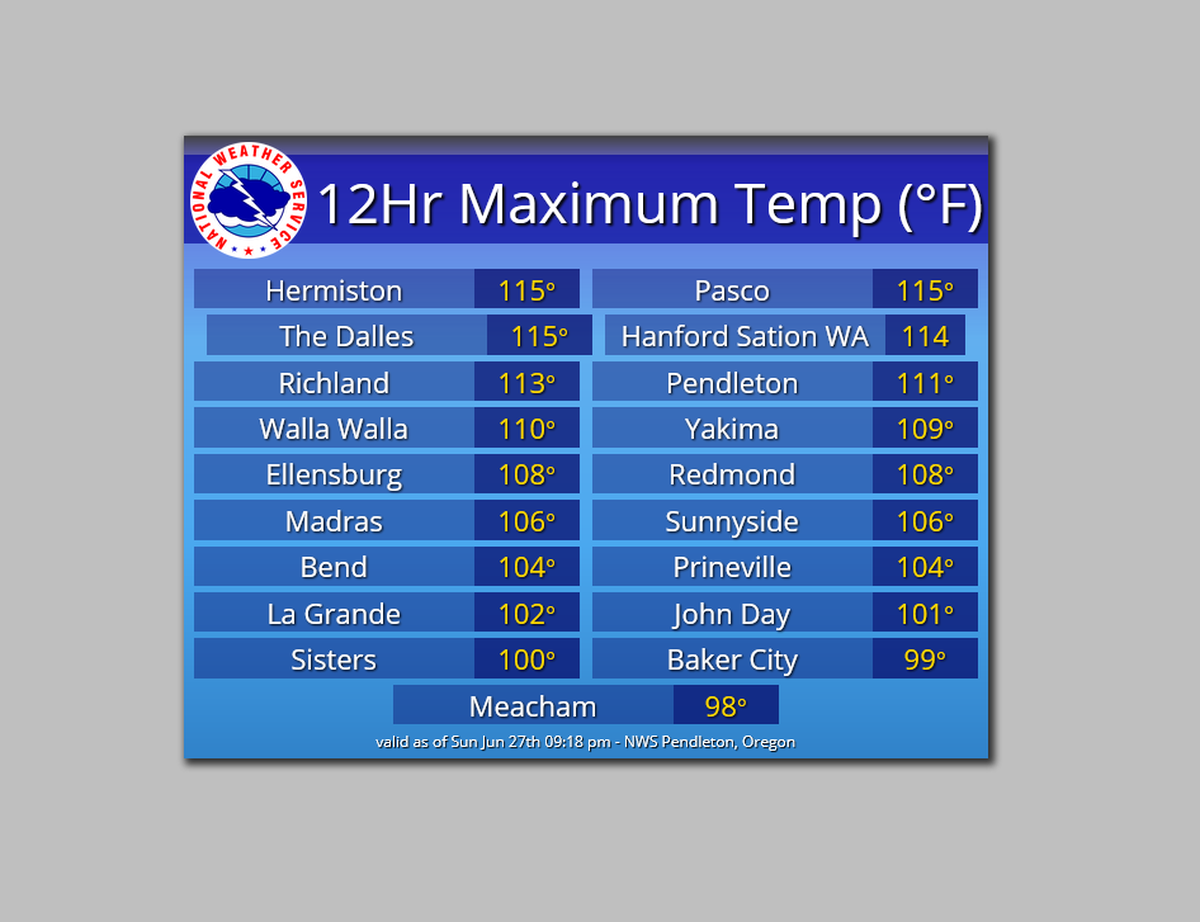
A record-breaking high of 115 for June was recorded Sunday at the airport in Pasco.
Richland had a high of 113, and a high of 114 was recorded at the Hanford Meteorology Station, according to the National Weather Service.
The previous record high for the Tri-Cities for any day in June was 111 degrees at the Tri-Cities Airport in 2015, according to the weather service. The record high in Richland for June previously was 110 in June 1958.
On the west side of the Cascade Mountains, all-time heat records have already fallen.
Highs ‘virtually unheard of’
“Temperatures of 110 F or greater are virtually unheard of west of the Cascades,” said AccuWeather senior meteorologist Randy Adkins.
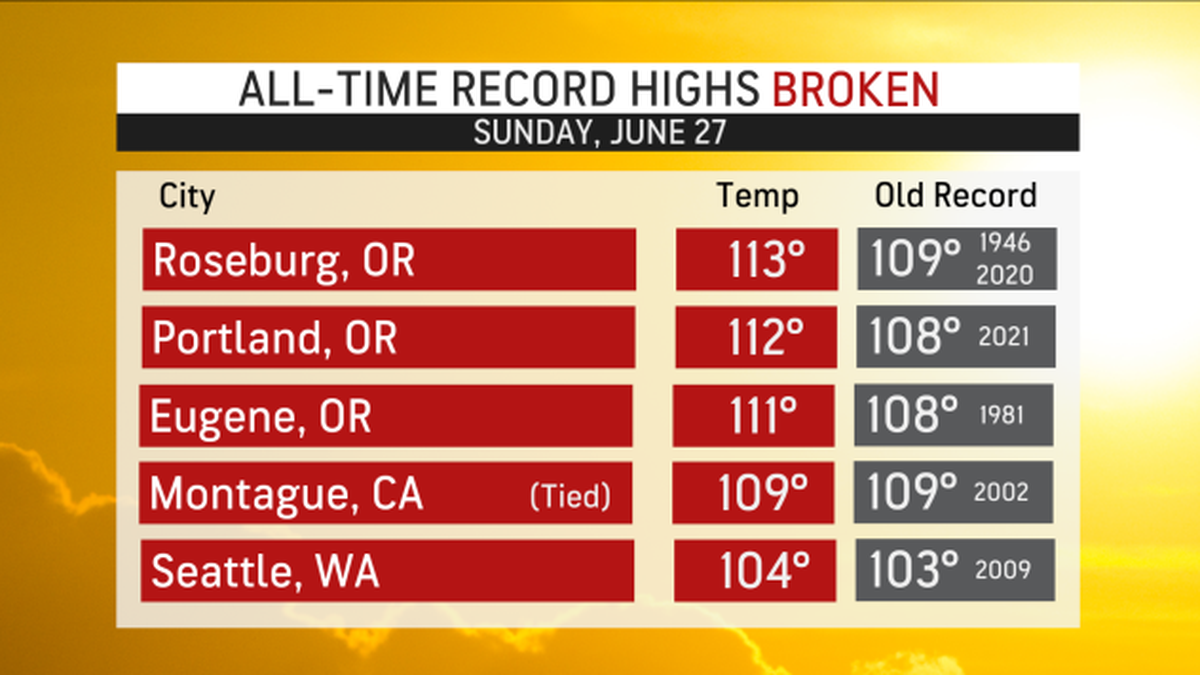
Seattle had temperatures higher than 100 degrees for two days in a row for the first time ever, according to AccuWeather.
On Saturday the high was 102 and on Sunday it was 104, setting an all time heat record for the city.
The new record was expected to fall on Monday, with a high of 111 forecast.
Portland had an all time heat record of 107 before the current heat wave started.
On Saturday the temperature reached 108 and on Sunday it reached 112, with even hotter weather forecast for Monday, according to AccuWeather.
In Eugene, Oregon, the U.S. track and field trials were postponed to 8:30 p.m. Sunday due to the extreme heat, and fans were advised to evacuate the stands.
The high temperatures have been particularly dangerous along the Interstate 5 corridor, where summer weather is usually moderate enough that many homes do not have air conditioning.
In British Columbia on Sunday an all-time high for the country was set with 116 recorded in Lytton, about 80 miles north of the Washington state border.
AccuWeather advised people who are flying in the Northwest to check for delays because aircraft need more time between takeoffs and landings in the heat.
People heading to the high mountains to escape the heat should be careful in snowy areas.
“Rapid melting and water rushing through or underneath snow and icepack can create dangerous conditions for anyone hiking,” said AccuWeather meteorologist Brandon Buckingham.
In the Tri-Cities the free COVID-19 testing site at Columbia Basin College off Argent Road in Pasco closed early Saturday an Sunday because of the heat. I
t was open for about four hours Monday before closing. Tuesday it is expected to open at 8:30 a.m., but likely will close early again.
Dangerous heat
The Kennewick Fire Department said Monday morning that it was being called out for heat-related illnesses.
“Our crews are busier than ever,” it posted to Facebook. Drink lots of water, stay out of the sun and don’t be too active, it advised.
The heat wave is particularly dangerous for children 4 and younger, whose bodies heat up three to five times faster than adults, according to the Centers for Disease Control and Prevention.
People older than 65, who are overweight, who are ill or who are taking certain medications also are at increased risk of heat-related illnesses.
Those without air-conditioning should head to a public place, such as a shopping mall or library, it said. Cooling off there for only a couple hours a day will reduce the risk of heat-related illness, the Benton Franklin Health District posted on Facebook.
The city of Kennewick announced Monday afternoon that it was opening a temporary cooling center for people without air conditioning at the Keewaydin Community Center at 500 S. Auburn St.
It will be open Tuesday, June 29, to Friday, July 2, from 8 a.m. to 5 p.m. It also will be open Saturday, July 3, from 11 a.m. to 4 p.m.
Amenities will include Wi-Fi, Nintendo gaming systems, a pool table, seating for people to bring their own card and board games, and bottled water.
The city of Richland is inviting people to cool down at City Hall, the Richland Community Center or the Richland Public Library. Face masks are required.
A cooling station with free water has been set up in downtown Kennewick at 204 W. Kennewick Ave. from 6 a.m. to 8 p.m. Monday through Wednesday.
The cost is being covered by a personal donation of Kennewick Mayor Pro Tem Steve Lee and his wife, Jessy.
Taking a cool shower or bath also can help people cool down, the CDC said.
Electric fans can provide some comfort, but once temperatures reach the high 90s they will not prevent heat-related illnesses, according to the CDC.
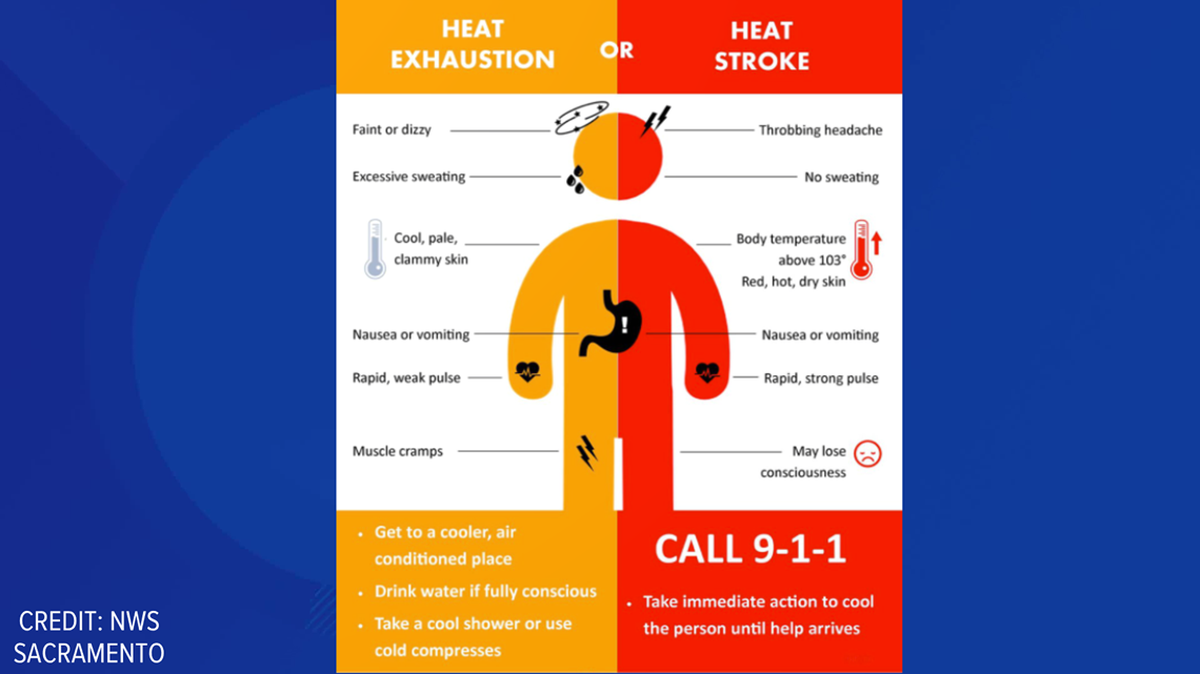
The Washington state Department of Health says symptoms of heat illness — dizziness, nausea, headaches, muscle cramps — require immediate action.
Move to a cooler location to rest for a few minutes and seek medical attention immediately if you do not feel better, it said.
Animals at risk
Pets may need increased attention to prevent overheating during the heat wave, warn veterinarians at Washington State University’s College of Veterinary Medicine.
“Dogs and cats do not sweat like humans,” said Raelynn Farnsworth, interim director of WSU’s Veterinary Teaching Hospital. “Instead, they pant and seek shade to eliminate excess heat.”
Because they lose water through exhaled air, plenty of drinking water that they can reach at anytime is needed, she said.
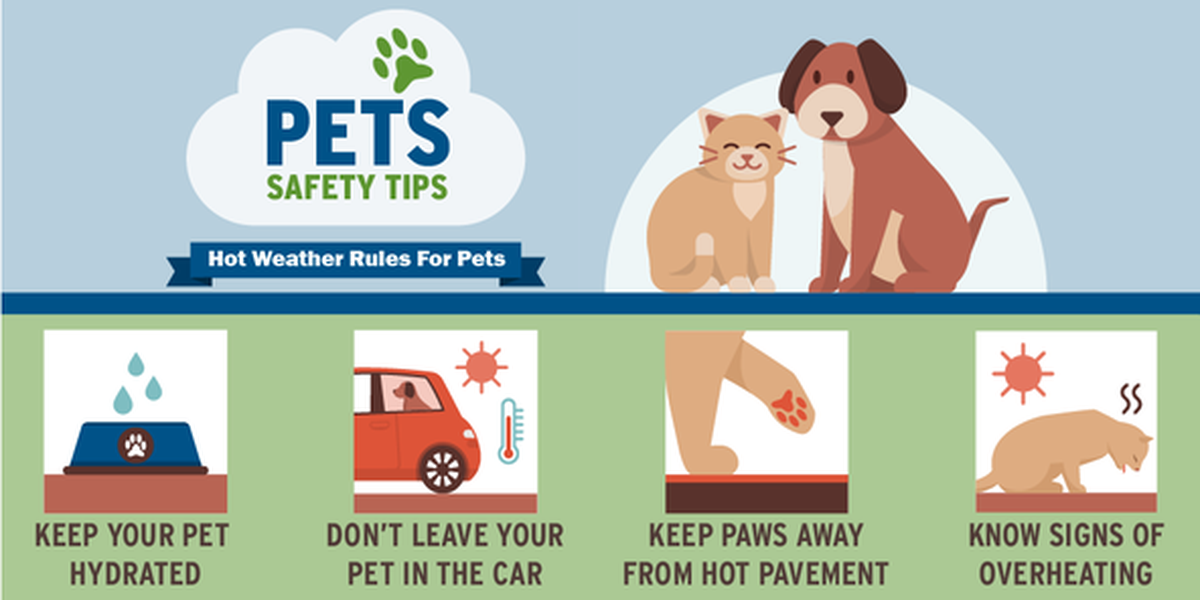
Dogs should be walked in the early morning and evening hours, with minimal time outside the rest of the day.
If it is too hot for a person to walk barefoot on pavement, it’s also too hot for paws, she said.
Animals should not be left inside parked cars, where temperatures can approach 200 degrees in a matter of minutes, she said. They can develop heat stroke quickly.
Cracking the car window will not prevent heat buildup, she said.
A dehydrated or overheated pet may pant heavily, stagger, vomit, have diarrhea, seizures or go into a coma, according to information from WSU.
Livestock should have access to shade, if possible, and plenty of cool, clean water.
Excessive heat and stagnant water can promote blue-green algae growth, which can be toxic to livestock.
This story was originally published June 28, 2021 at 12:11 PM.