
Is dividing WA in two a ‘win-win’ or ‘lose-lose’? Why some want a new state map
Editor’s note: This story will be part of a five-part series by The Olympian that examines how the nation’s political divide is reshaping the future of Washington state.
Blue skies stretched over the anti-Trump protest at the Washington state Capitol, where some demonstrators defiantly waved American flags.
Rusty Stead was one exception.
Instead, the rally-goer gripped a green, white and blue banner emblazoned with the silhouette of a Douglas fir tree: a symbol of the Cascadia movement.
November 2024’s presidential election, which secured Donald Trump’s return to the White House, felt like a slap in the face to Stead: “This doesn’t seem like my America anymore.” So when Stead learned about the Cascadia bioregion, the concept resonated.
“I’m happy to be a citizen of Cascadia more than I’m happy to be an American. … That’s my first love,” Stead said at the thousands-deep protest last June. “I don’t know if I’ll ever see secession in my lifetime. I would support it if we did.”
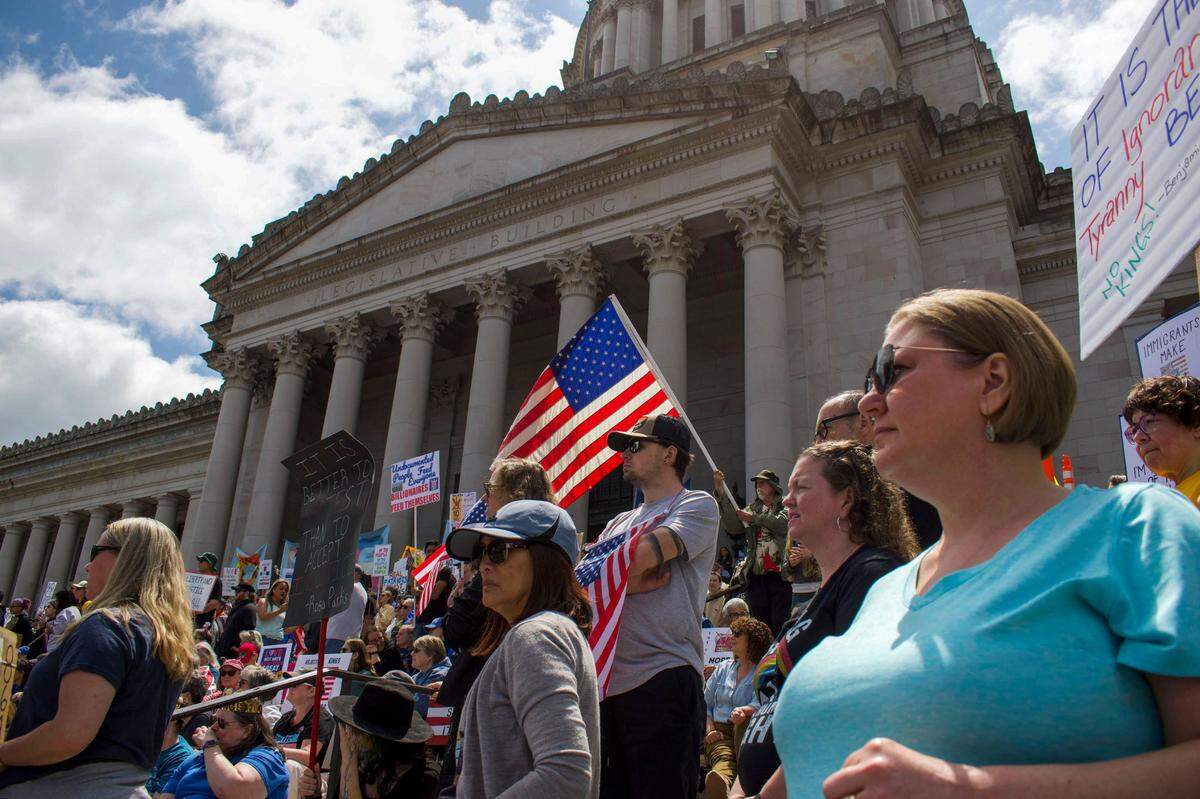
Cascadia is a cultural and social movement that recognizes a Pacific Northwest bioregion, defined by natural borders like watersheds and that includes Washington state and reaches as far as Northern California and Southern Alaska. Some adherents pine for a separatist effort to gain independence. In 2011, Time Magazine named the Republic of Cascadia in its list of “top 10 aspiring nations.”
The Cascadia movement may be unique, but it’s just one of several pushes that have aimed to reshape Washington state.
Proposals to divide the country are becoming increasingly popular in an ever-more-polarized political ecosystem. “National divorce” has trended on social media at various times in recent years. Blue state governors, attorneys general and health officials are banding together to buck Trump 2.0. Secessionist campaigns have cropped up elsewhere in the U.S., including California and Texas.
Critics seriously doubt that such cartographic designs will ever manifest in Washington. Yet those dreams speak to a growing disenchantment with the confines and political quirks of the state’s boundaries.
Many want a hand in recharting Washington’s borders moving forward, however far-fetched that goal may be. While supporters argue that new perimeters would lead to better representation, others maintain that Washington state — and the nation — would be stronger staying together.
The Win-Win Act
State Rep. Rob Chase spoke earnestly in an explainer video he made to promote one of his bills, looking straight at the camera. Dressed in a gray blazer and blue shirt, the Republican lawmaker from Spokane Valley stood in front of a backdrop of the historic marble Rotunda inside the Washington state Legislative Building.
First Chase delivered a wind-up, then the big pitch: Why not bifurcate Washington into two autonomous regions?
In the final days of the 2025 legislative session, Chase presented that concept in House Bill 2085. It was reintroduced in 2026 but never received a hearing.
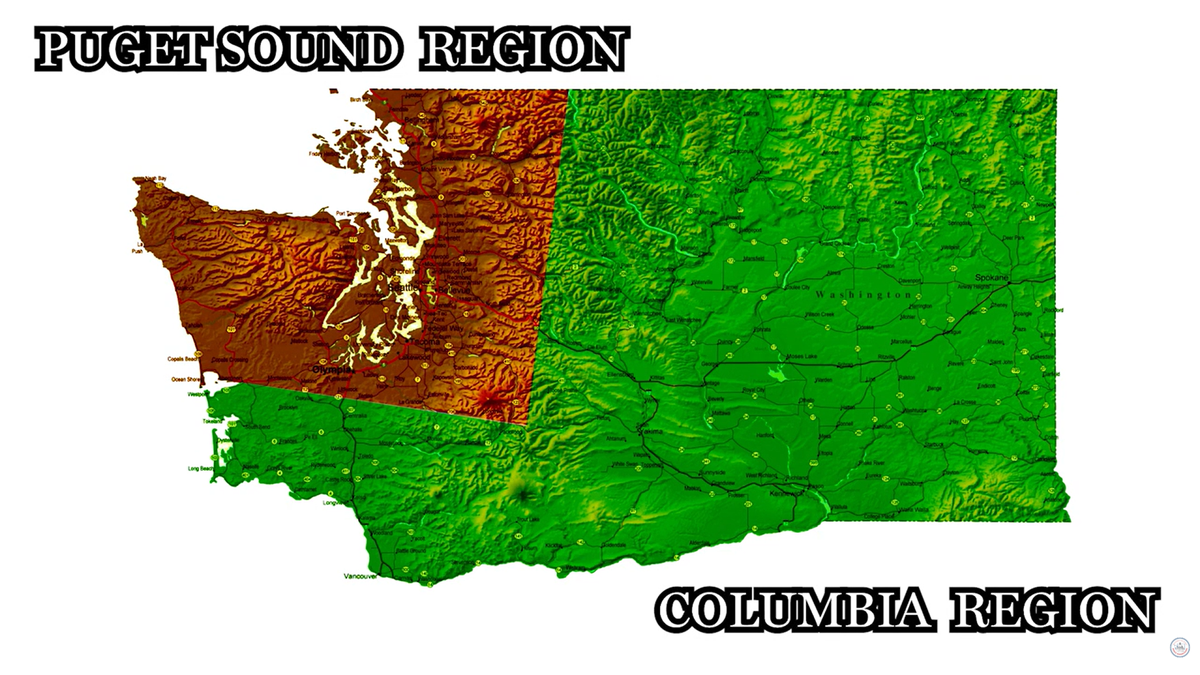
The legislation would pave the way to establish a “Columbia” region — encompassing counties east of the Cascades and those bordering its namesake river — that would generally hold more rural, conservative residents. The “Puget Sound” region would serve more urban, largely liberal voters and cradle counties hugging the Puget Sound and those within, and north of, the Olympic Peninsula.
Each zone would have its own regional legislature, governor and judges. The state would stay intact for federal-election purposes.
Chase argues that while Eastern Washingtonians would benefit from governance that’s more consistent with their values, westerners could keep their progressive policies and stop subsidizing the state’s other half.
As for the legislation’s nickname? The Win-Win Act. “To quote the most printed book in the world, ‘Let my People go!’” Chase said in a 2025 news release.
Densely populated Western Washington, where the bulk of the state’s residents live, consistently helps elect Democratic statewide officials — not to mention the lion’s share of the Legislature.
“They kind of control the state,” Chase told McClatchy in an interview. “So I really feel like we’re getting taxation without representation, you know, and that was one of the rallying cries of the American Revolution.”
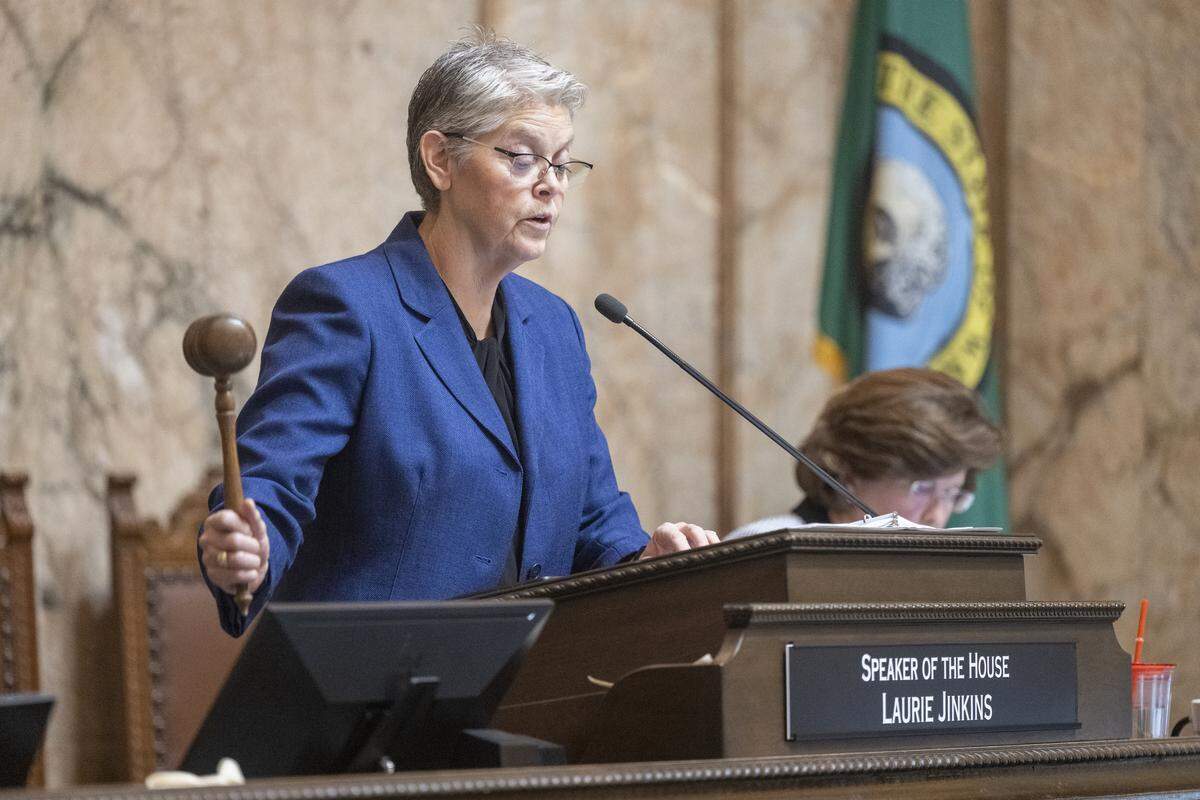
House Speaker Laurie Jinkins said she’s spoken with Chase about the proposal, which she doesn’t at all understand. To her, the state’s regional diversity makes it stronger in myriad ways. That would be lost under Chase’s idea by “narrowing everybody’s interests,” the Tacoma Democrat added.
“I think it’s a lose-lose bill,” Jinkins said.
State of Liberty
This isn’t the first time that Chase has backed a measure to redraw Washington. In 2021, he sponsored a bill to create a 51st state called “Liberty” that would have carved out the red-hued eastern portion of Washington. It didn’t get a hearing.
Slicing up the state is a talking point that’s been around for well over a century. Local historian Feliks Banel wrote in a piece for MyNorthwest in 2019 that frustrated easterners have vied to break free from their “Western Washington overlords for more than 150 years.”
Non-lawmakers have also led campaigns to design their ideal home.
Roughly a decade ago, a Western Washington man reportedly sought to launch an initiative to cleave the state and create a new one called “Madison,” named after former President James Madison. It wasn’t successful. Had it been, life in Madison would have meant lower property taxes and more business opportunities, its would-be founder told KING 5 at the time.
Jinkins said she doesn’t pay close attention to Washington-secessionist schemes, except in the case of someone like former Republican state Rep. Matt Shea.
Previous Shea-sponsored legislation to establish the state of Liberty served as “red meat for anti-government extremists,” Rolling Stone wrote in 2018. The following year, an independent investigation determined that Shea had “participated in an act of domestic terrorism against the United States” and assisted three armed conflicts against the federal government, Crosscut (later called Cascade PBS) reported at the time. He was expelled from the House Republican caucus and opted against running for reelection.
Yet the once-fringe concept of drawing up new border blueprints seems to be picking up steam in the mainstream, both in Washington and nationwide.
A quarter of Washingtonians said they’d support secession from the U.S. in a February YouGov survey. More than 60% of Californians in a poll last year reported that that state would be better off if it peacefully seceded. Some eastern Oregonians desperately want to break free and join forces with Idaho, while momentum has gradually grown for the Lone Star State to “Texit.”
Chase notes that forming a 51st state would face multiple mountainous hurdles. It would have to clear the state Legislature, sure, but it’d also need approval from the U.S. Congress.
Snapping Washington into new regions, on the other hand, could be accomplished via constitutional amendment, which would require a two-thirds vote in the state Legislature before going to voters. No congressional green light necessary.
By Jinkins’ reading, Chase’s idea would effectively create a red state and a blue state of Washington, undercutting residents’ thirst for more bipartisanship. She said the bulk of bills passed by the Legislature are bipartisan, which she said isn’t the case for Republican speakers in other states.
In the 2024 legislative session, nearly 96% of the 381 bills that reached the governor’s desk counted one or more “yes” votes from Republicans, legislative data show.
Chase said in his 2025 news release about the Win-Win Act that constituents often ask when Washington is going to split, and that they feel like their voices aren’t being heard in Olympia.
He contends that a regional approach would, for instance, allow Western Washington to support abortion rights and Eastern Washington to oppose them. Another hot-button issue in Chase’s neck of the woods: the state’s stance on allowing transgender girl athletes to participate in girls’ sports.
Washington’s geographical halves don’t see eye to eye on much, including housing, the environment, energy, taxes, guns, homelessness, the economy and jobs, the news release says. Chase doubts that chasm in worldview can ever be bridged.
Speaking with McClatchy, Chase said he’d made an elevator pitch to Democratic Gov. Bob Ferguson last year. With his autonomous-region proposal, Democrats would also win because they “wouldn’t have to subsidize us,” he remembered telling the governor.
“You could keep your funds, and maybe you could fix your ferry system, or get rid of some of the gridlock in King County,” Chase recalled saying. “And I’m sure your constituents would want that, you know — and they would probably think, ‘Well, OK. Let those cowboys go.’”
‘This does no good for education, natural resources, or public safety.’
Shea, the former Republican representative who left office in 2021, had tried for a Liberty state since at least 2015, the Northwest News Network reported. In 2019, he and another Spokane Valley Republican sponsored a bill to do just that, also petitioning Congress to launch a new state in Eastern Washington.
Democratic state Rep. Mia Gregerson chaired the committee to which both proposals had been referred. She explained at the time that she had no plans to put them up for hearings.
The way Gregerson framed it, shooting them down was actually in that region’s best interest.
“If we pushed forward down this path, eastern Washington could easily be the poorest state in the nation,” she said in a statement, the Northwest News Network reported. “This does no good for education, natural resources, or public safety.”
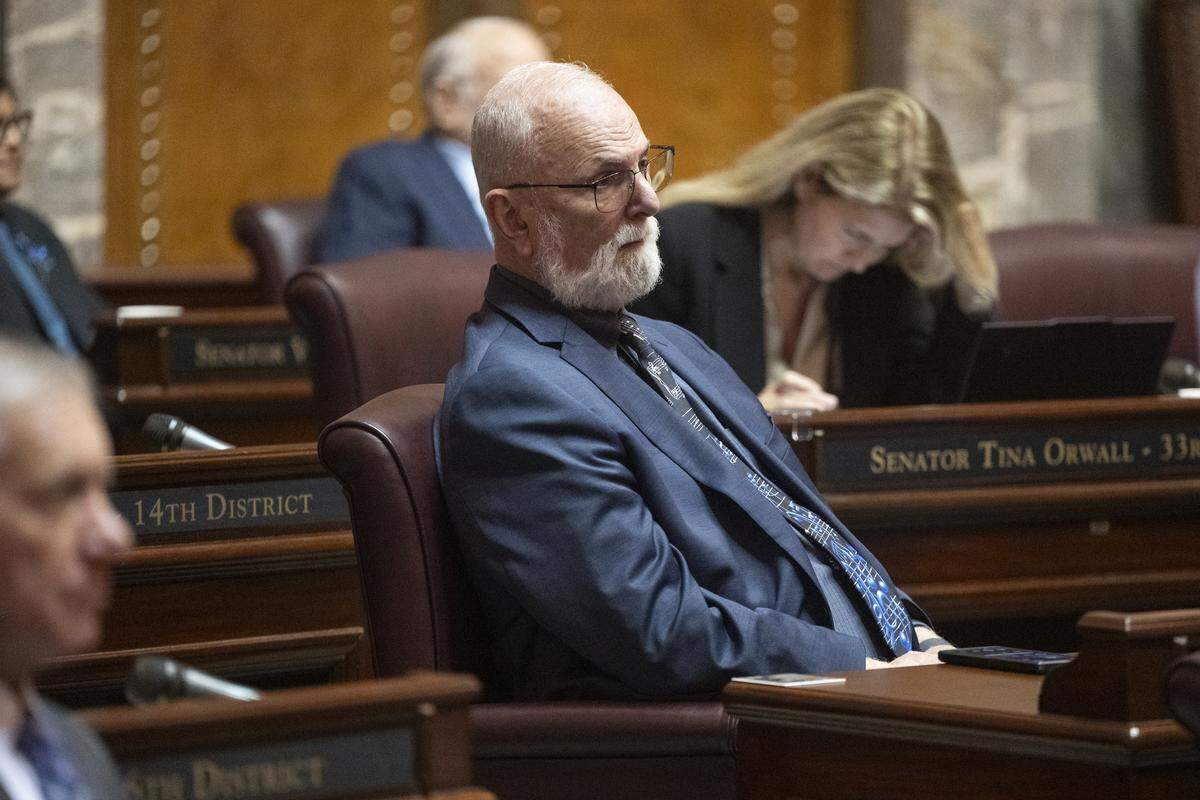
Republican state Sen. Phil Fortunato of Auburn was behind a similar, county-focused proposal in 2017 that sought to let the eastern part of King County break up with Seattle. Senate Bill 5932 would have allowed a new county to be formed and enabled current counties to merge.
In Fortunato’s view, Seattle has veered too far to the left, and the rest of King County is having to pay for it. If he’d had his way, Seattle would stay put while the eastern portion of King County would be liberated.
“They could have a $25 minimum wage. They could give away free needles,” he told KING 5 at the time. “They can do whatever the heck they want, they just can’t do it with my money.”
Cedar County Movement
The movement to form a new, Seattle-less county predates 2017. In the early 1990s, the so-called Cedar County movement wanted to leave the larger cities of King County so that the rural eastern areas would be better represented, including in terms of land-use and development restrictions, KING 5 previously reported.
Fortunato told McClatchy that the Cedar County movement was active around the time he served a term in the state House of Representatives starting in the late ‘90s.
Some 23,765 pro-Cedar petition signatures were submitted in 1996 to then-Secretary of State Ralph Munro, according to HistoryLink.org. Ultimately, though, the push sputtered out.
The way Fortunato tells it, Munro had said that the Constitution would allow a new county to be formed — but that it didn’t specify the procedure for how to do it. So, Fortunato said, as soon as he was elected to the Senate in 2017, he wrote a bill seeking to solve that problem.
The legislation eventually died.
Opponents dismiss ideas to divide Washington as impractical and extreme and suggest we should all just try to work it out.
Fortunato sees it differently.
“Well, we are trying to work it out; that’s why we’re trying to separate it. I mean, that’s a valid solution,” he said. “What’s wrong with putting people who ideologically agree together? What’s wrong with that?”
Jinkins thinks there’s plenty wrong with that.
She likened Republican pushes to manufacture distinct red sectors to “stomping my feet and saying, ‘I’m taking my toys and going home.’” In her mind, the question should really revolve around what’s stopping lawmakers from working together in a bipartisan way.
“I think we see a lot of it (bipartisanship) in Olympia,” she said. “I think we could stand to see more of it — but I don’t think that splitting the state is the way to do it.”
Soft secession
Many academics view secessionist efforts as unrealistic, if not logistically nightmarish.
Professor Todd Schaefer chairs Central Washington University’s political science department in Ellensburg east of the Cascades. He said that while some might want to escape the state’s broader liberal bent, hospitals and roads in Eastern Washington would suffer — or taxes would need to go up.
“Economically it’s probably a dumb move on the part of people on this side of the mountains,” he said, adding: “We get far more money from the west side than we pay in tax.”
Related arguments have circulated urging blue states to “soft secede” from the U.S. by banding together and refusing to cooperate with the U.S. government. Proponents posit that states like Washington, Massachusetts and New Jersey send more money to the federal government than they get back in return, while red states reap the rewards.
Although many doubt that the eastern part of Washington could ever stand on its own, Chase thinks that it could. He said the region wouldn’t be too economically different from Idaho.
Schaefer hopes that people won’t only choose to live near those who think the same. That wouldn’t be a good recipe for the nation staying together, he said.
“I don’t see it happening — but, you know, I never would have thought we’d see Donald Trump,” Schaefer said about movements to split the state. “Some of the stuff I’ve seen in the last 10 years I never thought I’d see either.”
As a lawmaker who’s proposed divvying up the state in multiple ways, one might assume that Chase would support a national divorce. They’d be wrong. “I think we’re best as a union; we want to stay in the union,” he said. “We just want representation.”
This story was originally published May 26, 2026 at 5:00 AM with the headline "Is dividing WA in two a ‘win-win’ or ‘lose-lose’? Why some want a new state map."