
Amendment to invest WA Cares money in stock market passing by wide margin
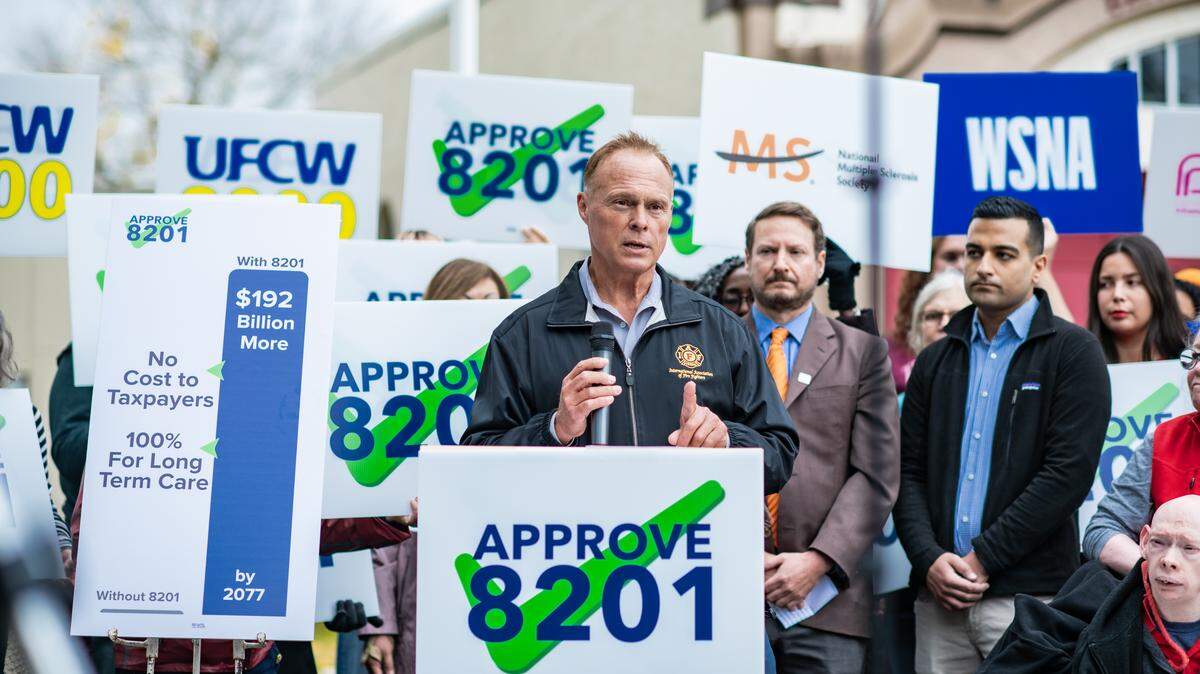
Should Washington be able to invest taxes collected for WA Cares, the state’s new long-term care program, in the stock market?
As of the statewide vote tallies Nov. 6, it appeared that voters were answering “yes” to that question. Senate Joint Resolution 8201 had received 704,023 votes “for” (56.7%) and 538,485 votes “against” (43.3%).
The measure was backed by a broad bipartisan coalition, with Gov. Bob Ferguson, a Democrat, and Senate Minority Leader John Braun, a Republican, spearheading the “yes” argument. Nurses, firefighters and home-care providers were among the pro-voices.
The state Legislature passed SJR 8201 to allow the fund centered on offering long-term care benefits for people with disabilities and seniors to be invested.
Yet a bipartisan group of lawmakers also voiced serious concern about the proposal in this year’s voters’ pamphlet.
The measure aims to allow investments to be made with payroll taxes gathered for WA Cares, created by the state Legislature in 2019. Backers insisted the measure is a “no-brainer,” but critics likened it to a game of “financial roulette.”
Washington’s Constitution generally prohibits public money from being invested in private companies’ stock. State funds are usually limited to investments in less-risky, fixed-income securities such as corporate and government bonds and certificates of deposit, which also typically yield lower return rates.
There are certain exemptions to that restriction, including the state’s retirement and pension funds. Now, it seems, the Long-Term Services and Supports Trust Account will be added to the mix of exempted funds.
Supporters have insisted that the measure would help produce greater returns and ensure long-term care funds are there when needed.
Yet a similar proposition was shot down by voters in 2020.
A recent poll, though, suggested that public sentiment may have since swayed: Of 600 likely voters, 47% said they intended to back the constitutional amendment, while one-third said they’d vote no, according to the poll conducted for the Northwest Progressive Institute by Emerson College Polling. Another 21% replied that they were unsure.
On Tuesday night, the Approve 8201 campaign cheered early returns. Ana Ascanio, campaign manager, said in a statement that last year voters rebuffed an initiative that would have driven the program into bankruptcy, and this year they’ve seemingly green-lit Amendment 8201.
“Voters are sending a clear message to lawmakers that they support strengthening this essential benefit for seniors and people with disabilities,” Ascanio said.
Justin Gill, president of the Washington State Nurses Association, said in a Sept. 23 TVW video urging a “yes” vote that SJR 8201 will grow the long-term care fund so “premiums stay low without costing taxpayers a penny.” He said the move was projected to add more than $67 billion over the next five decades to Washington’s long-term care benefits.
Gill said it’s a rare day when both political parties agree, but that the bipartisan pro-camp knows the measure will let the independent nonpartisan state investment board boost the fund using the highest fiduciary standards.
“If we don’t approve Measure 8201,” he added, “Washington’s Long Term Care Fund’s growth will be limited to low-return government bonds that may not even match inflation.”
Detractors have countered that the stock market can, at times, be unstable.
State Sen. Bob Hasegawa was filmed in a TVW video opposing the measure; the Tukwila Democrat was also joined by three Republican lawmakers in preparing the “against” argument in the voters’ pamphlet.
Hasegawa has said that the amendment would effectively allow stock-market “gambling” with Long-Term Care Trust Fund dollars, and that nothing has changed to justify its adoption this time around. He took issue with supporters’ assertion that the amendment would guarantee that long-term care dollars would be there when needed.
The lawmaker noted in an email that past stock-market crashes took years to recover from. If that happens again, then Washington would be left with two options: raise taxes or slash benefits, he said — or find money elsewhere in an already constrained budget.
“If we’re counting on those funds to be there, but it’s in a down trough of the cycle, what happens?” Hasegawa said in a Friday call. “That’s a problem.”
This story was originally published November 4, 2025 at 9:09 PM with the headline "Amendment to invest WA Cares money in stock market passing by wide margin."
.jpg)