
Did you know WA has humpback whales? Here’s when, where, how to see them in the Salish Sea
When the waters in the Pacific Northwest get extra cold in the winter months, many of our marine mammals, including cetaceans, migrate to warmer climates. This includes some of the whale species that frequent the Salish Sea.
So when whales go viral in other parts of the world, like the man who was recently swallowed and spit out by a humpback whale in Chile, Washingtonians may feel like they are missing out while waiting for months to see whales return.
Fortunately, there’s a lot to look forward to in the 2025 whale season. For example, Southern Resident killer whale populations are improving, with sightings up 48% in 2024, according to the Orca Behavior Institute.
Even the more elusive humpback whale species is seeing population improvements. Once abundant in the Salish Sea, the species was hunted to near extinction and is still bouncing back after receiving federal protections. There are now around 500 humpback whales in the Salish Sea, according to the Pacific Whale Watch Association.
Here’s what to know about Washington’s humpback whales, including the best way to see them.
Washington state whale species
When you think of whales in Washington, you probably imagine the iconic orca, with its distinctive shape and black and white markings. But numerous other whale species reside in Washington, according to the Washington State Department of Fish and Wildlife:
- Killer whales
- Humpback whales
- Gray whales
- Minke whales
- North Pacific Right whale
- Fin whales
- Sperm whales
- Blue whales
While you’re most likely to see an orca while whale watching, you also have a good chance of seeing humpbacks, minkes and gray whales.
The migratory patterns will vary by species. Humpback whales are highly migratory, generally in Washington between July and September, when our waters are a warmer, more habitable temperature.
However, all of these species except the minke whale is endangered at federal levels, most at the state level as well.
Humpback whales in Washington state
Humpback whales are a large baleen whale species, weighing up to 40 tons. The whales can be as long as 60 feet, according to the National Oceanic and Atmospheric Administration.
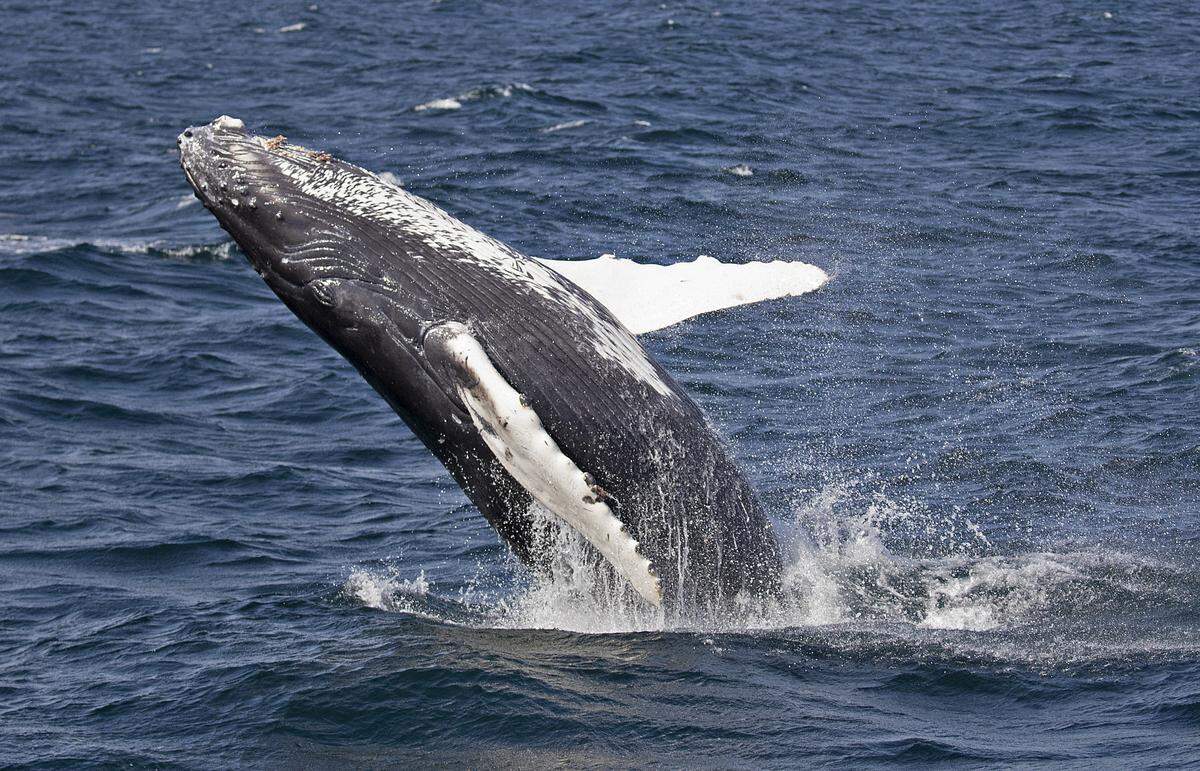
They have dark gray or black coloring on the back and sides, and white on the throat, belly and sides. When whale watching, look out for, of course, its distinctive humped back, or particularly long pectoral fins — humpback whales have the longest pectoral fins of any cetacean, according to WDFW, at about a third of their body length.
If there is a humpback whale around, it shouldn’t be hard to see these features, as they’re active often. They spend time near the surface, jumping out of the water and playing at the surface often, according to NOAA.
Humpback whales often travel alone, but will sometimes travel in groups of 10 to 15 whales. The WDFW says they mainly eat small schooling fishes and krill.
Can you go humpback whale watching in WA?
While there is no way to guarantee a whale sighting, especially of a particular species, whale watching in Washington can come with pretty good odds during peak whale season from mid-June to early September.
While many places in the Salish Sea can be used for whale watching, the San Juan Islands are particularly revered. Both the Travel Channel and CNN Travel included San Juan Islands in lists of top whale watching spots.
One of the best ways to spot whales in the Salish Sea is to join a whale watching tour. There are many options to choose from, on San Juan Islands or elsewhere, including but not limited to:
- Western Prince Whale & Wildlife Tours
- Deer Harbor Charters
- Salish Sea Tours
- Maya’s Legacy Whale Watching
- Spirit of Orca Whale Watching and Wildlife Tours
- Blue Kingdom Whale and Wildlife Tours
In Washington State, boats are legally required to leave 300 yards on its sides between any killer whales. If the boat is in a whale’s path, in front or behind, 400 yards of space are required. When whales are within a half mile of the boat, do not go faster than seven knots. If whales appear within 300 yards, cut the engine.
You also cannot feed orcas. Failure to follow whale protections could result in a $500 fine.
For other mammals, the rule is 100 yards of space. Whale warning flags are available, so you can inform fellow boaters of a whale’s presence. If you see the white flag featuring a yellow and red circle with a black whale tail, proceed with caution.
There is also increasing popularity and promotion for land-based whale watching on the Pacific coast. It is easy to spot many species of whales and other marine life without boarding a boat at all.
Humpback whale conservation efforts
Humpback whales are tracked by Distinct Population Segments, three of which frequent the Salish Sea. One is federally endangered, and one is federally threatened. The other is not listed as a threatened population.
The species as a whole, though, is considered endangered in the state of Washington, and labeled as a priority under the WDFW Priority Habitat and Species Program.
Once abundant in the North Pacific, populations were hunted to near extinction. Before commercial harvest practices, it’s estimated that around 15,000 humpback whales lived in the area. When the whales became federally protected in 1966, the estimates were down to 1,400 on the high side, according to the WDFW. Other estimates site less than 1,000 by 1986.
In recent decades, humpback whale populations across the world have started to bounce back. Protections are still in place to ensure the growing populations can continue to thrive.
WDFW identifies the following as threats to the humpback whales in the North Pacific:
Entanglement in fishing gear and marine debris
Ship strikes
Climate change
Human-generated marine sound
The whales, like all marine mammals, are protected under the Marine Mammal Protection Act.
If you see a marine mammal that is dead, injured or stranded, call the NOAA West Coast Region Stranding Network Hotline at 1-866-767-6114.