
‘Everyone cries.’ Russia’s war on Ukraine takes emotional toll at Fife specialty market
Honey cake in three flavors, rogaliki with a hidden center of apricot jam, pastries laced with the enchanting nuttiness of poppyseeds — the pastry case at Emish Market was stacked with its usual array of international treats, many inspired by Eastern European traditions.
But on the morning of March 11, 2022, an air of uncertainty mixed with a formidable sense of unity permeated the bustling store.
“You’re here, you’re safe, but it’s torture,” said general manager Yuri Kovalchuk, a Ukrainian immigrant and South Sound resident of nearly a decade. “It doesn’t feel real. It feels like a bad dream, and you just can’t wake up.”
He was wearing a black, hooded sweatshirt with the words “Slava Ukrayini, Geroyam Slava” written in abstract text on the chest, in the blue and yellow colors of the Ukrainian flag. It translates to “Glory to Ukraine, Glory to the heroes,” a call-and-response for Ukrainian independence first heard in the 1930s and resurrected when Russia invaded Crimea in 2014.
For Kovalchuk, the words show support for his people and for those who choose to fight — in this case, against the Russian president Vladimir Putin’s full-scale invasion of Ukraine.
The only full-service supermarket in Fife, Emish is also beautifully global, with American staples mingling with European imports, housemade sausages and warm sourdough bread studded with olives and rosemary.
Owners Vladimir Gapon and Anatoliy Zaika both emigrated from Ukraine about 20 years ago. Zaika and his wife Mariya previously operated Kusher Bakery nearby, and the fruits of their expertise now reside in the pastry case at Emish. They also own Paradise Village in Ashford, en route to Mount Rainier National Park, where the restaurant menu features Ukrainian borscht, Polish dumpling soup and Russian piroshki.
Gapon called the situation in his native country a tragedy and referenced friends and family hiding in basements.
“Don’t know what to tell more,” he said when reached by email.
His daughter, dressed in a traditional Ukrainian embroidered shirt with a flower headdress, has been handing out tea and popcorn at the store after school, accepting donations to help purchase food for refugees. A banner near the registers offers a QR code to connect customers with other support organizations.
‘WE ARE UKRAINIANS’
The staff at Emish reflects the store’s international charm. Stroll through the aisles and you’re bound to hear multiple languages, with employees switching seamlessly between English and Ukrainian, Russian, Polish and Spanish.
“We have everyone working here,” said Kovalchuk. “We don’t want to fight, with anyone, and we don’t want to bring that into our store. All these people — they make our team powerful.”
The last few weeks have been “very emotional,” said Olena Murphy, the store’s chief financial officer. Born in Crimea, where her father still lives, she moved to the United States from Kyiv, her mother’s hometown, eight years ago.
She said her first language is Russian, but she never felt discriminated against. She also speaks fluent Ukrainian, and English.
“We feel as the same nation,” she said. “We are Ukrainians.”
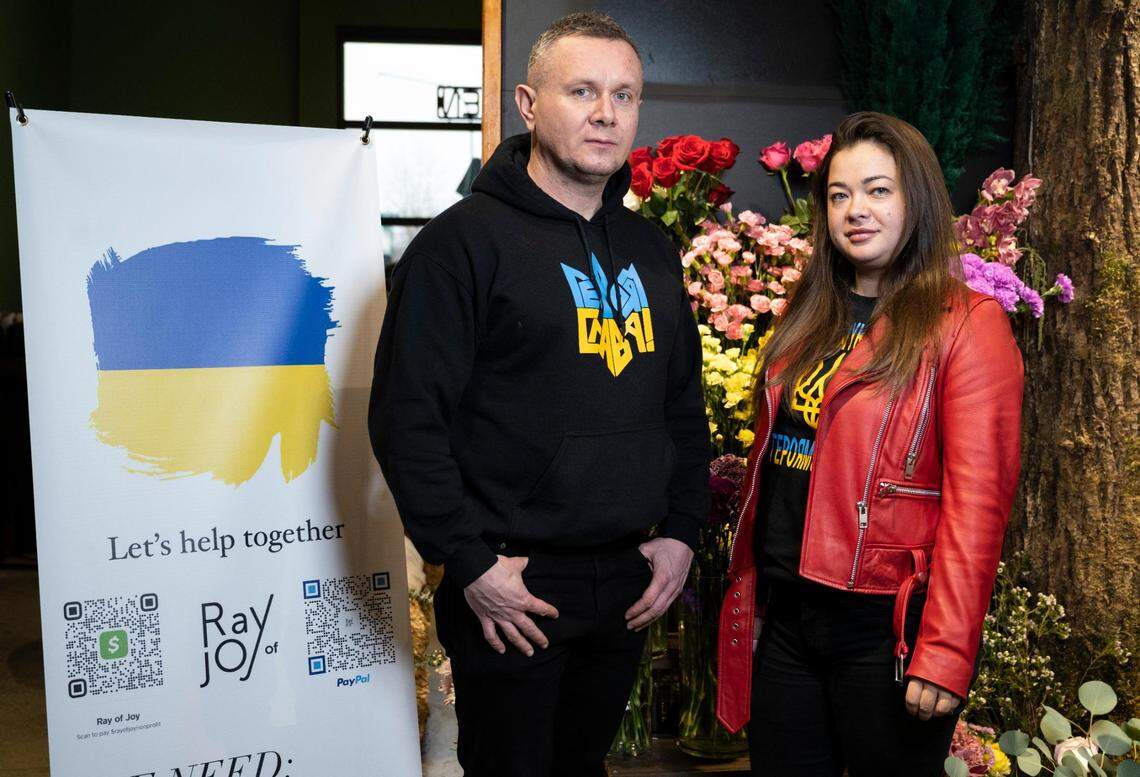
Both are affable and candid, but you can hear the anguish in their voices: a heartbreaking chorus of passion and hope, fury and frustration.
Before the war began, said Kovalchuk, Ukrainians recognized the threat Russia posed — in the sense of it being an unlikely scenario that could happen but probably wouldn’t.
“Nobody could have believed that a country, unprovoked, would start a bloody war,” he said.
Murphy has been fielding phone calls from family and friends fleeing the violence, trying to offer advice and encouragement from thousands of miles away. One of her cousins, she said, was stuck in a subway station in Lviv for two days with no food or water before escaping to Poland. Another fled to Spain on the first day of the invasion. They packed small bags with random items, not fully grasping in those frantic moments what they needed or when they would be able to return.
“They are just leaving with the clothes on their back and their documents. They didn’t know what they’d need. ‘What to do? What to do?’” they asked her. “They don’t know what to do.”
The hardest part, she added, is that she isn’t in Ukraine and is trying to piece together the reasons for the invasion from afar.
Watching scenes of bomb sirens and explosions, mothers pulling a single suitcase behind them with children by their side, windowless apartment buildings torn at the seams, Kovalchuk is thankful for the internet and for social media allowing news to travel quickly and freely around the world.
To know that in Russia, the only “news” is of a “special military operation” is particularly painful, he said, as if “someone puts my legs in lava.”
“They’re destroying our homes, our cities,” added Murphy. “They’re taking our memories.”
Every night, Kovalchuk falls asleep by eventual exhaustion — of keeping up with new details and travesties of the Russian invasion while trying to stay positive at work.
“Everyone cries,” he said, “but we don’t want to show it here.”
His morning routine has changed.
“When I wake up, I read the news and I text my friends a very simple question: Are you still alive?”
‘WE ARE AN INTERNATIONAL STORE’
As we walk through the store, an employee emerges from behind the meat counter. Originally from Moldova, she says hello in Ukrainian and then English and insists a team from The News Tribune try some sausages. She scurries back behind the deli and returns with slices of three varieties, then says the team must try some bread as well.
It’s still warm.
Kovlachuck said that Emish has considered removing Russian goods from the shelves, but they already spent the money. Would it help? Would it somehow hurt?
“We are an international store,” he said. “We’re not Ukrainian or Russian or whatever else. We have so many things. The U.S. gave us the opportunity to create this beautiful store. All cultures kind of invest something.”
Beyond concern for their relatives and compatriots in Ukraine, both Kovalchuk and Murphy stressed that the conflict does not start and stop at any border. They have determined where they would hide in their own homes, right here in the South Sound, should shelter from bombs become a necessity.
It might sound impossible, but said Murphy, “Everyone should expect it could happen to them.”
Then it was lunchtime, and the Emish Market cafe, with an eclectic menu of croissant sandwiches, burritos and crepes, not to mention those delicious pastries, filled up.
EMISH MARKET
▪ 2040 70th Ave., Fife, 253-262-6070, facebook.com/EmishMarket
▪ Daily 6 a.m.-11 p.m.
▪ Details: international market with focus on Eastern European imports, plus in-house bakery, deli and restaurant
This story was originally published March 15, 2022 at 10:33 AM with the headline "‘Everyone cries.’ Russia’s war on Ukraine takes emotional toll at Fife specialty market."