Debt overwhelming many in Washington state restaurant, hotel industries, new data show
If 2020 and 2021 were years of just surviving for restaurants and hotels, 2022 starts the big dig, as in digging out of debt.
“The tone and the reasons for the relief is a little bit different than 2021,” said Anthony Anton, president and CEO of the Washington Hospitality Association, in a news conference Friday held via ZOOM.
The association represents more than 6,000 members of the hotel, restaurant and hospitality industry in the state.
According to Anton, the restaurant industry as a whole saw a 30 percent drop in year-over year sales from 2020 second quarter through first quarter 2021 compared with 2019, with bars alone seeing a 54 percent drop.
“We now have a full year of revenue numbers of COVID. And we lost $5.4 billion as an industry when compared to 2019,” he told reporters.
The state’s hospitality workforce as a whole was short 28,600 workers by mid-November 2021, down 12 percent of the workforce, and Omicron is making it worse.
“On top of the 12 percent, we’re short in Omicron,” he said, adding another 15 to 20 percent in absentees of people out sick. “A lot of operators are like, ‘I don’t have enough people operate today — I’m going to close down,’ which community-wise I applaud. That means they are protecting you and doing the right things.
“But ... that continues to build upon that debt,” he added.
While worker shortages are hitting sectors across the spectrum, restaurant and hospitality industry-specific shutdowns, particularly in 2020, Anton said, also led to losing an estimated 40 percent of the workforce amid the uncertainty of reopenings and who would be hired back.
“As we’ve come back, a lot of our workforce went and got the job that they knew would be there. And now we’re trying to recoup,” he said.
Questions remained about who would want to come back to public-facing jobs in a pandemic and a public not uniformly in support of vaccinations or even COVID safety protocols.
He projected a three- to five-year window minimum of worker shortages “without some other kind of dynamic change.” That could mean more of the random closed days for workplaces to have enough staff as has been seen during the Omicron surge in places such as Starbucks.
“A lot of them are going to look at what shifts are profitable. And the old adage of, ‘I have to stay open seven days a week constantly,’ is probably going to shift back to, ‘If I’m slow and this is not a profitable week, do I need to be open?’”
He noted the average full-service restaurant operator debt from pandemic is $160,000. He cited figures that with the average annual net profit for sites at less than $50,000, operators are essentially facing three years with no income, assuming they can achieve a 4 percent margin.
“While Congress has stepped up and established the restaurant revitalization fund, and that’s great, it only provided enough money to fund about less than half of the restaurants who qualified. So many of our restaurants are still carrying that debt,” he said, adding that many are running out of time to pay that debt back.
Add to that supply-chain shortages continuing for food deliveries, and 2022’s “digging out” time grows even more challenging than the previous two years.
While more than 3,300 restaurants closed statewide between January 2020 and May 2021, plus an additional 243 between June and November of 2021, “it’s about 1,400 fewer than we expected,” he said, a testament to community support and outside aid.
Lodging
Lodging was hit even harder in Washington, he noted, seeing a 62 percent drop in business, and the impacts weren’t always evident to the public.
“While a lot of us can easily look and see businesses being shuttered in other industries, much of what happens in lodging is behind the scenes,” he said. “And closing is a much less feasible option.”
In Pierce County, numbers were up year over year (2020-2021), but still remain below 2019 in terms of hotel occupancy, hotel average daily rate and revenue per available room, according to preliminary partial data provided by Travel Tacoma - Mt Rainier Tourism and Sports.
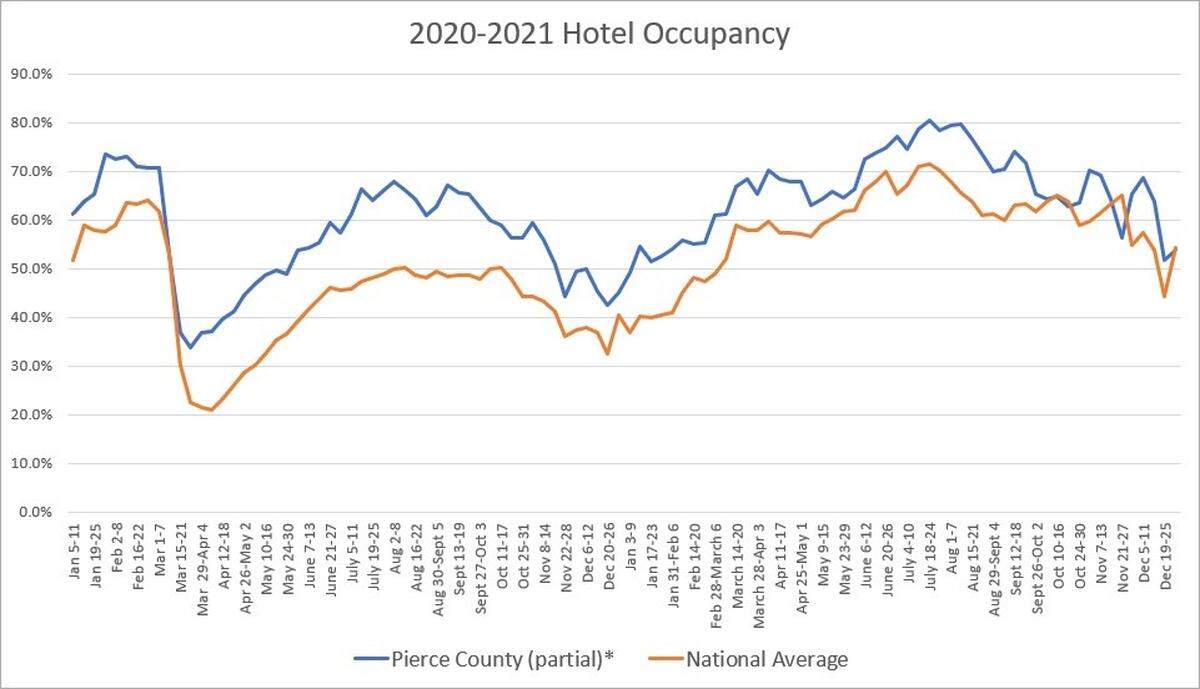
The partial data showed Pierce County hotel room occupancy peaking right after Fourth of July at or just above 80 percent and staying above the national average through most of the pandemic.
Full reporting of the spending data is expected in spring.
Anton ticked off the areas of relief that could help immediately.
“On the lodging side, specifically, we’ll be seeking the reimbursement of the eviction moratorium, documented costs and otherwise that the lodging experienced during COVID,” he said. “On the congressional side, back-filling the rest of the restaurant revitalization fund and getting some movement on the Save Hotel Jobs Act.
“And in the communities, individually ... If you can continue to do outdoor dining, if you continue to do some of the things you’ve stepped up to help people get out of debt, that will be very helpful. And then ... from a policy or otherwise standpoint, give the industry more time to get out of the hole that it’s in.”
This story was originally published January 14, 2022 at 2:21 PM with the headline "Debt overwhelming many in Washington state restaurant, hotel industries, new data show."