Overloaded WA hospitals no longer struggling with COVID, face other issues affecting care
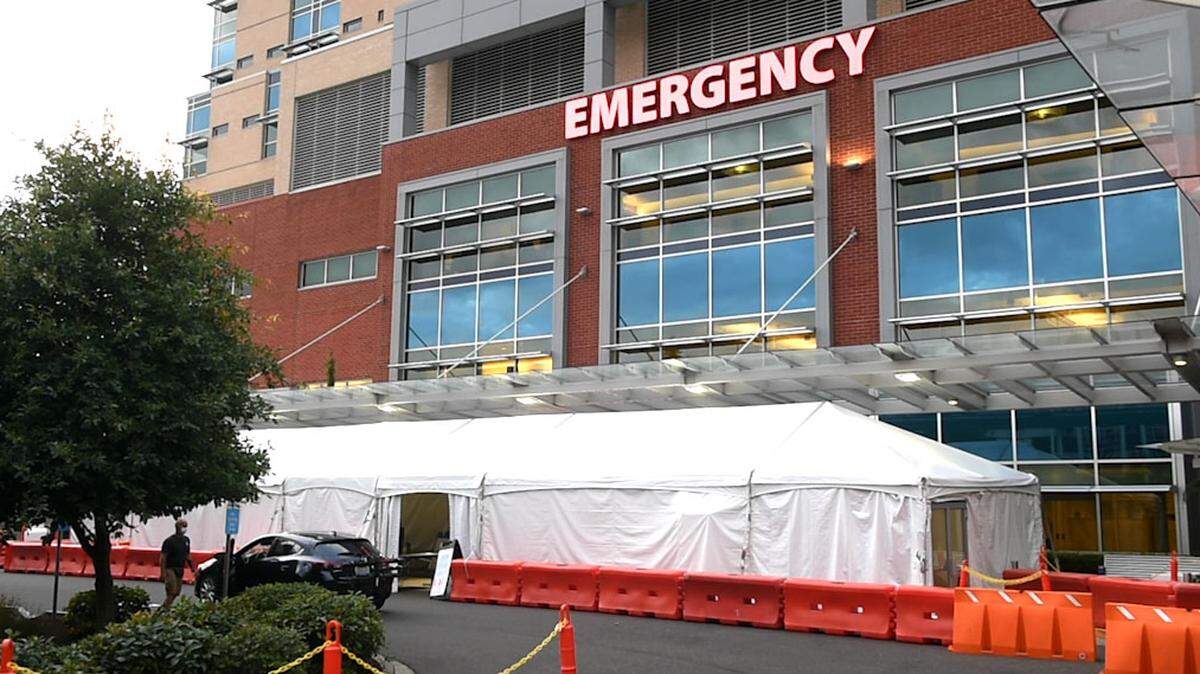
Hospital officials and medical staff spoke to reporters Monday to give their sides of current working conditions in Washington state’s hospitals, and both groups are calling for legislation targeting two different issues resulting in the same problem: delayed care.
While both agreed hospitals are overloaded, though no longer because of COVID-19, officials with the Washington State Hospital Association blame current regulations over transfer of patients who need to move into long-term care facilities, while three Washington health care unions blame critical staffing shortages that started before the pandemic and have now spun into a cycle of lost workers due to burnout, retirement or high-paying traveling nurse programs.
WSHA proposal and current COVID numbers
WSHA is “advocating for legislation to smooth the consent process to move patients who are stuck in the hospital to long-term care,” said WSHA executive vice president Taya Briley in WSHA’s briefing Monday.
In many cases, patients are left stuck at the hospital with nowhere to go amid shortage of care elsewhere.
“Right now a complex, expensive and court-intensive guardianship process is required. We think that existing state law that allows for designated family members to consent to health care makes much more sense and would be a lot more humane for these patients who don’t need to stay in the hospital,” Briley said.
“We are also strongly encouraging the deployment of state resources to complete patient evaluations faster, and streamlining, streamlining those evaluations to move patients to long-term care services. And we’re encouraging higher payment rates for long-term care facilities so that they can pay more staff to deliver care in the settings.”
In describing the patients unable to transfer out of hospitals and taking up beds, Briley told reporters Monday:
“They are patients who have complex long-term care needs, and a facility cannot be found due to staffing shortages or the inability to care for folks with these complex needs. They are people who are waiting through the very long process of evaluation and placement by the state Medicaid program and managed care plans .... Hospitals operate in hours and days and that process can operate in weeks and months. They are patients who could get a room in a post-hospital facility, but they don’t have a family member who’s authorized to consent to placement. State law for family consent to long-term care placement is remarkably complex.”
She added: “They are adolescents and adults who are in need of inpatient mental health treatment, but there isn’t an inpatient bed for them to go to.”
As a result of that and continued staffing shortages, she noted, many hospitals are delaying elective surgeries amid a continued shortage of beds without COVID being the driving force.
Current levels of COVID hospitalizations showed a slight uptick, with an average of 654 confirmed COVID hospitalizations this past week compared with the prior week’s average of 652, according to Briley.
“We’re seeing a sustained high number of patients on ventilators and an average of 12 to 20 COVID deaths per day,” she noted.
Current daily new hospitalizations average 116, she said, compared with an average of 1,150 hospitalizations a day the same time a year ago.
While COVID patient numbers have dropped, the patient-to-bed ratio burden hasn’t let up.
“We are concerned that a surge of hospitalizations from the omicron variant on top of an already crowded set of hospitals could lead to a situation where life-saving hospital care is denied to those who need it,” Briley said.
MultiCare told The News Tribune it has 110 COVID-19 cases in its Puget Sound hospitals, 96-98 percent unvaccinated. Capacity ranges from 80 percent at Mary Bridge to 122 percent at Auburn Medical Center. Its Allenmore facility is operating at 101 percent capacity, Good Samaritan in Puyallup at 118 percent and Tacoma General at 112 percent.
It added that 85 patients in its Pierce County hospitals are unable to be transferred yet.
There are 94 COVID patients across the Virginia Mason Franciscan Health system, VMFH told The News Tribune on Monday.
“We are continuing to experience high hospital and emergency department volume, but our hospitals remain open for care,” it said in a statement, without disclosing capacity numbers. “Hospitals are continuing to share resources as a system including safely transferring patients to nearby hospitals when appropriate or needed for their care.”
Dr. Jay Cook, chief medical officer for Providence Regional Medical Center in Everett, told reporters that one of every six beds at his facility was taken with someone unable to be transferred to another facility while also no longer needing care.
“We’re having difficulty finding outpatient care facilities to assume their ongoing life needs,” he said. “Many have severe dementia or other challenging behavioral conditions. Some have complex psycho-social, financial or other barriers. Our problem is that these vulnerable but not acutely ill individuals occupy inpatient beds and require the same limited hospital staffing needed for other patients with more severe acute medical problems that need our care.”
Cook noted the combination of staffing and bed shortages led to more than 40 non-emergency surgeries postponed in the past week.
“Providence Everett is facing significant staffing challenges in almost all inpatient departments, including nursing lab, environmental services and transport,” he noted. He added that the “staffing challenges are made worse by needing to provide an inpatient level of care for the high number of patients who have no ongoing medical reason for being in the hospital.”
He noted New York’s action last week to deploy National Guard units to help nursing homes and long-term care sites, adding, “We need similar funding and staffing supports in Washington both at the state and the federal levels.”
In a WSHA survey, Briley noted, top reasons for staff leaving included relocation for spouse’s work, leaving for traveling nurse work, retirement and burnout.
Officials also noted the inherent tensions of traveling nurses on staff, sometimes even circling back to work at their former sites through agency assignments, earning more than the employees who stayed on staff.
“Traveling has always been an option. It’s always been done. It has changed dramatically over the last couple of years with COVID and rates that frankly are unsustainable in a health care setting,” said Susan Stacey, registered nurse and chief executive for Providence Inland Northwest Washington in Spokane.
“If we’re going to keep the cost of health care to a reasonable cost, which impacts our consumers and our ability for people to get health care, we have got to manage that. Labor is our No. 1 cost.”
Unions: State needs to address staffing issues
Following WSHA’s briefing, representatives of health care unions UFCW 21, SEIU Healthcare 1199NW and Washington State Nurses Association announced they are putting together recommendations for the state Legislature to take up minimum safe staffing requirements and retention efforts, problems they feel were in play long before the pandemic and are now at the breaking point.
“I have seen lots of nurses leave,” said Julia Barcott, a critical care nurse at Astria Toppenish Hospital and WSNA union leader, speaking to reporters Monday. “They are retiring early.”
Others becoming travelers “make as much in a week as we do in a month,” Barcott said.
Others have gone to less stressful jobs in clinics and freestanding surgical centers to escape bedside nursing pressures, she said.
“Hospital executives are spending millions on traveling nurses and hiring bonuses,” she said. “But the staff nurses who have been there all along are getting little to nothing at all, which means even more of them want to leave. We must solve the retention problem.”
Among the actions sought from the Legislature are safe minimum staffing standards; enforcement of existing overtime and meal and rest break laws; ending mandatory overtime; and an investment in workforce development.
Representatives at Monday’s briefing disputed anecdotes of bed shortages playing a role in postponed patient procedures.
“If we had enough nurses and other health care workers throughout our health system across the state, we would be able to give this care to patients and not have to postpone things,” said Diane Sosne, registered nurse and SEIU 1199NW president.
“There is not a shortage of beds. There’s a shortage of health care workers who are able to care for patients in those beds,” she said.
In the union’s polling of workers, 84 percent of WA health care workers said they feel burned out, with 49 percent saying they’re likely to leave the profession in the next few years.
“Among those who said they were likely to leave, 70 percent said one of the biggest reasons was short staffing,” the unions noted in a release following the briefing.
This story was originally published December 13, 2021 at 2:26 PM with the headline "Overloaded WA hospitals no longer struggling with COVID, face other issues affecting care."