Leonard Forsman named first Native American on UW Board of Regents
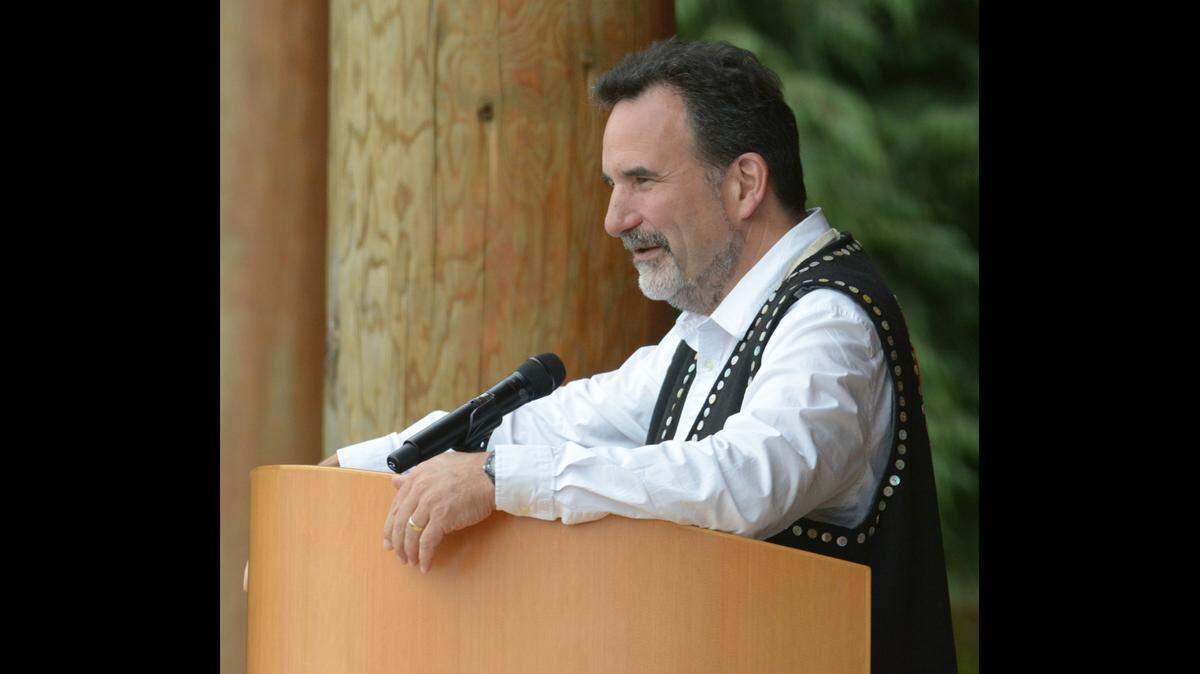
Leonard Forsman will become the first Native American to serve on the University of Washington Board of Regents Gov. Jay Inslee announced Monday, Oct. 25.
“Leonard has deep appreciation for the importance of education for all communities. His leadership experience with Suquamish and tireless work on behalf of Northwest Tribal communities will be invaluable to UW,” Inslee said in a news release. “He is a leader in every sense of the word and l look forward to his continued service to our region as a member of the University of Washington Board of Regents.”
Forsman is chairman of the Suquamish Tribe and grew up on the Port Madison Indian Reservation on Bainbridge Island, where he currently lives with his wife Jana Rice. He has served on the Tribal council for more than 30 years and is the President of the Affiliated Tribes of Northwest Indians — a non-profit organization that represents 57 Tribal governments across Washington, Oregon, Idaho, southeast Alaska, northern California and western Montana.
“I am humbled and honored to receive this appointment to the UW Board of Regents. I would like to thank Gov. Inslee for selecting me to help lead this prestigious institution and my Tribal council and citizens for their support,” Forsman said in a news release.
In an interview with McClatchy, Forsman said he was awe-struck by the appointment, but noted that Tribes have been asking for a Native American regent for quite some time.
“The Tribes have obviously become more prominent politically through our perseverance and also through the issues surrounding social justice. People have become awakened into the idea of having us included in the decision-making going on our homelands,” he said. “I feel there’s more to be done and the university can do more in Indian Country for present and future students and alum by working with Tribal governments to find places we can work together and solve problems.”
Forsman said that centering Tribal issues will be both his biggest focus and biggest challenge.
“It’s a vast place and there’s often competing interests. Our responsibility as Tribal governments cross through a lot of things — natural resources, conservation, cultural preservation and education along with the university’s mission to work on all that and recruit more Native students and teachers. The university is making an investment in becoming a major part of our continued growth,” he said in an interview with McClatchy.
Forsman aims to promote the construction of Phase II of the Intellectual House — a longhouse-style facility on the UW Seattle campus aimed at providing a multi-service learning and gathering space for American Indian and Alaska Native students, faculty and staff.
Recent UW alumnus Owen Oliver — who put together UW’s Indigenous Walking Tour, which includes a stop at the Intellectual House — said Forsman was instrumental in bringing the facility to the campus and he hopes to see more funding for it during Forsman’s term on the board.
“It’s amazing to have the first Native person be a part of the advisory board — a Coast Salish person,” Oliver said. “I’ve been family friends with Leonard for a long time and I’ve known him on a personal level. His hospitality, bounds to tradition and leadership with Suquamish really showcase his work and I’m excited to see him at UW.”
Forsman said he plans to center Tribal education initiatives, recruit Native students, train Native teachers, develop Tribal curriculum and encourage more research projects that benefit Indian Country.
“I’ve always believed that recruitment of Native students is important, but the retention is the most important part. How do we make these students stay the four years and be excited to finish and move on and serve their communities? Allocation of those funds to help Native students stay on campus is of the utmost importance so we can continue to have more people like Chairman Forsman at the table,” Oliver said.
Oliver is Quinault and Isleta Pueblo and son of the late Marvin Oliver — a renowned artist, UW emeritus professor of American Indian Studies and adjunct curator at the museum. He said his father’s role in academia has always shown him the importance of Native students learning from Native faculty and is hopeful for Forsman’s leadership in this area.
“I think learning from Native faculty is about hitting those inter-generational connections. It’s more than having a teacher— it’s having a friend and a mentor who cares about your well-being spiritually, physically and intellectually,” said Oliver, a spring graduate of American Indian Studies and political science. “I don’t think I could’ve done it without Native faculty and that’s a lot of the reason why I went to UW in the first place — it’s an amazing place to be engaged by Native academics.”
Forsman also said he aims to enhance and expand the university’s research efforts to serve Indian Country priorities such as climate change.
In 1987, Forsman graduated from the University of Washington with a bachelor’s degree in anthropology and has continued to be deeply involved with the university’s Tribal summits.
“As a student in the early 1980s, I dreamed of a day when Tribal students and Tribal nations would be recognized appropriately on campus and beyond. This is a great step towards realizing that dream, and I take seriously the responsibility bestowed upon me to serve the university and the Tribes,” Forsman said in the release.
While a student at UW, Forsman worked as an intern at the Suquamish Tribal Archives in a partnership with the Burke Museum and later became director of the Suquamish Museum.
He said working under James Nason —who is Comanche and a curator emeritus at the Burke Museum — and others showed him the value of Native students working with Native professors and leaders.
“To work under Dr. Nason... and others and building those important relationships early on as a student was a great experience... That can be experienced again if we get the proper resources for Tribal programs, especially American Indian Studies,” he said in an interview.
BEHIND THE STORY
MOREPlease help support this reporting
Natasha Brennan covers Washington state tribes’ impact on our local communities, environment and politics, as well as traditions, culture and equity issues, for McClatchy media companies in Bellingham, Olympia, Tacoma and Tri-Cities.
She joins us in partnership with Report for America, which pays a portion of reporters’ salaries. You can help support this reporting at bellinghamherald.com/donate. Donations are tax-deductible through Journalism Funding Partners.
You can sign up for her weekly newsletter here.
Forsman is still engaged at the Burke and is a member of the Burke Museum Advisory Board. President Barack Obama appointed Forsman to the Advisory Council on Historic Preservation in 2013 and 2016 where he served as vice-chairman until 2019.
“His work with the Burke Museum has brought a broader perspective to regional Tribal history and culture, and his dedication to historic preservation has made tremendous impacts across the United States,” Inslee said.
Forsman also serves on the boards of the Kitsap Regional Coordinating Council, the Seattle Waterfront Steering Committee, the Suquamish Tribal Cultural Committee, the Suquamish Museum, the Washington Indian Gaming Association, the West Sound Partners for Ecosystem Recovery and the Tribal Leaders Congress on Education.
The University of Washington Board of Regents governs and stewards the university. The 10-person board selects, supervises and evaluates the university president. Nine of the regents are appointed by the governor to serve six-year terms. One student regent serves a one-year term.
This story was originally published October 25, 2021 at 4:56 PM with the headline "Leonard Forsman named first Native American on UW Board of Regents."