Here’s why Kennewick shoppers will pay more sales tax starting in 2025
Purchases in one Tri-Cities community are about to get a bit more expensive.
The Kennewick City Council on Tuesday approved an increase to its sales tax to cover existing pavement improvements and transportation projects. It also created a new government authority — a Transportation Benefit District, chaired by the council — to oversee the new tax.
The 10-year tax amounts to one-tenth of 1%, or an additional penny on every $10 purchase.
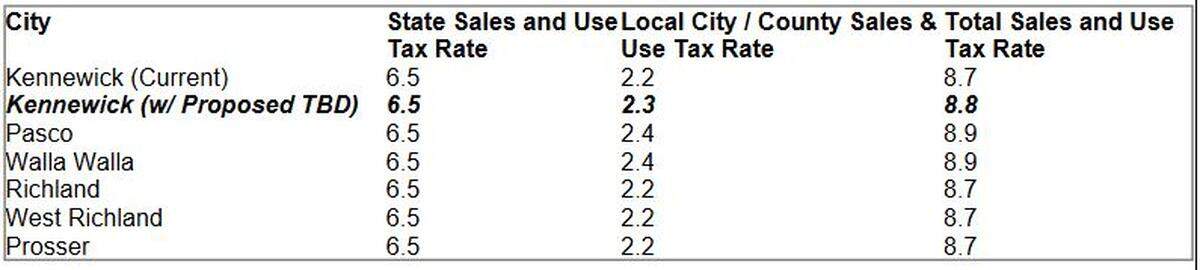
It goes into effect April 1 next year and increases Kennewick’s total sales tax to 8.8%.
The Transportation Benefit tax will raise an additional $1.75 million in its first year, then $3 million in following years.
The new revenue source was created to help correct a $5 million hole in the city’s 2025-26 biennial budget, which was approved Tuesday.
Several other efforts also were taken to right the ship, including reallocating excess water-sewer taxes and some sales taxes to the general budget.
The result is a balanced $456 million budget that prioritizes community safety, economic and industrial development, utility and services improvements, and future capital projects. No layoffs are planned for the city’s 436 employees.
Cities across the U.S. are seeing big spending gaps because of inflation, higher labor costs and the expiration of one-time COVID funds. Washington state also is facing a budget shortfall of several billion because of lower tax collections.
Pasco currently has the highest total sales tax in the Tri-Cities at 8.9%, compared to 8.7% in Kennewick, Richland, West Richland and Prosser.
City expenses rise
City Manager Erin Erdman said several expenses, including new contracts and criminal justice costs, also are to blame for the shortfall. The city is also “playing it safe” with conservative revenue projections.
The new Transportation Benefit tax will pay for existing contracts to stripe, crack seal and repair city roads based on the highest need, Erdman said.
That work was previously funded with contributions from the city’s capital improvement program, as well as a $1 million annual transfer from the operating fund, according to city documents.
Kennewick maintains about 836 lane miles of streets and roadways in the city limits.
Mayor Gretl Crawford said they considered several options, including creating a new vehicle licensing tab fee, similar to one in Richland. But they settled on a sales tax, which places the burden on not just residents but also visitors who use the roads.
But inflation is a tangible thing, Crawford noted, and the tax increase is “not to be scoffed at.”
“It is a balancing act, and I know that the city has worked hard to engage with each other and work with one another to try to find those balances. And as much as I, again, don’t like paying taxes — all the taxes everywhere — these are the taxes that are staying within our locality and making our lives better and our community better,” she said.
Councilman Loren Anderson expressed doubt the tax would ever “sunset,” calling it a “death spiral, to some degree.”
“It will never go away. Put that in the record: It will never go away even though it says 10 years,” Anderson said.
Though he and other council members reluctantly supported the plan, Anderson thinks future city councils will continue the tax for other needs. He also highlighted that some Washington municipalities collect sales taxes in the double digits, though the state’s share of sales tax is just 6.5%.
“I see the need for it, 100%,” Anderson said. “I mean, I’ve lived in communities where the roads are garbage, and everyone’s ruining their vehicles because the roads are really atrocious — Oklahoma City is one of them.”
“At what point do we start saying, ‘OK, maybe instead of increasing taxes perennially, in perpetuity, for eternity, maybe we talk about cutting.’ And nobody ever wants to talk about cutting, but I think at some point the city has to say, ‘Where can we cut, what can we cut, how can we cut and still maintain the quality of life?” he said.
Three Rivers Convention expands
Creation of the Transportation Benefit District and its tax passed the council in two 6-1 votes, with Councilman John Trumbo the lone dissenting voice.
Trumbo compared the effort to failed ballot measures in 2013 and 2016 that tried increasing sales taxes to fund the Three Rivers Convention Center expansion. Now in the hands of the Kennewick Public Facilities District, which received an $8 million loan from the city, that project is underway and is on track to break ground.
“I remember distinctly at that time saying that the need is real. You don’t have to make a case for the need, I get it. But I kind of walked out on the gang plank and said, just find another way — and I’m still of that mind,” Trumbo said.
“I don’t want to tie the hands of the new city manager, but I want to find another way,” he continued.
But Councilman Jason McShane drew a direct link between reclassifying the city’s expenditures and the convention center, saying the new tax lets the city afford the convention center expansion.
He says the project is a great investment that will drive economic growth and add jobs, and he’s heard city staff already talking about cutting costs in the next biennium. Delaying these capital projects would cost the city more in the long term, he argued.
“When we talk about finding another way, I think we have been trying to find another way. But I do think we need to recognize that part of that is our responsibility as council to look at the options in front of us and make those decisions that are the tough ones, to be able to afford the infrastructure that needs to be made,” McShane said.