
Blinken meets with activists from Cuba, Venezuela and Nicaragua during Los Angeles summit
The Biden administration excluded the authoritarian leaders of Cuba, Venezuela and Nicaragua from the Summit of the Americas in Los Angeles, but voices from those three nations have been heard throughout the week in events where activists denounced the suppression of individual freedoms and the circumstances of hundreds of political prisoners.
Members of civil society gathered from across the hemisphere in Los Angeles agreed to condemn “the dictatorships of Cuba, Venezuela and Nicaragua” as well as Cuba’s “interference” in other countries, in support of activists from those countries present at the event.
“Civil society won here,” said Carolina Barrero, an art historian and activist forced into exile after months of house arrest for participating in protests against the Cuban government. “The dictatorships were not invited, but civil society was. The principles and values of democracy prevailed over economic and political interests, over political ambiguity, and that in itself is a gain.”
Following criticism for considering inviting a representative from the Cuban government, U.S. officials have repeatedly mentioned the lack of democracy in Cuba, Venezuela, and Nicaragua at various summit sessions. Secretary of State Antony Blinken met on Tuesday in an event closed to the press with a group of human rights defenders from those countries. Blinken also accused the three regimes of criminalizing journalism.
Read Next: Biden officials saw no good options on who to invite leading up to Americas summit
“The detention and politically motivated trials of peaceful protesters in their home countries continue as an affront to democracy,” Assistant Secretary of State Brian A. Nichols said in another summit forum. “The harsh sentences passed down to unjustly detained people in Cuba, Nicaragua and Venezuela punish the political opposition and attempt to silence anyone who supports democracy.”
With eerie similarity, relatives and friends of political prisoners described the deplorable situation in which they live during an event on the side of the presidential gathering organized by the Institute of Race, Equality and Human Rights.
The situation for Cuban prisoners “is terrible,” said Anamely Ramos, a former Cuban art teacher and member of the San Isidro movement of dissident artists. “They are sent to punishment cells; they have to resort again and again to hunger strikes to demand rights. When they get sick, they don’t get the medical care they need.”
Victoria Cárdenas, the wife of Juan Sebastián Chamorro, a former presidential candidate imprisoned by Daniel Ortega in Nicaragua, and Munira Muñoz, a lawyer and coordinator of the organization Foro Penal USA/Venezuela, gave similar accounts.
“Nicaragua is a big prison,” said Cárdenas. “Women, in particular, are very badly treated, held incommunicado in cells without bars, and only have contact with their interrogators. They are all completely defenseless. I believe that there is no coincidence that prisoners in these three countries live in similar conditions.”
Cuba currently has 728 political prisoners connected to the July 11 protests, the largest number in the Americas and the Caribbean, said Laritza Diversent, a Cuban lawyer and founder of Cubalex, an organization that has documented the arrests.
More than 1,400 Cubans were detained after the massive protests against the government of Miguel Díaz-Canel last year. Previously, the governments of Nicolás Maduro in Venezuela and Daniel Ortega in Nicaragua also responded to social protests by jailing hundreds of protesters.
Among those arrested for the protests on July 11 in Cuba are at least 56 minors, said Salomé Bacallao, an activist with Justicia 11J, a group also tracking the arrests and trials against protesters.
“At least five minors between the ages of 12 and 15 will fully serve their sentence of one year in prison in centers administered by the Ministry of the Interior, without even having the right to a defense or a trial, and also subjected to repeated interrogations without the presence of their parents or lawyers,” Bacallao said in another civil society forum session. “Seventy-two women with sentences of up to 20 years also remain in prison for protesting.”
Ramos, the member of Movimiento San Isidro, highlighted the case of Maykel “Osorbo” Castillo, the Cuban rapper who received the Grammy Award for the song “Patria y Vida” while in jail. He has been detained for more than a year and was recently tried.
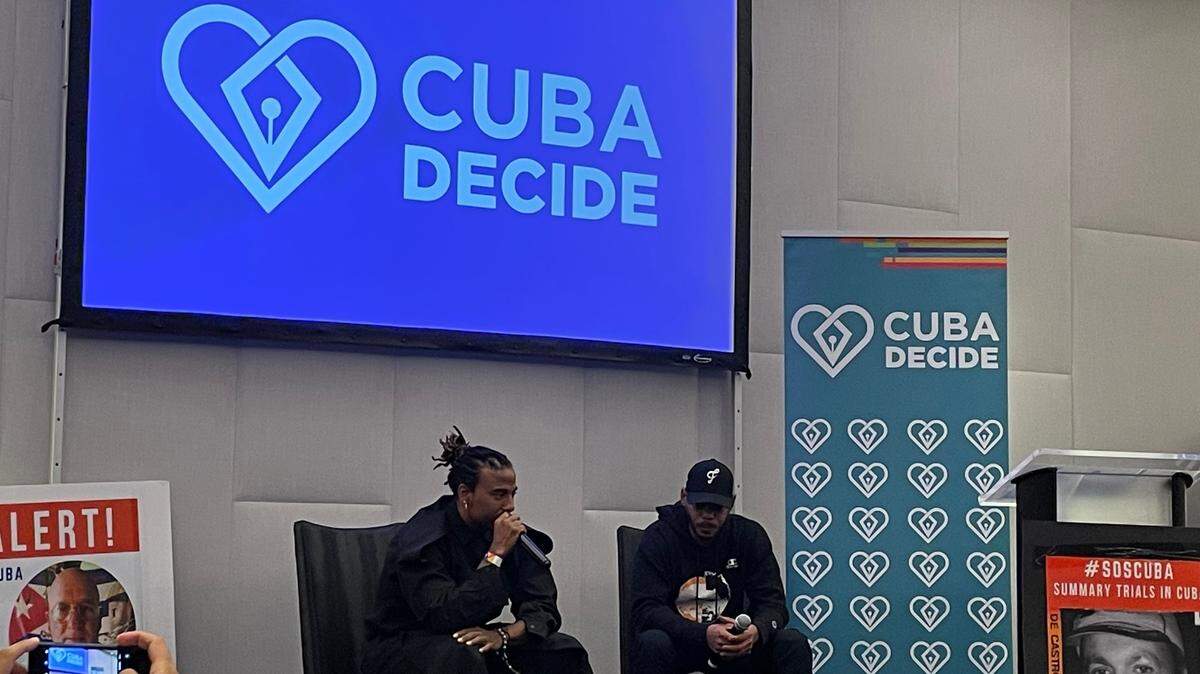
The song, which became a protest anthem in Cuba, was also heard in Los Angeles at an event organized by activist Rosa María Payá and Cuba Decide on Wednesday night.
“ ’Patria y Vida’ is not just a song; it is a road map for the country,” said rapper Yotuel Romero, the leading force behind the Grammy award hit. Romero said he was particularly proud that the six authors of the song were Black. “The nature of the Cuban dictatorship is racist.”
Romero and Ramos participated in the meeting between Secretary of State Blinken and activists from Cuba, Venezuela and Nicaragua. The singer said that he used the opportunity to highlight the suffering of the children of those imprisoned by the Cuban government.
Activists also found creative ways to draw attention to political prisoners.
Members of the Latin American Network of Youth for Democracy walked down the Hollywood Walk of Fame carrying stars with the names of political prisoners in those three countries.
Cárdenas, the wife of the former presidential candidate detained in Nicaragua, sent a final message to the international community: “Do not be indifferent to this situation that oppresses innocent people.”
This story was originally published June 9, 2022 at 7:44 AM with the headline "Blinken meets with activists from Cuba, Venezuela and Nicaragua during Los Angeles summit."