
Franklin County agrees to settle voting rights lawsuit. Elections will change
The end to a legal battle over Latino representation in the Franklin County commissioner districts may be in sight a second time.
The commissioners unanimously agreed this week to a settlement that would let them keep their current districts, but change how commissioners are elected starting in 2024.
It also requires the county to pay $375,000 in attorneys fees to the UCLA Voting Rights Project attorneys.
While the commissioners have signed off on the agreement, it still needs to be presented to a judge in Franklin County Superior Court — likely at a Monday hearing.
Three local members of the League of United Latin American Citizens represented by the voting rights project filed the lawsuit in April 2021, saying the current districts and election process make it impossible for Latinos in the county to elect a candidate they want.
The legal battle has taken twists and turns including a previous agreement that county attorneys submitted that two commissioners claimed they were surprised by.
The new agreement followed an hour-long executive session on Tuesday and a presentation from the third attorney the county hired to represent them — Francis Floyd.
It also comes a week before Franklin County was expected to start a trial that could have meant a drastically changed map, and more than $1.5 million in attorneys fees, Floyd said.
“(The settlement) solves the problem and makes the county in compliance with the Washington Voting Rights Act today, but also I think it sets it up so we have compliance in the future,” he told the commissioners. “If we were to go to trial, I think it would be unlikely that we could get our map approved.”
He added that there is nothing in the settlement or the case that is characterizing the commissioners or the county as racist.
“That is something that is mischaracterized,” he said. “What this lawsuit merely indicated is that there was racially polarized voting ... that is just a function of the demographics of this county and the ethnic makeup of the county.”
Effective in 2024
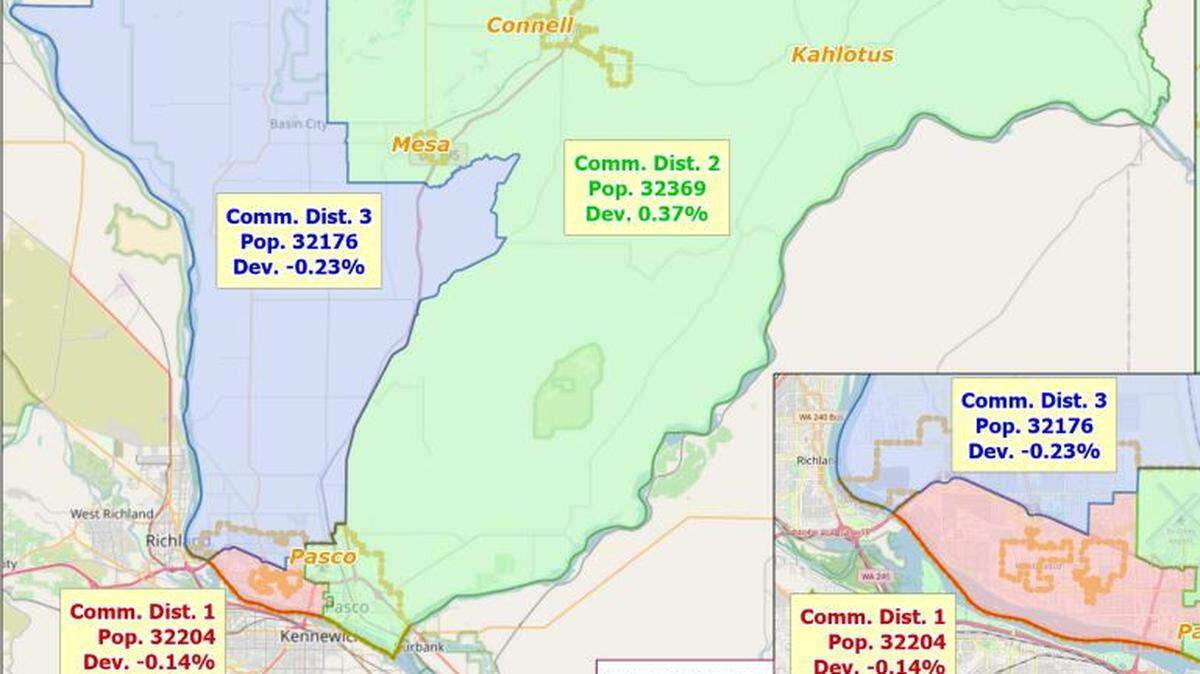
The county will get to keep the maps that were approved at the beginning of the year, Floyd said.
That map largely resembles the map the county currently uses, which divides Pasco mostly between Commissioner Brad Peck’s and Commissioner Rocky Mullen’s districts. Commissioner Clint Didier’s district touches the northwest portion of the city.
The county’s demographer Peter Morrison said the map follows the state and federal law.
The map is expected to have one majority Latino district by 2024, Morrison said at the time.
The biggest change goes into effect in 2024, meaning whoever runs for District 3, the seat currently held by Didier, will be the final one elected under the current system.
Peck’s and Mullen’s seats are currently up for election in 2024.
Under the agreement, only people living in those districts will be able to vote for those commissioners both in the district and general elections.
Reactions
Didier called the agreement a victory for the county. He pointed out that they only have to pay a portion of the attorneys’ fees and don’t have to change their current districts.
Commissioner Brad Peck called the settlement reasonable.
“I think it clearly is in the best interest of the citizens of Franklin County, which candidly is the only thing I care about, and who prevailed or didn’t is far less important to me than we have a legally-compliant system that all parties can settle and agree on,” Peck said.
On the other side, Matt Barreto, the voting rights project’s faculty director, said the settlement is a historic win for the Latino voters in Franklin County.
He noted that the county tried fighting the change for more than a year, and had chances to avoid paying any attorneys fees, but it was only on the eve of the trial that commissioners agreed to make a change.
This will be the second county challenged in court under the 2018 law.
Franklin County is following Yakima County in settling. Both cases went right up to the eve of the trial, Barreto said.
“I think it sends a signal to other jurisdictions and to the entire region that at-large elections violate the state Voting Rights Act,” he told the Herald.