Franklin commissioners clash in contentious redrawing of voting districts
After a contentious meeting this week, Franklin County commissioners selected a redistricting map. How long that map will last, or if it’s even legal, seems up for debate.
The goal of the meeting was to pick a map that divides the county into three voting districts based on population shifts before a Washington state deadline.
Because the county is currently being sued about alleged voter rights violations involving discrimination against Latino voters, the commission’s map choice may end up before a judge.
The next step in the process is a public hearing at 7 p.m. Tuesday, Jan. 4 at the HAPO Center, 6600 Burden Blvd., in Pasco.
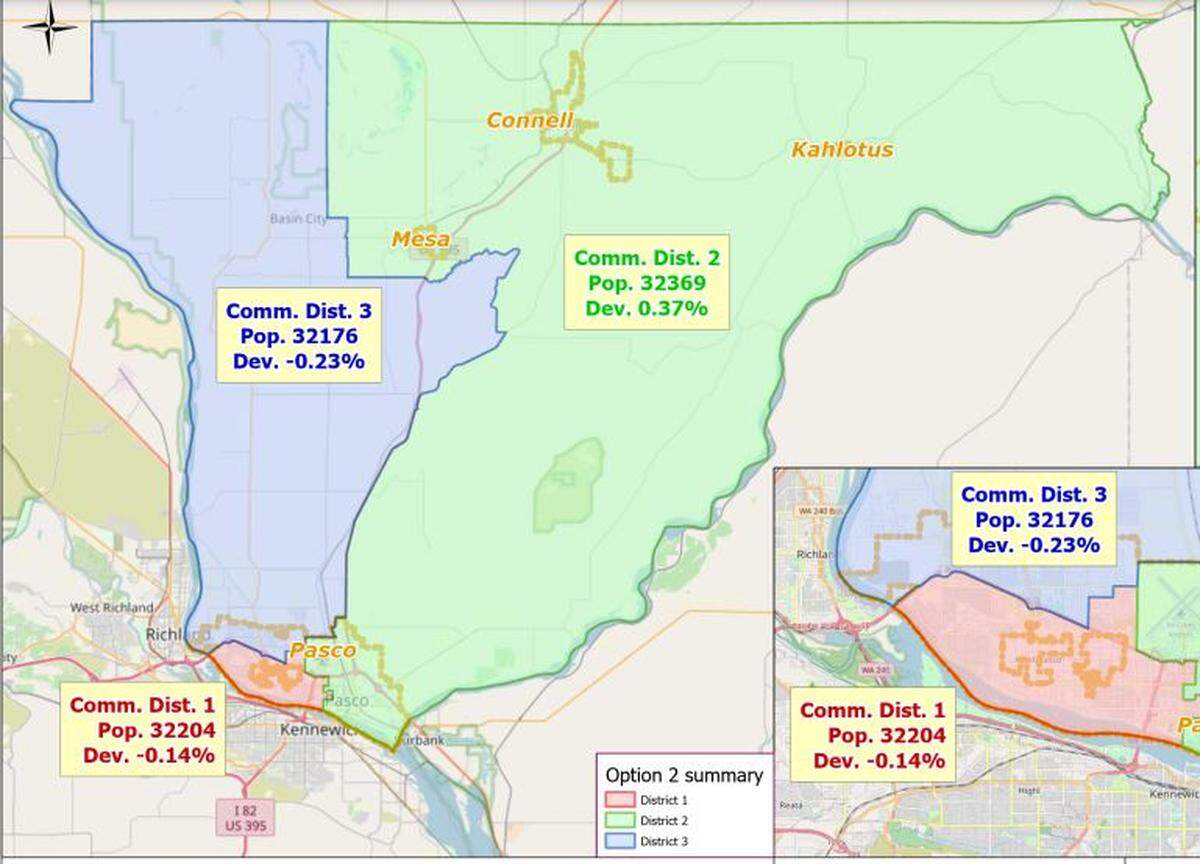
The map they ultimately picked to move forward in a 2-1 vote would have the city of Pasco west of Highway 395 in its own district as District 1, and the rest of the county divided into two large, adjacent districts stretching north and south. It mirrors the current district map configuration for the commissioners.
The map was not among the four maps favored by the commission’s hand-picked redistricting committee. Instead, the commissioners picked a map that’s similar to their current map. The committee came up with six maps and ranked them.
Each of the districts will have about 32,200 people.
Process questioned
And if Tuesday’s commission meeting was any indication, residents will have plenty to say about it.
Before beginning discussion on the proposed redistricting maps during the regular meeting, commissioners listened to public comments.
Jeffrey Robinson, chairman of the Franklin County Democrats, called into the meeting to comment. Robinson took issue with the process. He believes the commissioners have not been transparent about their choices, and that they have undermined public confidence in the board.
Last week the county’s lawyer said a closed-door redistricting committee meeting was not subject to state open meetings law, because it was considered an “advisory council” to the commissioners.
Robinson said the court should pick the map that most closely aligns with what the plaintiffs in the lawsuit have proposed, in order to ensure that residents in Pasco are equitably represented.
He said some board members have been trying to undermine the process by selecting maps that don’t adequately reflect the population of the county.
He favors a map that would give the city of Pasco two fully self-contained districts to reflect the fact that the city accounts for most of the county’s population and tax base. He questioned why the board would attempt to pick a map they know could land them in legal trouble.
“This is not something to be proud of,” he said. “If you must pick a map today, again, pick a map that the plaintiffs have put forward because that’s the one that follows the law and compromise system.”
He also raised concerns that two of the three commissioners, Clint Didier and Rocky Mullen, were violating the state COVID mask mandate by not wearing face coverings during Tuesday’s public meeting.
Commissioners debate
District 1 Commissioner Brad Peck said that while the lawsuit shouldn’t necessarily drive their decision, the board should keep in mind that taxpayers would be on the hook for the cost of the lawsuit, if the map they choose violate state or federal voting rights laws. He estimated those costs could run from $750,000 to $2.5 million.
“We will be responsible for paying the plaintiff’s costs in the most likely outcome,” Peck said. “We serve the people best, I think, when we find an outcome that meets our needs, complies with the law and doesn’t cost the county millions in legal fees.”
The commissioners sparred for more than half an hour over the maps they had to choose from and the merits of the lawsuit.
Commissioners said Map 6 would likely be the one closest to what the lawsuit plaintiff’s want. Peck outlined what he believes were the issues with the map proposals, and where he believes many of them would run afoul of state and federal law.
“I will point out that the Washington Voting Rights Act and the federal voting rights act, whether we like them or not, are law and we are in a lawsuit and are going to be compelled one way or another to comply with them,” Peck said.
District 2 Commissioner Rocky Mullen said he favored Map 2, because of the representation it would give smaller communities in the northern portion of the county.
“The job of the commissioners is public safety and the roads, the commissioners used to be called the Road Commission because that was their duty,” Muller said. “It begs the question of (what) the lawsuit is trying to put forth … to make sure they win their area, it’s the very meaning of gerrymandering in my opinion. I think that the majority of the north county can be divided into two parcels. I cannot vote for a map that has 90% of the county in one district, I think it’s wrong.”
Peck retorted that the commissioners have many other equally important duties in serving every citizen of the county, and their job was to select a map that represents people, not geographic area.
The 2020 Census showed the county’s population grew to 96,700 in the past 10 years.
Pasco accounts for 77,100 of that, a nearly 29% increase. Connell has about 5,400 people, up 29%.
The other incorporated and unincorporated parts of the county lost population. Mesa’s population fell to 385; Kahlotus to 147; Basin City to 1,063; Eltopia is 298 and Merrill’s Corner, 124.
The unincorporated population is 13,600, up 1.3% over 10 years.
Latino voters
District 3 Commissioner Clint Didier favored Map 4. He argued that choosing Map 2 would exacerbate the lawsuit.
Didier said he chose Map 4 because it would evenly divide up the county, and every commissioner would have a segment of the city and the outlying areas.
He also criticized leadership in the Hispanic community, saying it is their own fault they do not have proper representation.
“With the population of this county at 54% Hispanic, at this point in time, for them not to have representation would clearly be a reflection of their leadership,” Didier said. “If they can’t motivate the people into being interested in registering to vote, that is the heart of this lawsuit to motivate and stimulate people to get on the docket to vote, with 54% of the populous there is no reason they are not being represented.”
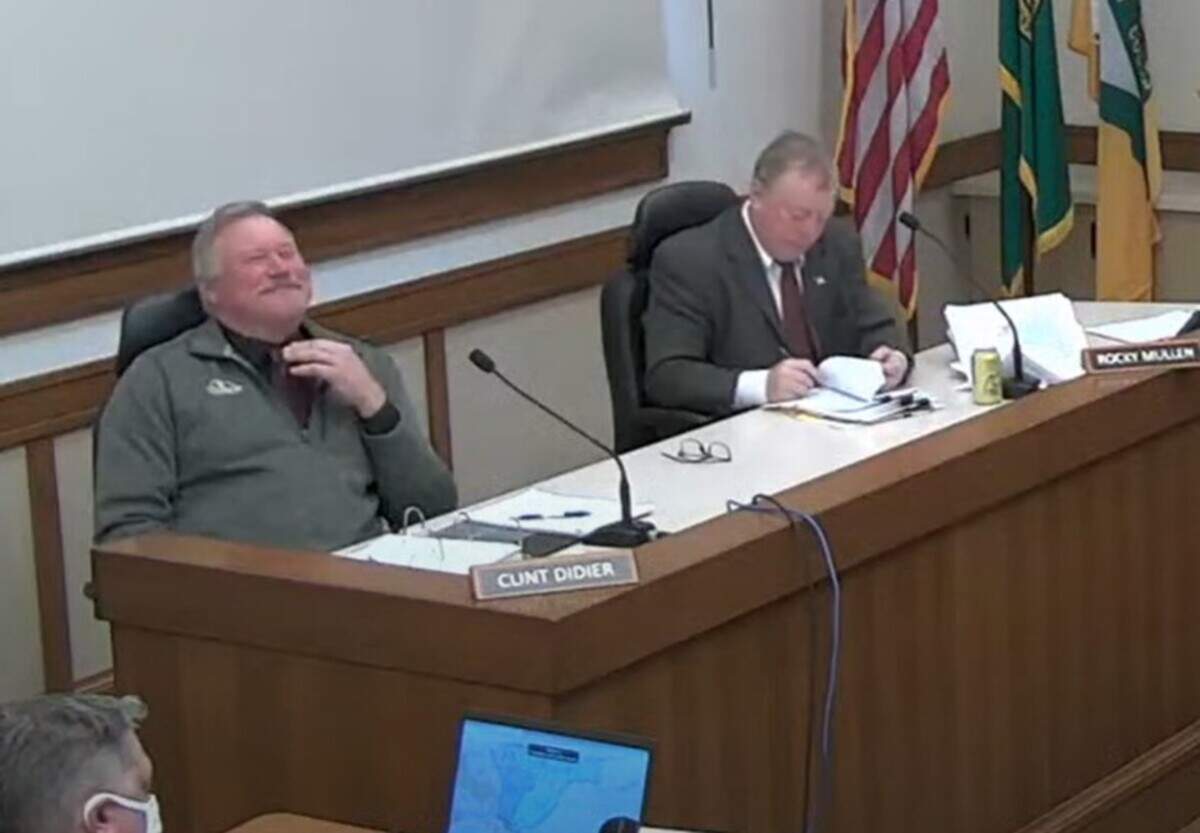
In a second public comment portion of the meeting, Robinson called in to fire back at Didier, calling his statement offensive and racist. The live video of the meeting showed Didier appearing to cover part of his face and laugh in response to Robinson’s comments.
After much deliberation, the board agreed they needed to vote on a map to present at the public hearing.
Peck said that while he does not like either Map 2 or Map 4, he would proceed with the vote to meet the board’s deadline for making a selection, with the understanding that no matter what map they chose, it would likely end up being decided in court.
“And you’ve already stated that Map 2 would land us right in court, so you’re playing right into that lawsuit,” Didier responded.
“Actually, we’re already in a lawsuit and I said, by numbers for each of the maps, what the defects are,” Peck responded. “I said Map number 2 fails the Washington (Voting Rights Act). That’s one commissioner’s opinion. Since this decision is ultimately going to be out of our hands anyways (making the decision) gets us off the dime ….“
“For this board to accomplish anything and move forward, it’s necessary to come to a consensus, often with compromise,” Peck continued. “I just want to be clear, I don’t think 2 or 4 are the best choice, but given the option I will support 2 and second (the motion to vote on) it.”
Ultimately the board chose Map 2 in a 2-1 vote, with Didier voting against. The public can comment on the decision on Tuesday, Jan. 4. Then the commissioners vote to pick a map and it’s used in the next election unless it’s challenged in court.
This story was originally published December 30, 2021 at 11:10 AM.