US attacks Iranian cargo ship while preparing for new round of talks
By Tyler Pager, Shirin Hakim and Sanam MahooziNYT News Service/Syndicate Stories
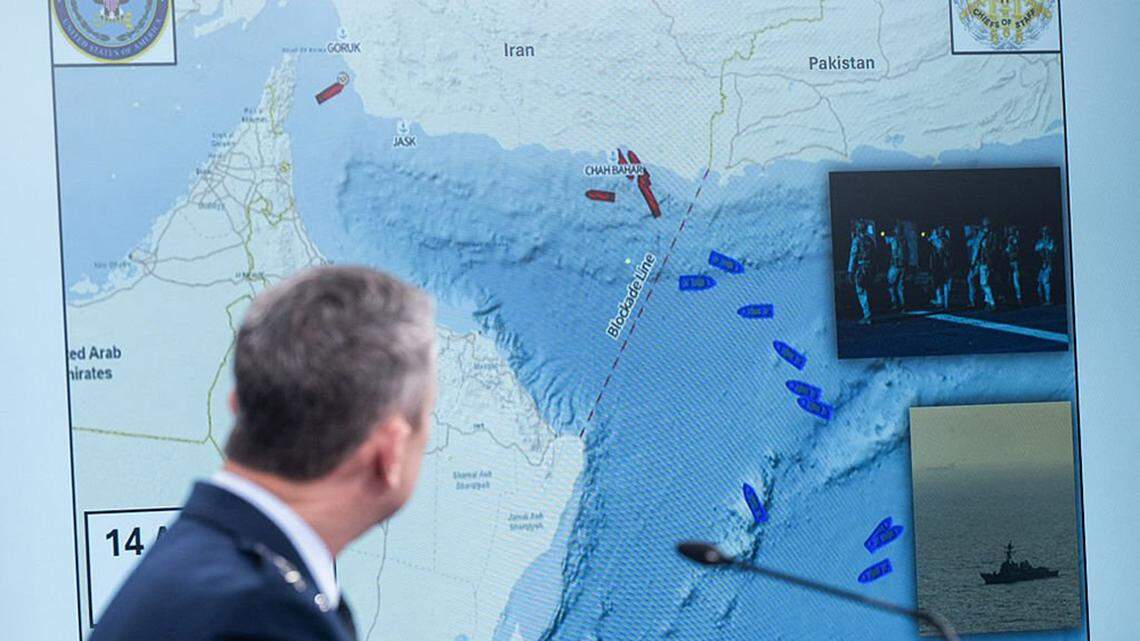
Chairman of the Joint Chiefs of Staff General Dan Caine speaks as a map of the Strait of Hormuz is displayed during a news briefing at the Pentagon in Washington on Thursday. A U.S. Navy destroyer on Sunday attacked and seized an Iranian cargo ship that defied a U.S. blockade of Iran’s ports, President Donald Trump said.
SAUL LOEB
AFP via Getty Images
A U.S. Navy destroyer on Sunday attacked and seized an Iranian cargo ship that defied a U.S. blockade of Iran’s ports, President Donald Trump said, posing a fresh threat to the fragile ceasefire that is set to expire this week.
Trump announced the attack hours after a White House official said the U.S. was dispatching a high-level delegation, including Vice President JD Vance, to peace talks in Pakistan, although the Iranian state media said Iran had not agreed to a meeting.
The guided missile destroyer USS Spruance fired on the cargo vessel Touska, Trump said on Truth Social, “blowing a hole” in its engine room before Marines took possession of the vessel. The president said the ship was under U.S. sanctions because of a “history of illegal activity” and that U.S. forces were “seeing what’s on board!”
Trump did not say whether there had been any casualties. Iran’s semiofficial Mehr news agency did not acknowledge the seizure of a ship. It reported that U.S. forces had fired on an Iranian merchant vessel, but said naval units from Iran’s Revolutionary Guard had forced the Americans to retreat.
U.S. Central Command said in a statement that a U.S. Navy destroyer repeatedly warned the Iranian-flagged cargo ship to stop over a six-hour period Sunday before disabling the vessel to allow helicopter-borne Marines to board and seize it.
The Touska had departed from Malaysia with cargo and crossed the U.S. blockade line before it was intercepted, according to TankerTrackers.com, a company that monitors global oil shipments.
The attack occurred in the Gulf of Oman, south of the Strait of Hormuz, the economically vital waterway that has become a flash point in negotiations.
Early in the war, Iran imposed a blockade on the channel itself, through which roughly 20% of the world’s oil normally travels, causing oil and gasoline prices to spike. A week ago, the United States began enforcing its own blockade of traffic to Iranian ports after the first round of peace negotiations with Iran failed to reach an agreement.
Iran announced on Friday that the strait was open to traffic, but Trump kept the U.S. blockade in place. That angered the Iranians, who reversed course and reimposed their blockade of the strait. On Saturday, Iran attacked two Indian-flagged vessels attempting a transit, acts Trump called a “total violation of our ceasefire.”
The fate of the strait is top of mind for U.S. negotiators, who Trump said would travel to Islamabad, the Pakistani capital, this week for talks. The stakes for the negotiations, should they happen, are high: Failure would risk reigniting the fighting and extending the global economic upheaval wrought by the war.
A White House official said Vance was expected to lead a U.S. delegation, accompanied by top Trump aides Steve Witkoff and Jared Kushner. The negotiations would be the second meeting of high-level officials since a two-week ceasefire went into effect on April 8.
The ceasefire is expected to expire in a couple of days, and the rhetoric is intensifying as the deadline approaches. Trump on Sunday renewed threats against Iran’s civilian infrastructure if the strait is not reopened and an extension of the ceasefire is not reached.
“We’re offering a very fair and reasonable DEAL,” Trump wrote on social media. “I hope they take it because, if they don’t, the United States is going to knock out every single Power Plant, and every single Bridge, in Iran.”
Such attacks would, in most cases, be considered war crimes under international law. Targets that have both civilian and significant military uses constitute more of a gray area, although Trump’s threat encompassed all bridges and power plants in the country.
Mike Waltz, the U.S. ambassador to the United Nations, said Sunday that targeting civilian infrastructure in Iran remained on the table if a deal were not reached to extend a ceasefire and he contended that such attacks would not constitute war crimes.
“We have a long history of taking down bridges, power plants and other infrastructure that is powering Iran’s military,” Waltz told NBC’s “Meet the Press.” “In the laws of land warfare and the rules of engagement, any type of infrastructure that is commingled is absolutely a legitimate target.”
The last round of negotiations, led last weekend by Vance in Islamabad, ended without a breakthrough. The meeting was the highest-level encounter between Iranian and U.S. leaders in decades.
In recent days, Trump repeatedly said Iran had assented to nearly all of his demands on the country’s nuclear program. Iranian leaders vehemently denied that claim.
Pakistani officials have not confirmed they would host talks this week between the United States and Iran. However, Islamabad was placed on a security lockdown Sunday night, similar to the one deployed over a 2-mile perimeter last weekend when it hosted the first round of negotiations. The luxury hotel where Vance met with Iranian officials has been emptied, and Pakistani officials have said they would deploy 10,000 additional security personnel in the city, including hundreds of special forces and snipers.
The back and forth over the strait and the state of negotiations clouded what had been a hopeful moment in the Middle East. Last week, under U.S. pressure, Israel agreed to a 10-day ceasefire in its fight in Lebanon against Hezbollah, the Iran-backed militant group. Iran had demanded that the fighting in Lebanon stop as a condition of negotiating peace with the United States and Israel.
People walk near a building destroyed by airstrikes in the Hay El Sellom neighborhood of Beirut, Lebanon, following the announcement of a ceasefire, on Sunday, April 19, 2026. (Diego Ibarra Sánchez/The New York Times) DIEGO IBARRA SANCHEZ NYT
A man clears debris on a building destroyed by airstrikes at the Hay El Sellom neighborhood of Beirut, Lebanon, following the announcement of a ceasefire, on Sunday, April 19, 2026. (Diego Ibarra Sánchez/The New York Times) DIEGO IBARRA SANCHEZ NYT
Rescue workers search for victims buried in the rubble of several buildings destroyed by an Israeli airstrike in Tyre, Lebanon, on Sunday, April 19, 2026. (David Guttenfelder/The New York Times) DAVID GUTTENFELDER NYT
Fatima Hassan Hamzi, 9, visits a temporary grave for her uncle at a cemetery in Tyre, Lebanon, April 18, 2026. Gathering at the cemetery for the first time since the ceasefire, families hope to relocate the remains to their now accessible home villages. (David Guttenfelder/The New York Times) DAVID GUTTENFELDER NYT
Women comfort Suheila, second from right, as she grieves over a temporary grave for her son, who was a fighter with Hezbollah, at a cemetery in Tyre, Lebanon, April 18, 2026. Gathering at the cemetery for the first time since the ceasefire, they hope to relocate the remains to their now accessible home villages. (David Guttenfelder/The New York Times) DAVID GUTTENFELDER NYT
Bottles are filled with water on a street in Beirut, April 18, 2026. Prime Minister Benjamin Netanyahu said Israeli troops would remain inside Lebanon, as part of what he called an "expanded security zone" from Lebanon's Mediterranean coast to its border with Syria, south of the Litani River. (Diego Ibarra Sánchez/The New York Times) DIEGO IBARRA SANCHEZ NYT
Family members grieve over a temporary grave for Hussein Bourse at a cemetery in Tyre, Lebanon, April 18, 2026. Gathering at the cemetery for the first time since the ceasefire, they hope to relocate the remains to their now accessible home villages. (David Guttenfelder/The New York Times) DAVID GUTTENFELDER NYT
Family members grieve at a cemetery in Tyre, Lebanon, April 18, 2026. Gathering at the cemetery for the first time since the ceasefire, they hope to relocate the remains to their now accessible home villages. (David Guttenfelder/The New York Times) DAVID GUTTENFELDER NYT
A man passes by a destroyed Lebanese ambulance in the southern village of Jouaiyya, Lebanon, as people return to their homes after the announcement of a 10-day ceasefire in the Israeli Hezbollah war, April 18, 2026. (David Guttenfelder/The New York Times) DAVID GUTTENFELDER NYT
Riding on the back wheel of their motorbike, two Lebanese men pass through the ruins of the town of Chehabiyeh, Lebanon as people return to the town after the calling of a ten-day ceasefire, April 18, 2026. (David Guttenfelder/The New York Times) DAVID GUTTENFELDER NYT
A woman walks through the ruins of a building in the southern Lebanon town of Borj Qalaouiye, as people return after the announcement of a ten-day ceasefire, April 18, 2026. (David Guttenfelder/The New York Times) DAVID GUTTENFELDER NYT
A Lebanese soldier steps from a military vehicle in the ruins of Tebnine, Lebanon, April 18, 2026. (David Guttenfelder/The New York Times) DAVID GUTTENFELDER NYT
Yusuf Mokaled, 14, carries an Iranian flag over his shoulder as he walks through the destruction in Tebnine, Lebanon, April 18, 2026. (David Guttenfelder/The New York Times) DAVID GUTTENFELDER NYT
A Lebanese family returning south on the Beirut to Sidon coastal highway, on the second day of the ceasefire, Saturday, April 18, 2026. Prime Minister Benjamin Netanyahu said Israeli troops would remain inside Lebanon, as part of what he called an "expanded security zone" from Lebanon's Mediterranean coast to its border with Syria, south of the Litani River. (Diego Ibarra Sánchez/The New York Times) DIEGO IBARRA SANCHEZ NYT
A Lebanese family returning south on the Beirut to Sidon coastal highway, on the second day of the ceasefire, Saturday, April 18, 2026. Prime Minister Benjamin Netanyahu said Israeli troops would remain inside Lebanon, as part of what he called an "expanded security zone" from Lebanon's Mediterranean coast to its border with Syria, south of the Litani River. (Diego Ibarra Sánchez/The New York Times) DIEGO IBARRA SANCHEZ NYT
A Lebanese family returning south on the Beirut to Sidon coastal highway, on the second day of the ceasefire, Saturday, April 18, 2026. Prime Minister Benjamin Netanyahu said Israeli troops would remain inside Lebanon, as part of what he called an "expanded security zone" from Lebanon's Mediterranean coast to its border with Syria, south of the Litani River. (Diego Ibarra Sánchez/The New York Times) DIEGO IBARRA SANCHEZ NYT
Lebanese families returning south on the Beirut to Sidon coastal highway, on the second day of the ceasefire, Saturday, April 18, 2026. Prime Minister Benjamin Netanyahu said Israeli troops would remain inside Lebanon, as part of what he called an "expanded security zone" from Lebanon's Mediterranean coast to its border with Syria, south of the Litani River. (Diego Ibarra Sánchez/The New York Times) DIEGO IBARRA SANCHEZ NYT
A Lebanese family returning south on the Beirut to Sidon coastal highway, on the second day of the ceasefire, Saturday, April 18, 2026. Prime Minister Benjamin Netanyahu said Israeli troops would remain inside Lebanon, as part of what he called an "expanded security zone" from Lebanon's Mediterranean coast to its border with Syria, south of the Litani River. (Diego Ibarra Sánchez/The New York Times) DIEGO IBARRA SANCHEZ NYT
Lebanese men assess damage from Israeli airstrikes in the streets of Dahiyeh, the large southern suburb of Beirut, on the second day of a ceasefire, Saturday, April 18, 2026. People continued to travel back to southern Lebanon in large numbers on Saturday, enabling residents to take stock of the scale of destruction of their homes and villages. (Diego Ibarra Sánchez/The New York Times) DIEGO IBARRA SANCHEZ NYT
A migrant worker walking by a camp for internally displaced people on the grounds of a convention center in Beirut, on the second day of a ceasefire, Saturday, April 18, 2026. People continued to travel back to southern Lebanon in large numbers on Saturday, enabling residents to take stock of the scale of destruction of their homes and villages. (Diego Ibarra Sánchez/The New York Times) DIEGO IBARRA SANCHEZ NYT
Lebanese men assess damage from Israeli airstrikes in the streets of Dahiyeh, the large southern suburb of Beirut, on the second day of a ceasefire, Saturday, April 18, 2026. People continued to travel back to southern Lebanon in large numbers on Saturday, enabling residents to take stock of the scale of destruction of their homes and villages. (Diego Ibarra Sánchez/The New York Times) DIEGO IBARRA SANCHEZ NYT
Copyright 2026 The New York Times Company
Get one year of unlimited digital access for $159.99