
How Iran's ‘defeated’ military can still challenge US naval blockade
With President Donald Trump ordering the U.S. Navy to blockade Iran after failed peace talks, the Islamic Republic’s battered armed forces still have some cards to play that could raise the costs of war for the White House.
Trump has repeatedly declared Iran’s military “defeated” since launching a joint campaign with Israel in late February. Yet Iran continued to launch missile and drone strikes against both Israel and nearby Arab countries hosting U.S. military bases.
Hostilities largely paused when the U.S. leader declared a two-week ceasefire on Tuesday to allow for negotiations. But those talks ended over the weekend without a deal, leading Trump to attempt to break Iran’s stronghold over the vital Strait of Hormuz energy trade chokepoint by sending warships to prevent any vessels from entering Iranian ports.
And while the remnants of Iran’s already outmatched forces pale in comparison to U.S. military might, the operation carries sufficient risks to likely keep U.S. ships at a distance as Tehran has long prepared for a close-quarters confrontation.
“The U.S. boardings won’t take place in or near the Strait precisely because Iran has spent decades designing and building its asymmetric naval system precisely to overwhelm enemy naval forces,” Arran Kennedy, maritime security analyst at the consultancy Control Risks, told Newsweek.
“That threat is why the U.S. Navy had, until Saturday, hitherto been unwilling to expose assets worth billions of dollars and hundreds of sailors to Iranian weaponry and will remain reluctant to do so,” he said.
Iran’s asymmetric arsenal
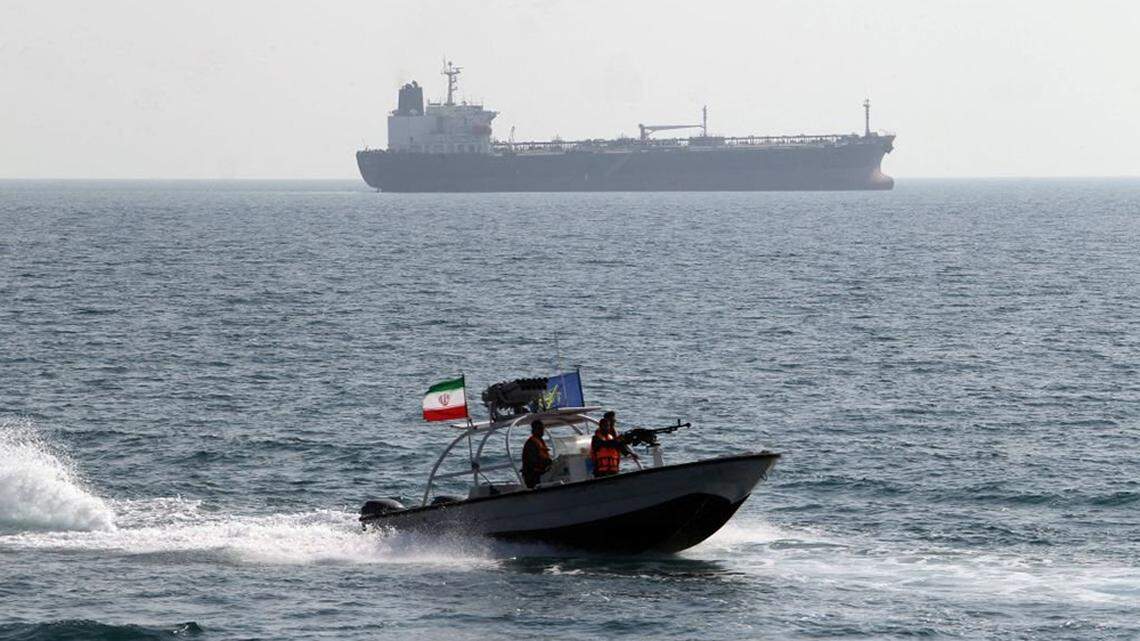
Among the most potent tools in Iran’s arsenal are small, fast-attack craft commanded by the Islamic Revolutionary Guard Corps (IRGC) Navy.
While many of Iran’s larger warships overseen by its conventional navy were destroyed in the conflict, the IRGC is believed to retain much of its militarized speedboat fleet, some suited with anti-ship missiles and capable of attempting swarm attacks against the towering, state-of-the-art U.S. Navy assets.
Also posing a potential threat to the U.S. side is Iran’s coastal defense array, including cruise missiles capable of reaching across the narrow Strait of Hormuz. These platforms have also reportedly been spared the brunt of U.S.-Israeli strikes focused on ballistic missile launchers, which still remain a persistent threat.
A report published Sunday by Iran’s Press TV outlet alleged that two U.S. Arleigh Burke-class guided missile destroyers, the USS Michael Murphy and USS Frank E. Peterson Jr., were forced to retreat after Iranian cruise missile systems locked onto their positions and warnings from IRGC personnel.
Newsweek has reached out to U.S. Central Command for comment regarding the unverified incident.
CENTCOM had earlier announced that the two ships were involved in operations to clear sea mines, which remain a major problem for both military and civilian ships attempting to transit the Strait of Hormuz.
Another disruptive measure available to Iran is its sizable arsenal of drones, particularly loitering munitions. While capable of carrying only relatively limited munitions, Shahed-model unmanned aerial systems have been employed to devastating effect in large numbers throughout the conflict.
All of these assets could also be used to intensify strikes against U.S. military facilities, oil and gas sites and other infrastructure across the Gulf Cooperation Council (GCC) states across the Persian Gulf.
“Separate to attempting to attack U.S. naval assets enforcing the blockade,” Kennedy said, “Tehran could hit back by more directly striking GCC port infrastructure or vessels serving those states - which, given that so few vessels are sailing the Strait, means attacking such ships currently sheltering in the Gulf.”
Lessons from the past
The U.S. has a history of conducting and supporting naval blockades during wartime, including the Civil War, both World Wars and the Cold War-era U.S. interventions in Korea and Vietnam.
Michael Connell, Middle East and Russia specialist at the Center for Naval Analyses, pointed out that “historical examples suggest that blockades can be a useful tool, but it generally takes time for them to yield results.”
“They also tend to be resource intensive,” Connell told Newsweek. “Although in this case, the U.S. need not blockade all of Iran’s coast, only the Strait and few smaller Iranian ports on the Gulf of Oman.”
The U.S. and Iran have also previously clashed in the Persian Gulf. During the 1980-1988 Iran-Iraq War, both nations targeted merchant ships off their coasts in what came to be known as the “tanker war,” prompting a U.S. escort mission.
Months before a ceasefire was reached between Baghdad and Tehran, the U.S. responded to the mining of one of its guided missile frigates by striking several Iranian naval targets, sinking five Iranian vessels and crippling other military infrastructure.
Yet Iran has applied many lessons from previous conflicts, and the U.S. has drawn some conclusions of its own - some less than favorable.
During a 2002 war game known as “Millennium Challenge” conducted in the lead-up to the U.S.-led invasion of Iraq, the “Red Team” representing a Persian Gulf state managed to overwhelm the far more powerful U.S.-simulated “Blue Team.”
Retired Marine Corps Lieutenant General Paul Van Riper utilized an arsenal of cruise missile salvos, smaller quick boats and suicide charges to take out prized warships. The Pentagon continued resetting the exercise until a U.S. victory.
Connell argued that the U.S. would mitigate the risks to ships the farther they remained from Iranian territory.
“The closer U.S. vessels and aircraft get to the Iranian coastline (or islands occupied by Iranian forces inside the Gulf), the greater the risk,” Connell said. “The risk would likely increase if the Navy were to conduct opposed boardings or try to reestablish freedom of navigation in the Strait, for instance, by conducting mine clearance operations.”
“The risk could also increase if other adversaries were to share advanced military technology with Iran that could be used to target U.S. forces,” he added.
Geopolitical complications
Another overarching question surrounds the manner in which U.S. forces would treat merchant ships attempting to break the blockade, particularly vessels associated with powerful nations such as China.
“At a minimum, the US would need to establish a screen of vessels and aircraft outside of the Strait to monitor traffic and interdict shipping bound for Iranian ports,” Connell said. “The U.S. Navy would also need to decide what to do with any vessels that might attempt to run the blockade. It could simply sink them, or it could attempt to detain them.”
“The latter would require additional resources, particularly if the Navy needed to conduct opposed boardings,” Connell said. “If the vessels were flagged by a third-party state, such as China, and/or if they were escorted by that state’s naval forces, additional factors would need to be considered.”
Kennedy also raised the issue, noting “what we don’t yet know is which states will be willing to host any seized vessels, or what the U.S. will do with any seized cargoes.”
Thus far, limited traffic transiting the Strait of Hormuz has followed Iran-controlled routes, sometimes reportedly paying a toll that has since emerged as one of several sticking points in negotiations between Washington and Tehran.
Trump’s blockade is aimed at shattering this arrangement and may have an impact beyond trade directly associated with Iran.
“While most of the focus has been on ships bound to or originated from Iran, the inclusion in the U.S. notices of Iranian ‘coastal areas’ and reference to only permitting ‘neutral’ vessel transit passage suggest it might extend to vessels sailing the Strait of Hormuz via the Iran-controlled route established a few weeks ago, even if those vessels are not servicing Iranian trade,” Kennedy said.
“That’s important because this has been the route by which limited non-Iran-linked traffic has left the Gulf following diplomatic negotiations, payment of a transit fee, or in some cases likely both,” he added. “Iran has attempted to keep this route going post-ceasefire, by which it means to dictate which ships can and can’t sail the Strait, but the U.S. blockade aims to weaken that grip.”
Given the importance that Iran’s hold over the Strait of Hormuz occupies in its strategy to weather the U.S.-Israeli war, he argued Tehran would be unlikely to give in easily even in the face of intensified U.S. pressure.
“Although the blockade will test Iranian political and military resolve to defend its newly established control of the Strait, the U.S.’ blockade by itself won’t force Iran to re-open it to all traffic,” Kennedy said. “Control over the Strait is Tehran’s most significant leverage in bilateral political talks with the U.S.”
2026 NEWSWEEK DIGITAL LLC.