4-foot predator killed by hiker turns out to be first-of-its kind sighting in Bolivia
In a dense forest of northern Bolivia lived a “cryptic” predator. The 4-foot-long creature had gone largely unnoticed due to its remote home and camouflage.
Not anymore.
Scientists ventured into the lowlands of La Paz in 2015 to survey wildlife, according to a study published July 10 in the peer-reviewed journal Herpetozoa. They were searching for several hard-to-find reptiles known as vine snakes and sharpnose snakes.
During the hike, a wildlife guide “accidentally severed” a 4-foot-long snake while clearing a trail near the camp, the study said.
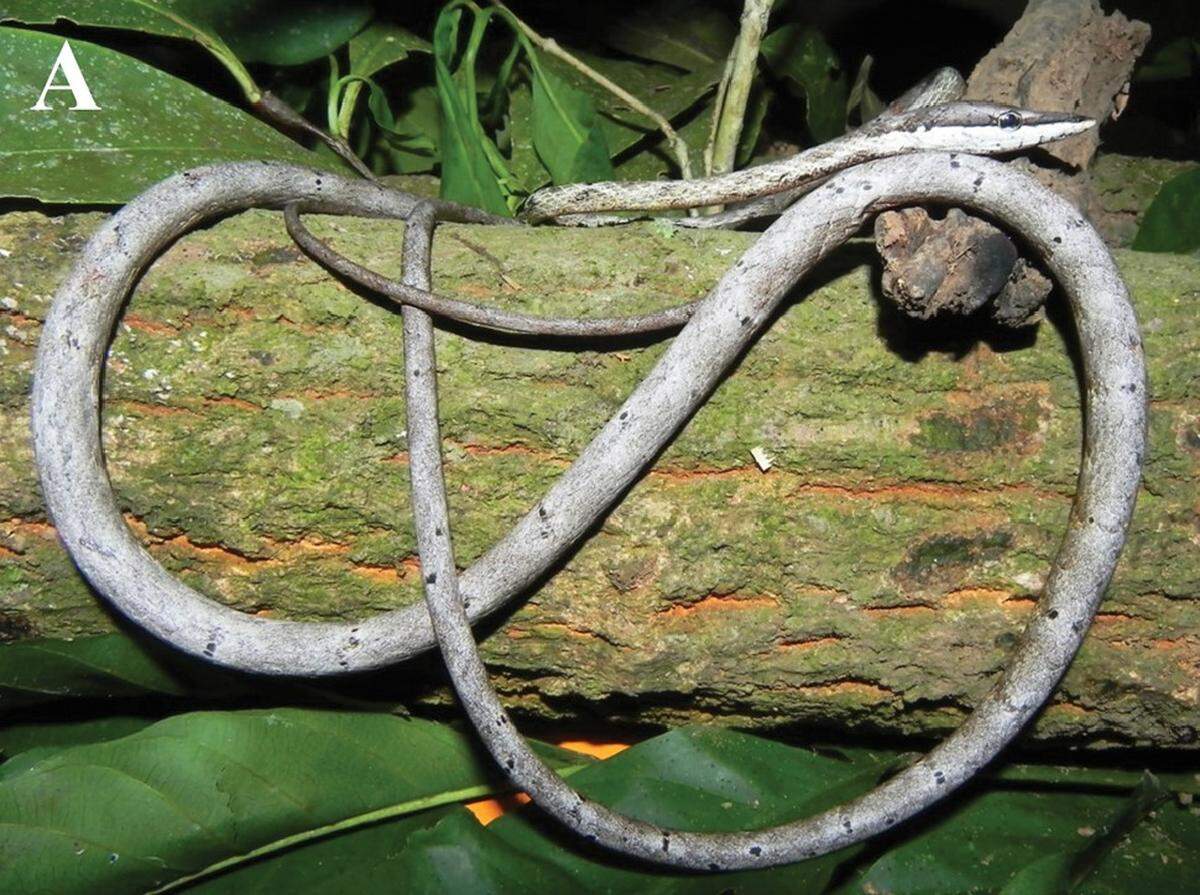
Researchers took a closer look at the dead predator and identified it as the country’s first record of an Oxybelis inkaterra, or Inkaterra vine snake.
A photo shows the 4-foot-long Inkaterra vine snake looped over a branch. Its coloring is a mixture of grays, creams and light browns. Its head appears quite pointy.
The snake likely felt “threatened” by the hiker and “remained motionless, mimicking one of the branches of the shrub it was on,” researchers said. “Unfortunately, this behavior caused it to go unnoticed by the guide, resulting in the unfortunate accident.”
Inkaterra vine snakes have also been found in Peru and Ecuador, the study said. In museum archives, researchers also found two more Inkaterra vine snakes, one caught in Bolivia in 2005 and the other with no date or location information.
La Paz, the region where researchers found the Inkaterra vine snake, is in northwestern Bolivia and near the border with Peru.
Vine snakes are generally “quite cryptic, due to their coloration, elongated head, and attenuated slender bodies and long tail,” researchers said. They feed on “a diversity of small vertebrates, including lizards, birds, amphibians and mammals.”
Because of their camouflaged appearance, vine snakes are “very difficult to observe and capture.”
The research team included Luis Rivas, Gustavo Rey-Ortíz, Cord Eversole, Randy Powell, Gonzalo Navarro-Cornejo, Edson Cortez, Mauricio Ocampo, Gabriel Callapa and Arturo Muñoz.
The team also documented several other poorly known snake species.
This story was originally published July 11, 2024 at 1:32 PM with the headline "4-foot predator killed by hiker turns out to be first-of-its kind sighting in Bolivia."