
Senator says Tri-Cities businesses have a role in maintaining U.S. technology leadership
A proposed infusion of $200 billion to build and maintain U.S. leadership in key research areas and keep the benefits in the country has the potential to boost the Tri-Cities as a research and technology innovation center.
Pacific Northwest National Laboratory in Richland is well positioned as Congress continues work on legislation, said Sen. Maria Cantwell, D-Wash.
She visited PNNL last week to hear not only from lab leaders but also Tri-Cities economic development leaders and Tri-Cities entrepreneurs as discussions prepare to start in Washington, D.C., on reconciling Senate and House versions of research spending bills.
The Senate-approved U.S. Innovation and Competition Act included $17 billion for research at the nation’s 17 national labs, including PNNL, over five years, thanks to the efforts of Cantwell.
Bipartisan interest in the legislation was boosted by the need to keep the United States competitive as other countries, including China, increase their research spending and capabilities.
“What we want is to empower more innovation,” Cantwell said. “And I think the lab is well positioned on this. I think there’s a lot of opportunity for PNNL to continue to play a leadership role — I think it’s necessary that you play a leadership role.”
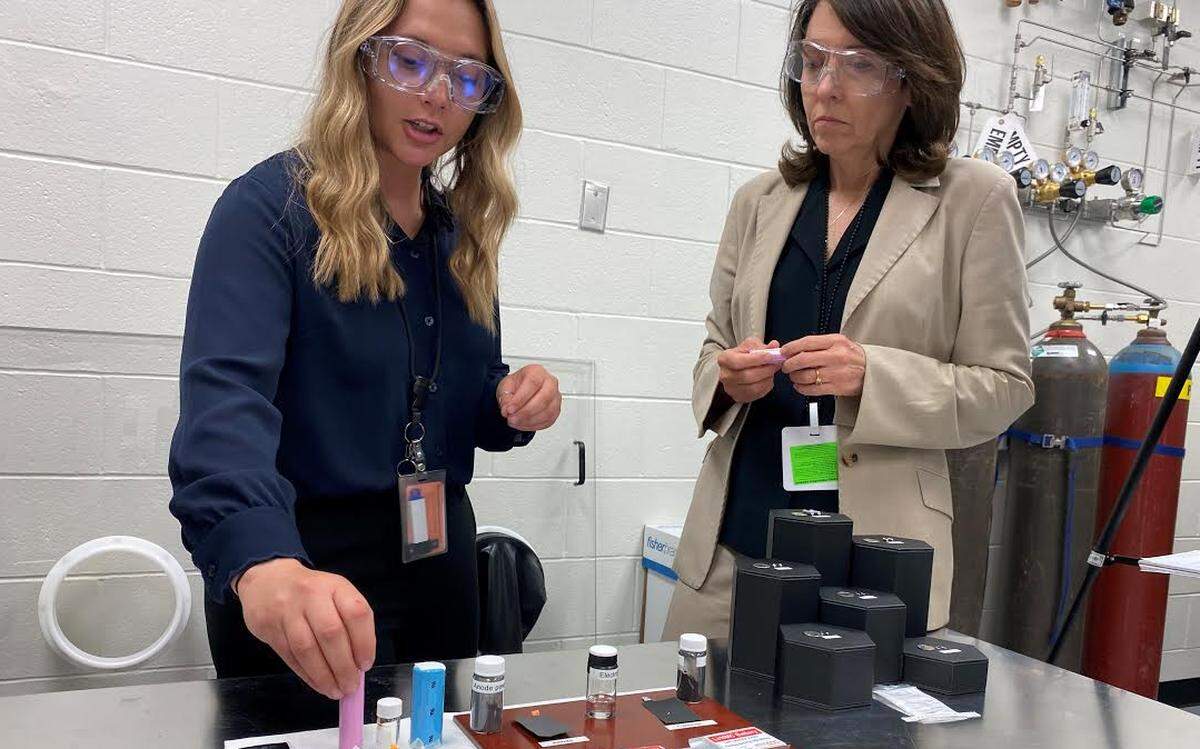
Among the lab’s strengths are quantum computing and high-performance computing, biotechnology, genomics, materials science and cybersecurity.
PNNL already is growing thanks to its expertise in areas key to the nation’s future, including clean and reliable energy.
In the last 15 months the number of permanent staff has increased by 164, to reach an all-time high employment of more than 5,000 employees, an all-time high for the national lab.
“What I’ve been told by all the national lab directors is .... ‘unleash us. Tell us what the priorities are. Tell us what the key challenges are that we are facing in out country’,” said Deputy Energy Secretary David Turk, who attended the meeting virtually.
Research trends
There are two big trends in the research environment, said Jud Virden, associate PNNL director for energy and environment.
One is the competition has become global, he said.
“In my opinion, we are still the leaders in the world,” he said.
But other countries are getting more organized about moving from fundamental science discovery to bringing technology to consumer use.
He described a visit outside the United States to the biggest battery plant in the world and watching BMW vehicle batteries that were based on chemistry developed in the United States but that were being manufactured overseas.
“That’s the most important thing, for all of us to do better to move through that innovation cycle and make sure things end up here,” he said.
The other trend is coordinating the U.S. expertise in artificial intelligence, machine learning, multi-disciplinary research, high performance computing and quantum information in a way that other countries cannot and in a way that accelerates how quickly new ideas are moved into the marketplace.
“It is an incredible opportunity and differentiator for us as a country” as it moves new technology to being used, he said.
Tri-Cities as technology hub
Turk said he’s interested in how national labs can benefit the communities and states in which they are located, working with companies and entrepreneurs to bring new technology to the market and develop technology hubs, he said.
“I already think of the Tri-Cities as a technology hub,” Cantwell said.
PNNL plays a major role in that with entrepreneurs like Robert Wegeng, president of STARS Technology Corp. of Richland.
He received training from the Department of Energy to transition from his decades of research at PNNL to starting a business to bring patented technology he worked on to the marketplace.
His company is working with the Southern California Gas Co., the nation’s largest natural gas utility, to set up a commercial demonstration unit this year of the compact, low-cost hydrogen generator technology the company is developing. The hydrogen would be used for fuel-cell powered buses.
The system will be assembled in Richland.
Another entrepreneur, Todd Brix, founder of OCO Inc., said his company consolidated operations last year from Ohio, Oregon and Seattle in the Tri-Cities, in part because of its large renewable energy base and low-cost electricity.
It also is working with PNNL.
“We think the Tri-Cities is the best, first place for what needs to happen in terms of R&D and manufacturing in the energy transition,” he said.
OCO is developing technology that converts carbon dioxide, water and electricity into electrofuels and electrochemicals.
This story was originally published July 5, 2021 at 5:00 AM.