
Improved LIGO near Richland could detect first gravitational wave
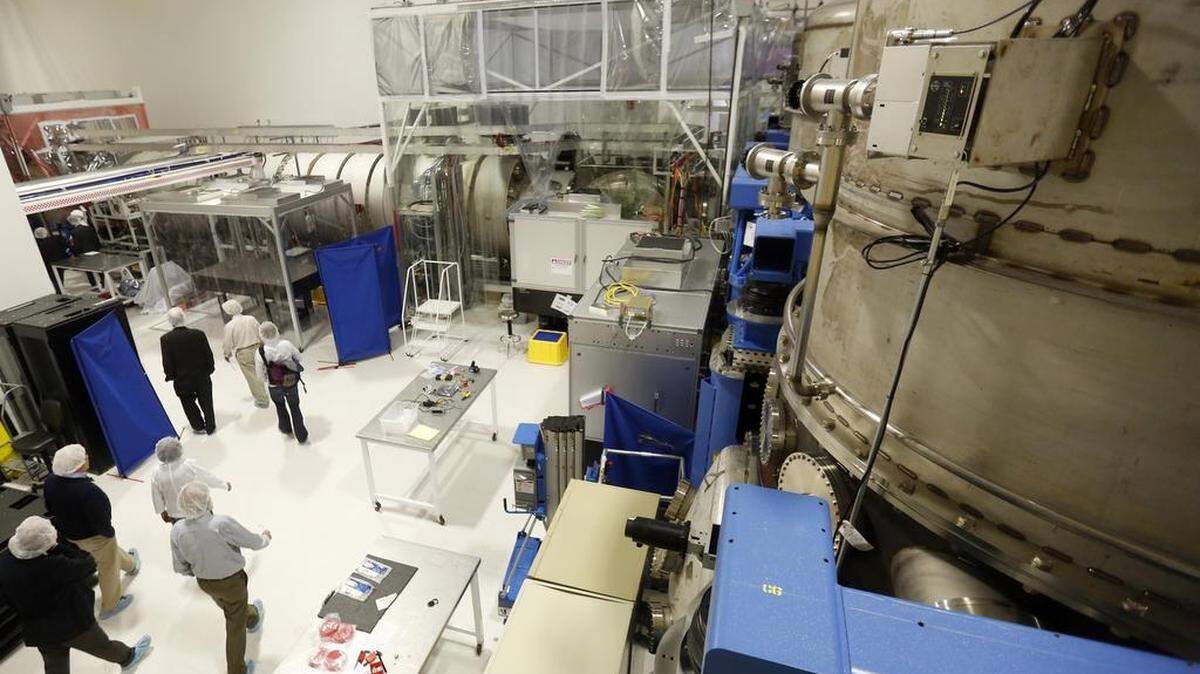
A century after Albert Einstein predicted the existence of ripples through space and time, the first such gravitational wave could be detected at a scientific complex in the shrub steppe north of Richland.
Such a discovery could open up a new world of information about the universe, advancing knowledge in physics and establishing a new field of astronomy based on information gleaned from gravitational fields.
From about 2002-10, scientists used the Laser Interferometer Gravitational-wave Observatory, or LIGO, on Hanford land to attempt to detect a gravitational wave coming from outer space and passing through the Earth. A twin LIGO in Louisiana is used for the same purpose.
To date they’ve been unable to find them.
But Tuesday, scientists from around the globe gathered to dedicate Advanced LIGO at Hanford. The facility has been shut down since late 2010 for a major upgrade and revamp.
It’s intended to increase the sensitivity of instruments to detect gravitational waves by a factor of 10.
The improved LIGO provides a “critically important step going forward to understand the extraordinary mysteries of the universe,” said France Córdova, director of the National Science Foundation, at the dedication.
“It gives science a highly sophisticated instrument for detecting gravitational waves … that we believe carry with them information about their own violent origins and about the nature of gravity that cannot be obtained by conventional astronomical tools.”
Researchers believed the original LIGO at Hanford had the sensitivity to detect gravitational waves from 100 galaxies, said David Shoemaker, the Advanced LIGO project leader at the Massachusetts Institute of Technology. The Washington and Louisiana observatories are operated by MIT and the California Institute of Technology.
But chances of a detection were not great at the original LIGO, given an estimate, which is highly uncertain, that there could be an astronomical event producing a gravitational wave once every 10,000 years per galaxy.
With the upgraded equipment that’s been installed, Advanced LIGO has the sensitivity to detect gravitational waves from 100,000 galaxies, Shoemaker said.
Gravitational waves are caused by an acceleration or change in direction of objects with the mass of the sun and moving near the speed of light, such as two neutron stars that orbit each other until gravity pulls them together and they collide.
The ripple that sends through space and time has a force so great it could be felt on Earth. As it passes through the planet it stretches objects lengthwise and causes them to compress sideways — a circle could become an ellipse.
But the change would be barely detectable.
LIGO is trying to detect a movement about one thousandth of a diameter of a proton, which is the nucleus of a hydrogen atom. It would take 10 trillion such movements to equal the width of a human hair.
To detect a gravitational wave, the Hanford LIGO has mirrors suspended by fine wires at the end of two vacuum tunnels stretching about 2.5 miles into the shrub steppe, one to the northwest and the other at a right angle to the southwest. A laser beam is split in half to travel down each leg of the tunnel and bounce back.
In the absence of a gravitational wave the return light goes back toward the laser. A gravity wave, by changing the distances in the tunnel, would cause some of the return light to veer in a different direction.
Improvements to LIGO include changes in the laser, the mirrors, the seismic isolation systems and how the microscopic motion is detected.
It’s been called the “ultimate high-risk, high-reward project,” said Córdova, an astrophysicist. “Advanced LIGO is among the largest and most ambitious projects NSF has ever funded.”
The redesign of the interferometers has been paid for by $205 million from the National Science Foundation and $30 million from partner agencies in Germany, the United Kingdom and Australia.
In addition to the improvements at Hanford and in Louisiana, LIGO is working with India on a proposed interferometer there to begin operations in 2022. Other detectors are based in Germany and Italy, with Japan working on one.
Detecting a gravitational wave at multiple observatories is expected to help scientists locate the sources of the wave.
Advanced LIGO at Hanford is planned to start up for a three-month run this fall. Scientists do not have high hopes that a gravitational wave will be detected in its first run, Shoemaker said.
But there could be a high probability that a gravitational wave could be detected in a six-month run with increased sensitivity, 100 years after Einstein predicted the existence of gravitational waves based on his theory of relativity, he said.
By a nine-month run starting in 2017, LIGO could be making regular discoveries, he said. The observatory will not be at full sensitivity until 2019.
Now scientists can only guess at how often a gravitational wave could be detected. It could be once a week or once per month, said David Reitze, the LIGO laboratory executive director at Caltech.
The information provided by the gravitational waves could help explain how stars explode and how matter behaves under extreme gravity, he said. It could provide information on where objects called gamma ray bursts come from, he said. They produce more energy in a few seconds than the sun produces in its lifetime, he said.
The increased sensitivity of Advanced LIGO comes with the ability to tune the instrument for specific astrophysical sources. This will allow Advanced LIGO to look at the last minutes of the life of pairs of massive black holes as they spiral closer and coalesce into one larger black hole.
Advanced LIGO also will be used to search for the gravitational cosmic background, allowing tests of theories about the development of the universe just after the Big Bang.
The observatories are located in Washington state and Louisiana, but the scientific collaboration includes 950 scientists at universities across the United States and in 15 other countries.
“Discovery-driven research is the currency of human progress,” said Kirk Kolenbrander, MIT vice president. “Research expands our level of knowledge and enables real world solutions. Without basic science, our best guess never gets any better.”
LIGO at Hanford offers public tours at 3 p.m. the fourth Friday of the month at at 1:30 p.m. the second Saturday of the month. Directions are posted at www.ligo-wa.caltech.edu/traveler.html. Call 509-372-8181 for more information.
This story was originally published May 19, 2015 at 10:33 PM with the headline "Improved LIGO near Richland could detect first gravitational wave."