
Time capsule to be opened in 2389 sealed shut in Richland (w/video)
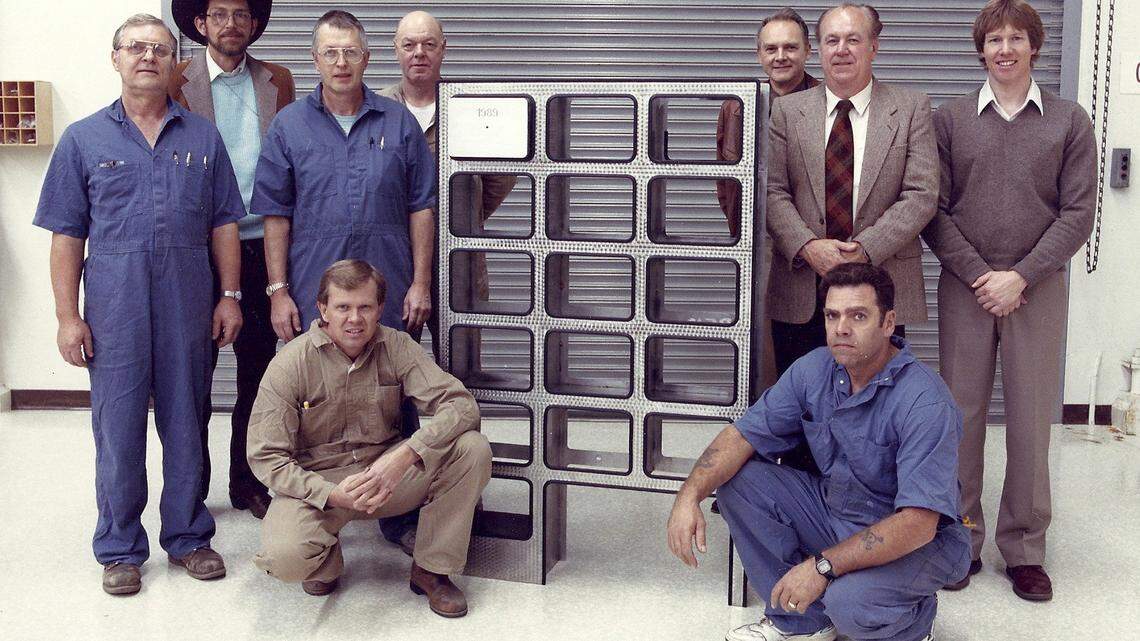
The latest time capsule to be opened on Washington’s 500th birthday was making its way back across the state Thursday evening to be locked up in a vault in the rotunda of the State Capitol.
It arrived at HiLine Engineering in Richland earlier in the day to be carefully packed full with items and messages from around the state and welded shut.
It is the second time capsule that will be stored away in the Capitol as part of a project started on the state’s 100th birthday in 1989. A time capsule is planned to be stored away every 25 years until 2389.
“I didn’t think it was going to be so full,” said Benjamin Helle, of the Washington State Archives, as he slid object after object into the stainless steel canister designed in 1989 by Hanford engineers.
It included two Amazon Kindles filled with books by Washington authors or about Washington, from Snow Falling on Cedars to The Boys in the Boat. Trail guides, which should show how the state changes over centuries, were loaded onto the devices.
The people of the future also can read a script of the Half-Life video game developed in Bellevue.
To make sure that the Washingtonians of the future can turn on the Kindles, batteries that could corrode have been removed, and instructions have been added on how to hook up a 4-volt battery supply to leads with alligator clips.
Including books in the way people actually read them should be tremendously interesting, said Greg Bear, a science fiction writer, whose book Darwin’s Radio is included in the time capsule.
Seeds from five rare Washington state plants, including Barrett’s beardtongue and Whited’s milkvetch, were sealed up in hopes they will still be viable in 375 years.
To represent the arts, glass sculptor Dale Chihuly donated a piece of blue crystal glass. Fellow artist Ginny Ruffner donated a pink- and green-veined crystal leaf.
Those who unpack the time capsule may have their knowledge of ancient sports trivia tested. They will find a bobblehead doll of Mariners star Felix Hernandez winding up for a pitch and a Super Bowl coin from the Seattle Seahawk’s winning year.
Hundreds of messages from Washington residents to the future were included. A word cloud showed that “hope” was a dominant sentiment.
With just a little room left after those and other treasures were stacked tight, pockets were emptied by those gathered at HiLine for the capsule sealing.
In went Target and Winco receipts, a lottery ticket, a Subway gift card, an expired driver’s license, a dollar bill and a “Got milk” smiley button.
“Even if we put in tremendously mundane things, it becomes interesting” in hundreds of years, said Knute "Skip" Berger, architect of the centennial time capsule project.
Should a volcano cover the state with ash and obliterate civilization, the capsule could be what archaeologists unearth to tell the story of the people who once lived here, Bear said.
“We tried to focus on things from the last 25 years that represent the people of the state,” said Eric Meadows of Bonnie Lake, Wash.
He’s one of the former students, 10 years old in 1989, who volunteered at the time to be “Keepers of the Washington Centennial Time Capsule.” They’ve been tracked for a quarter century to make sure they could be found to fill the time capsule sealed in Richland Thursday.
But as soon as the capsule is sealed, its contents can be on the way to being nothing more than novelty items.
“It’s amazing how quickly things go out of date,” Berger said.
Consider 1989. Treasures sealed up then included a telephone directory, a catalog from the former Frederick and Nelson department store and Microsoft Bookshelf, which once promoted CD-ROM technology.
The state of Washington turned in 1989 to Westinghouse Hanford, then the Hanford nuclear reservation contractor, to design and produce not only the canisters but the rack that will store the 16 time capsules in the capitol. It also sealed up the first capsule.
Jim Homan worked on the project then and, now a project manager for Kurion in Richland, recruited HiLine to donate welding for the current capsule.
A quarter century ago, with plutonium still stored at Hanford, getting permission to carry a sealed box off-site through Hanford security gates took some work, Berger said. But pre-9/11, taking the sealed box on an airplane to Western Washington was no problem.
DOE was not allowed to donate the rack and the capsules, considered federal property. But it created a document saying they were on loan to the state for 400 years and then needed to be returned. A donation has more recently been worked out.
Thursday, to preserve the contents of the latest capsule, air inside the 16 by 10 by 7 inch container was replaced with argon before it was welded shut.
The next class of 10-year-olds has been selected from around the state to prepare to fill the capsule to be placed in the vault in 2040.
Bear is looking further out, imagining what will happen when the capsule sealed Thursday is opened in 2389.
He envisions a future when skin cells and fingerprints from all the people the donations have passed through will be collected from inside the capsule and their images will be created to stand around the capsule.
“The ghosts will rise again,” he said.
This story was originally published February 12, 2015 at 10:41 PM with the headline "Time capsule to be opened in 2389 sealed shut in Richland (w/video)."