
Historic link made from $17B Hanford treatment plant to radioactive tank waste
Hanford workers have connected the nuclear reservation’s tank farms to the vitrification plant that will be used to treat radioactive waste in the tanks — a significant step forward for the project.
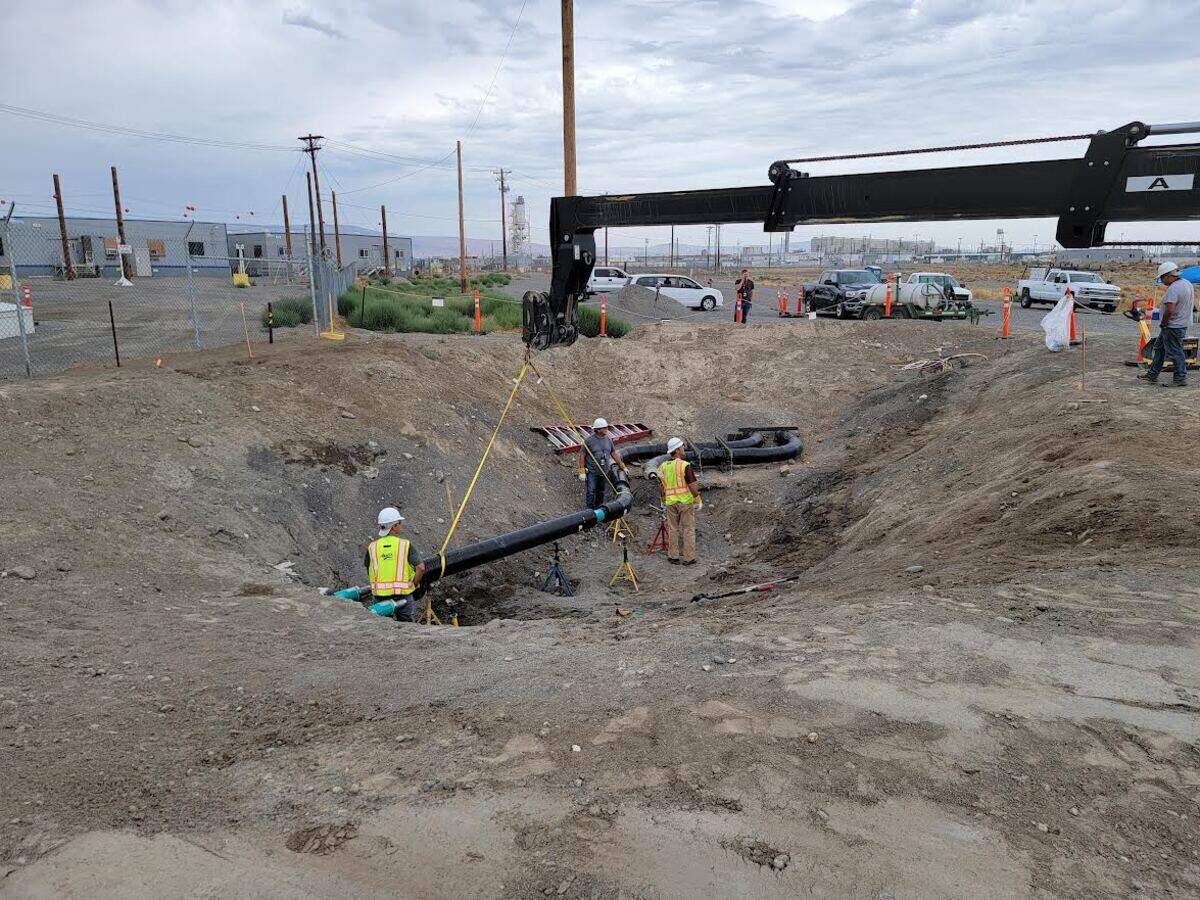
A newly constructed 3,500-foot-long pipeline now connects one of the site’s 27 double-shell tanks with the $17 billion plant that will be used to treat waste for disposal.
The Department of Energy has a federal-court ordered deadline to start treating some of the least radioactive of 56 million gallons of tank waste by the end of 2023.
The waste is left from the production of about two-thirds of the plutonium for the nation’s nuclear weapons program from World War II through the Cold War at the Eastern Washington site.
Technical issues have delayed completing the facility at the plant that was planned to separate tank waste into high level radioactive and low activity waste for separate treatment and disposal.
But DOE has come up with a system that will allow some of the low activity waste to be removed from tanks to allow vitrification, or glassification, of the waste at the vitrification plant.
The Tank-Side Cesium Removal System will pretreat some of the liquid portion of the waste in the tanks, removing radioactive cesium and the small amount of solids in the liquid that must be treated and disposed of as high level radioactive waste.
It is expected to start pretreating waste early next year.
Earlier this year workers installed the pretreatment system next to a double-shell tank that will be used as a holding tank for the waste to be treated first at the vitrification plant.
The new underground pipeline, with a reinforced pipe within a pipe to guard against leaking, will be used to move the waste to the vitrification plant in batches.
“For the first time, tank farms are connected to the vit plant, providing the avenue for transferring treated tank waste to the plant for vitrification,” said John Eschenberg, president of DOE’s tank farm contractor, Washington River Protection Solutions.
Getting the pipeline installed is “a huge piece” of getting waste treatment started, which is a Washington state priority at Hanford, said David Bowen, nuclear waste program manager for the Washington state Department of Ecology, a Hanford site regulator.
Construction on the massive vitrification plant started in 2002.
The pipeline is another example of progress made this year toward the start of tank waste treatment, said Brian Vance, DOE’s Hanford manager.
Vitrification plant progress
“It’s exciting to see the physical connection from the tank farms to the vit plant,” said Valerie McCain, vitrification plant project director for Bechtel National, the contractor designing, building and commissioning the plant.
Bechtel workers are in the final throes of testing equipment needed to treat low activity waste, McCain said.
The plant is making significant progress toward another key step, preparing to heat up the first of two 300-ton melters for low activity waste by the end of the year, she said.
Waste and glass-forming materials will be combined in the melters and then heated to 2,100 degrees Fahrenheit to produce a stable glass form for disposal.
Once a melter is started it will run continuously, both during startup and treatment of radioactive waste, until it is ready to be replaced with a new melter.
This story was originally published August 19, 2021 at 11:01 AM.