
‘Ongoing threat.’ Groups demand action on leaking Hanford nuclear waste tank
The newly discovered leak in another of Hanford’s aging tanks storing radioactive waste does not appear to threaten the health of Washington people in the near term, said Gov. Jay Inslee.
The Washington state Department of Ecology has the legal authority under the Tri-Party Agreement to take immediate action in response to the leaking tank only if it is “necessary to abate an imminent and substantial endangerment” to people or the environment.
Instead, the agency is starting talks with federal energy officials on what to do next.
If the two agencies can’t agree, then the state could take action, such as fines, and require specific steps to deal with the underground leak.
But groups from Seattle to the Tri-Cities that follow Hanford closely spoke out after the public was told Thursday about the leak.
Demands ranged from immediately emptying the tank to building better storage tanks for waste to a pilot project that could get more waste treated soon.
DOE notified the state Thursday that the tank was leaking, after investigating that possibility since March 2019.
Estimates of the amount of waste that have leaked vary, but the Department of Ecology puts it at a rate of nearly 1,300 gallons per year with an estimated 1,700 gallons leaked into the soil since March 2019.
“It’s a serious matter whenever a Hanford tank leaks its radioactive and dangerous chemical waste,” Laura Watson, the Department of Ecology director, said. “Based on the information we have right now, the leak poses no immediate increased risk to workers or the public, but it adds to the ongoing environmental threat at Hanford.”
The agency had been tracking federal government information about the possible leak for more than a year when energy officials began the formal assessment of the issue.
Governor’s response
“Obviously, this is a concern,” Inslee said, during a media briefing last week.
“This recognition of an ongoing incident I think highlights the need for additional resources at Hanford to prevent further tank leakage,” he said.
The governor believes Congress should find opportunities to pay for construction needed to prepare waste now held in underground tanks for treatment and to glassify the tank for permanent disposal, his staff said.
Transferring waste from leak-prone single shell tanks to hold them in newer double-shell tanks is only a stop-gap measure and permanent solutions are needed, he said.
Tank B-109 is the second of Hanford’s 149 single-shell tanks identified as having active leaks in recent years. In 2013 Tank T-111 was discovered to be leaking about a half gallon to a gallon a day of waste.
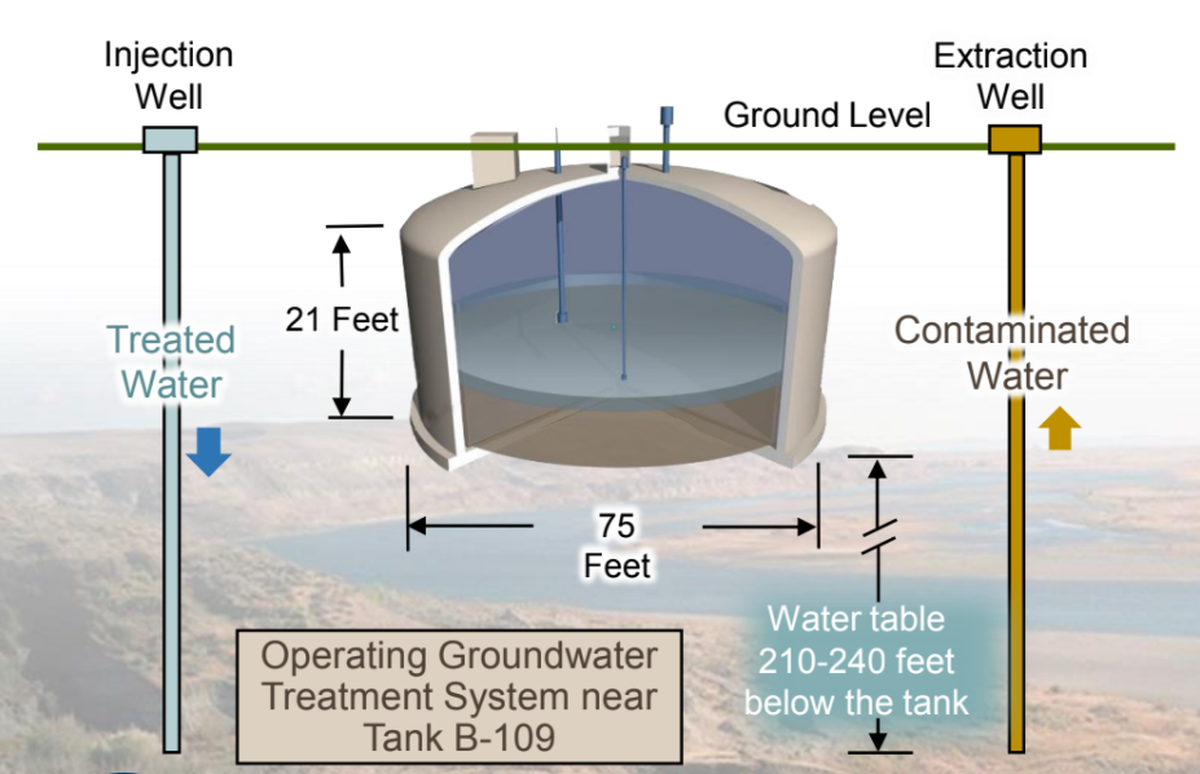
Tank B-109 has been in use since World War II and currently holds about 123,000 gallons of waste, including about 15,000 gallons of liquid waste.
Hanford is left with 56 million gallons of mixed radioactive and other hazardous chemical waste from the past production of two-thirds of the nation’s plutonium for its nuclear weapons program during World War II and the Cold War.
Work is underway to empty waste from leak-prone single-shell tanks into 27 newer double-shell tanks until it can be treated for permanent disposal.
As DOE works to start turning some of the tank waste into a stable glass form for disposal at the Hanford site’s $17 billion vitrification plant by the end of 2023, space is running short in the double-shell tanks.
New tanks vs cleanup
Hanford Challenge, based in Seattle, said Tank B-109 needs to be emptied into another tank, putting pressure on DOE to build more tanks.
It quoted a Government Accountability Office report saying that DOE said that insufficient space in double-shell tanks was the top risk to its work to empty and close its aging tanks.
“We should not wait any longer to build more tanks because it takes about 6 years to design and build a new tank,” Hanford Challenge, a Seattle-based advocate for Hanford workers, said in a statement. “How many more tanks will leak in that timeframe?”
This new leak of B-109 puts a spotlight on the need for Congress and DOE to act immediately to increase funding for cleanup and design and build new tanks, it said.
DOE has resisted building more double-shell tanks, saying Hanford’s cleanup budget is better spent on work to dispose of the waste.
The Tri-City Development council agrees.
“The permanent solution is to get the waste out of the tanks and treat it — that needs to be the priority,” said David Reeploeg, TRIDEC vice president for federal programs. “Constructing new tanks at this point would only kick the can down the road and divert limited funds away from actual cleanup.”
The single most important thing that can be done to reduce risk from tank waste is to get it out of the tanks and into a solid form, he said.
More can be done to get waste treated as quickly as possible, said Bob Thompson, Richland city councilman and the chairman of Hanford Communities, a coalition of local governments.
DOE and its regulators could move forward with the Test Bed Initiative, he said. The initiative is a pilot project to grout some of the least radioactive Hanford tank waste and send it to a Texas repository with space designated for DOE waste disposal.
Heart of America Northwest, a Seattle-based Hanford watchdog, agreed that the leaking tank shows the need for DOE to proceed with the Test Bed Initiative.
Groundwater risk
“There’s no such thing as a small leak from a high-level nuclear waste tank,” said Gerry Pollet, Heart of America Northwest director. “Contamination will reach groundwater which flows to the Columbia River.”
DOE said that waste leaking into the soil from Tank B-109 would take 25 years to reach groundwater. It is in an area already contaminated from the disposal, spills and previous leaks of waste and contaminated liquids of about 52 million gallons.
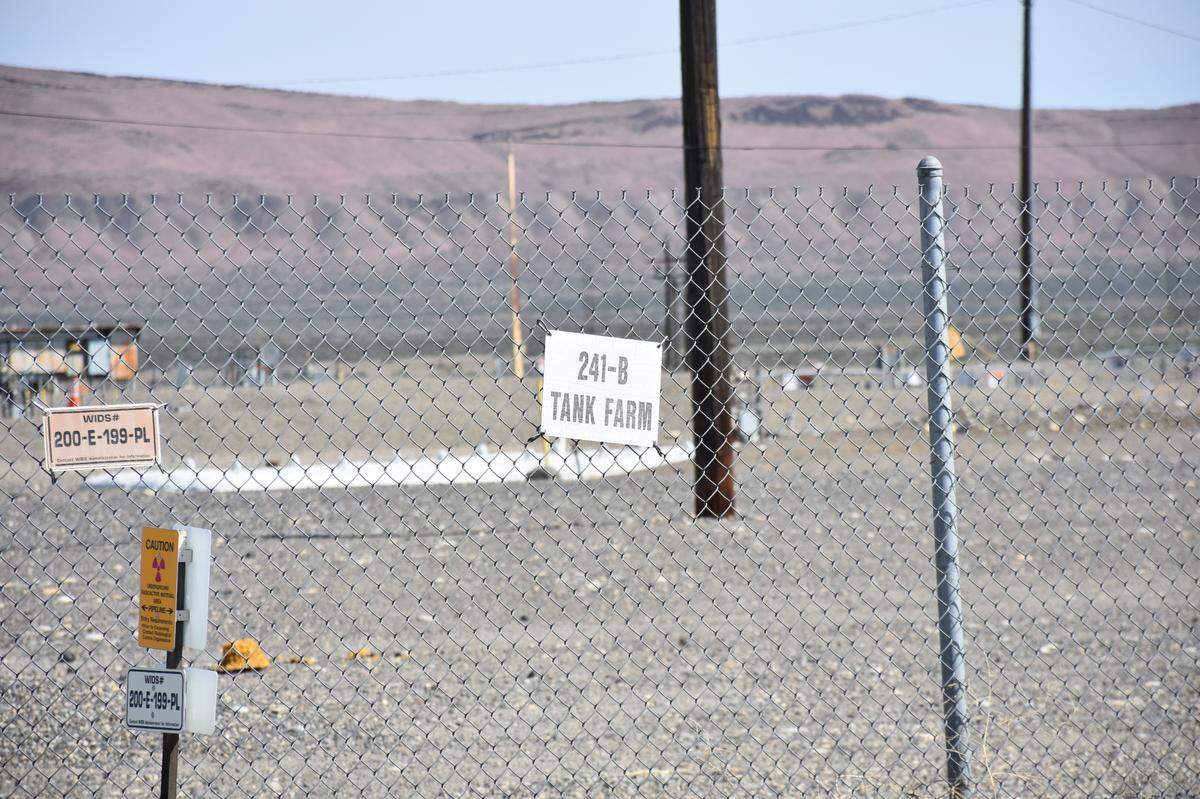
About 57 of Hanford’s single-shell tanks are suspected of leaking or spilling radioactive waste into the ground in the center of the site in the past and disposing of contaminated liquids into the soil was an excepted past practice.
By about 2005, DOE had completed a campaign to pump as much liquid waste as possible from the site’s 149 single-shell tanks to make them less likely to leak.
However, Tank B-109 still has about 2,000 gallons of liquid waste sitting on top of the sludge and saltcake it holds and an estimated 13,000 gallons of liquids held up in the tank’s solid waste, similar to the way a sponge holds water.
DOE is pumping contaminated groundwater up in central Hanford and removing two of the radioactive constituents, technetium and iodine, that likely would travel through the soil fastest from the leaking tank.
But to claim that solves the problem is “false and misleading,” Pollet said.
Different radioactive and chemical contaminants in the waste will travel through the 210 to 240 feet of soil beneath the tank to reach groundwater over thousands of years.
The Washington State Department of Ecology needs to require DOE to empty the tank immediately, he said.
Tank B-109 is about two miles from the nearest double-shell tank and building the piping and infrastructure to move it those miles would cost hundreds of millions of dollars, according to DOE.
This story was originally published May 1, 2021 at 10:34 AM.