
Take-cover alert lifted at Hanford nuclear reservation in area just north of Richland
A take-cover alert was issued at about 4:20 p.m. Thursday at the Hanford nuclear reservation in the 300 Area just north of Richland along the Columbia River.
A Department of Energy official said the alert was issued as a precaution after a one-gallon container of an unidentified substance was found.
About 5 p.m., the substance in the container was identified as a 2% iodine solution, possibly used for cleaning masks, and shortly after that workers were allowed to leave the buildings were they had taken cover.
During a take-cover alert workers must stay indoors with windows and doors closed and ventilation systems shut off. They are barred from eating or drinking.
A barricade has been placed around the area where the container was found near a mobile office building and the 324 Building.
The alert was issued as hundreds of workers were ending their day shift and leaving the center of the site.
The Wye Barricade, the secure entrance to the site nearest to Richland, was closed to prevent traffic from driving by the 300 Area.
Workers leaving the center of the site were told to turn onto Route 10 South to reach Highway 240 and then go south to Richland.
The 300 Area at the southeast end of Hanford was a major industrial area for the nuclear reservation when the site was producing plutonium for the nation’s nuclear weapons program.
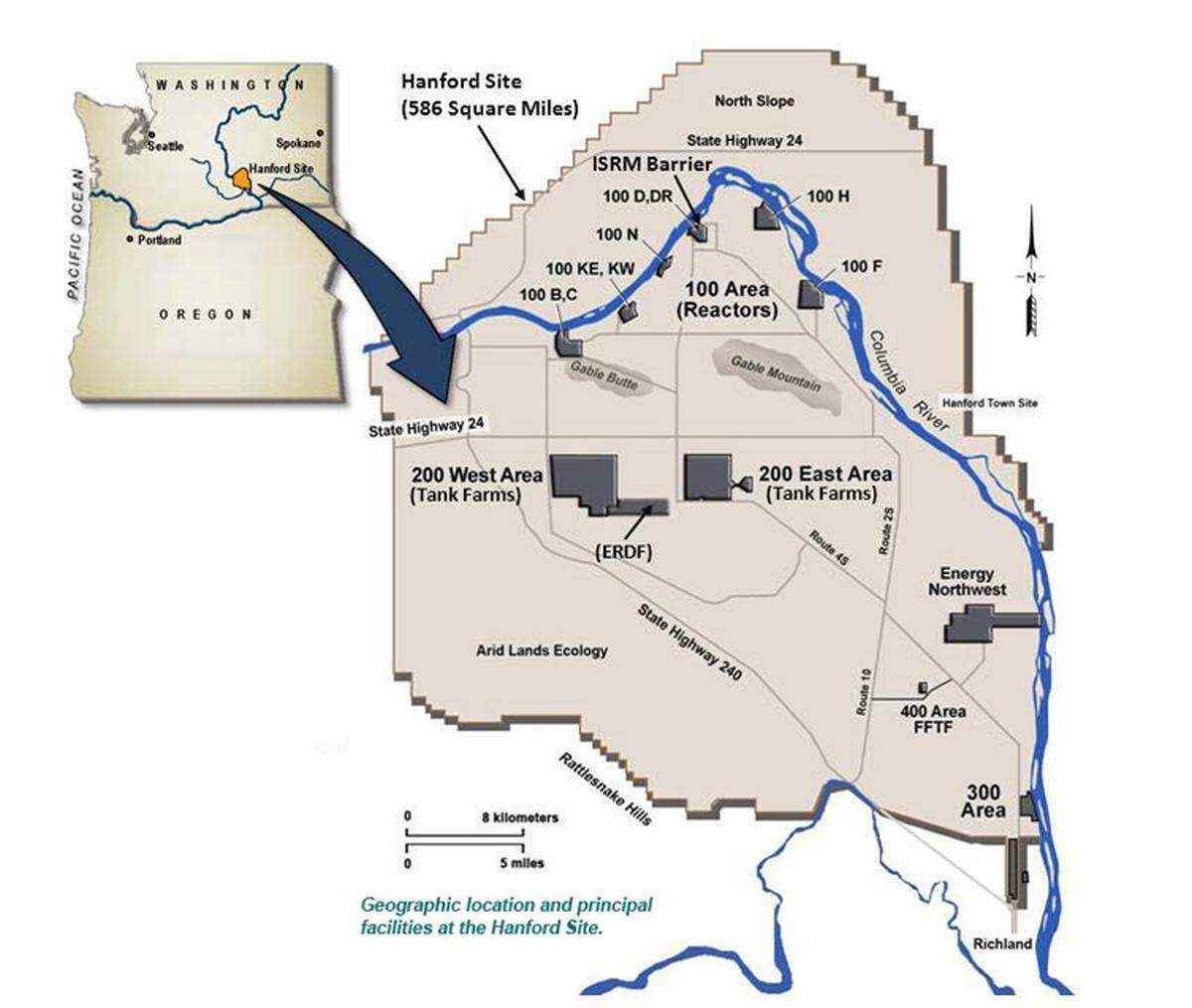
The 300 Area was used during World War II and the Cold War to fabricate uranium fuel for Hanford’s nine production reactors and for research, including at six research reactors in the 300 Area.
Environmental cleanup of the area was largely complete in 2015 after 16 years of work. Some 209 structures, ranging from sheds to buildings larger than a football field, and the six research reactors were demolished or otherwise removed.
However, the 324 Building remains standing after a spill of high level radioactive waste was discovered beneath the building just before demolition was started.
Work is continuing to prepare to dig up the contaminated soil at the spill site. The building remains standing to provide a protective shield from the spill’s radiation and to prevent precipitation from reaching the spill and helping it spread to the nearby Columbia River.
Pacific Northwest National Laboratory continues to use four building in the 300 Area, including two large research facilities with research laboratories.
The best known is the 67-year-old Radiochemical Processing Laboratory in the 300 Area.
It is the only U.S. lab certified by the International Monitoring System of the Comprehensive Nuclear Test-Ban Treaty Organization and carries out research to ensure countries around the globe are in compliance with nonproliferation treaties.
This story was originally published August 20, 2020 at 5:01 PM.