
Hanford strategy for worst nuclear waste criticized. Plant estimates skyrocket to $41 billion
The Department of Energy’s strategy for pretreating high-level waste at Hanford is “unclear” 20 years after construction of a massive glassification plant began, while costs continue to soar, says a new federal report.
The Government Accountability Office released a report to Congress this week focusing on the plant’s Pretreatment Facility, where construction stopped seven years ago because of technical issues.
The issues involved safety concerns to prevent a possible explosion or radioactive waste leak.
U.S. taxpayers have spent $11 billion on the Hanford glassification plant, but the Pretreatment Facility is unlikely to be finished on schedule or as designed, the report said.
Under one scenario being studied, some of the worst waste at Hanford could be shipped across the nation to South Carolina to be stabilized for disposal.
Since construction stopped in late 2012 on the pretreatment plant, $752 million has been spent, with construction not ready to restart anytime soon, the GAO report indicated.
DOE also has spent $428 million developing alternatives for some of the work expected to be done at the pretreatment plant.
There is no cost estimate for completing the Pretreatment Facility, the largest facility at the plant, the GAO report said.
Completing the entire vitrification plant could cost $19 billion to $30 billion more than the $11 billion already spent, the GAO said.
That would put the total cost at $30 billion to $41 billion.
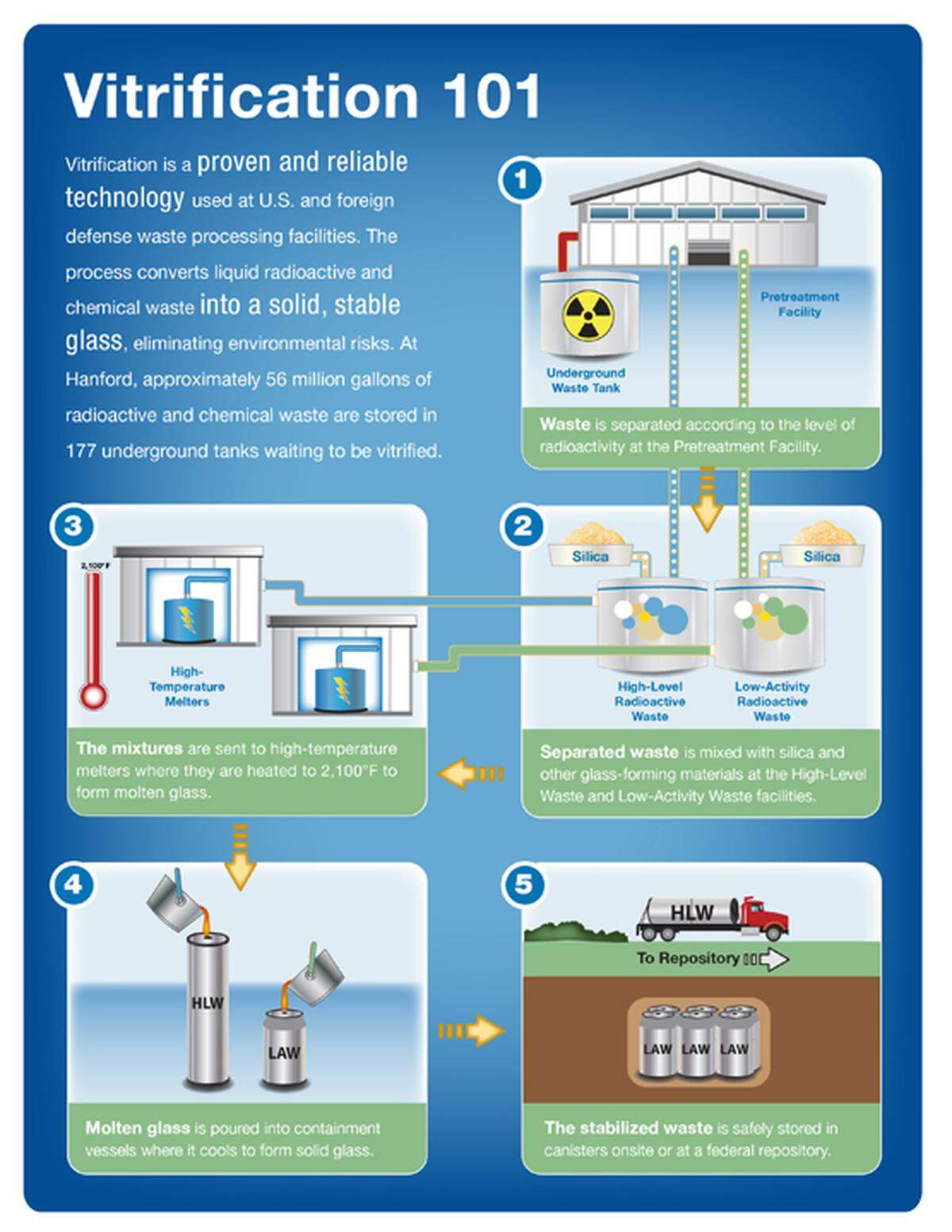
The plant, named the Hanford Waste Treatment Plant, is being built to to glassify much of the 56 million gallons of radioactive waste in underground tanks, turning it into a stable form for disposal.
The waste is left from the past production of plutonium at Hanford in Eastern Washington for the nation’s nuclear weapons program from World War II through the Cold War.
2023 waste treatment focus
When Bechtel National was awarded a contract to build and start the plant in 2000, plans called for waste from the tanks to be sent first to the largest facility at the plant, the Pretreatment Facility
It stands about 12 stories high and covers an area larger than a football field.
There waste retrieved from underground tanks was to be separated into low activity radioactive waste and high level radioactive waste for glassification at separate facilities at the vitrification plant.
But after technical issues were raised in 2012 related to how well the pretreatment plant could handle the high level portion of the tank waste, DOE proposed a new plan.
It would first start vitrifying the low activity radioactive waste by developing other methods to separate that waste from tank waste.
A federal court judge agreed to the plan in 2016 but set a deadline for DOE to start vitrifying that waste by the end of 2023. The plant must be fully operational in 2036, the judge ordered.
DOE has since been focused on meeting the 2023 court-enforced deadline, including spending about $428 million developing those alternative pretreatment approaches, rather than on facilities that will handle high level waste, the GAO report said.
When construction stopped on the pretreatment plant it was about 40 percent complete.
Waste issues resolved?
DOE has spent about $323 million to resolve technical issues at the facility since late 2012, with the rest of the $752 million spent on the plant during those years paying for overhead, project management, facility maintenance and DOE oversight.
The $752 million also included $68 million to modify Bechtel’s contract and provide incentive pay for work that included resolving technical issues.
DOE and Bechtel said in mid 2019 that they believed technical issues had been resolved. But the solutions to the issues have yet to be designed and engineered.
The Defense Nuclear Facilities Safety Board does not consider the technical issues resolved because there are no engineering and design plans completed, let alone started. It already has identified some deficiencies that need to be addressed, the GAO report said.
Technical issues raised in 2012 included preventing hydrogen from building up in piping and vessels in the facility, which could cause an explosion.
There also were concerns about preventing corrosive materials from eroding equipment, potentially cause a leak of high level radioactive waste.
Solutions were complicated by the challenge of areas in the Pretreatment Facility that will be so radioactive once the plant begins separating out high level radioactive waste that humans can no longer enter the building.
Pretreatment alternatives
“The next steps could involve significant work and potential rework to the facility,” including in areas of the facility already completed, the GAO report said.
Design work, if funding is available, will not be completed until at least 2022, DOE told the GAO.
Part of the delay is related to a DOE study of alternatives for separating a high level waste stream out of tank waste — just as it is working on for low activity waste — possibly bypassing the pretreatment plant.
The GAO report said it is looking at 15 alternatives, including completing the Pretreatment Facility as planned or repurposing it.
Other alternatives include building alternate high level waste pretreatment facilities or shipping the waste to DOE’s Savannah River, S.C., site for vitrification.
Savannah River already is vitrifying its tank waste, which is less complex than the waste stored in Hanford tanks.
Hanford’s waste comes from multiple chemical processing methods used to separate plutonium from irradiated uranium fuel.
Local DOE officials said they will not develop a cost for completing the Pretreatment Facility until there is a decision about the future of the facility and any updated design changes for it, according to the GAO report.
But comparing options for pretreatment of high level waste cannot be done effectively without a cost estimate of completing the pretreatment plant, the GAO report said.
The report backed up its conclusions with a study by the Army Corps of Engineers and a DOE Hanford lifecycle cost and schedule report to say the Pretreatment Facility “is unlikely to be completed as designed and scheduled.”
Ecology’s pretreatment concerns
The issue is further complicated by concerns of the Washington state Department of Ecology, a Hanford regulator.
DOE and Ecology have agreed to negotiate a path forward for treating and disposing of Hanford’s tank waste, and may rely on a mediator to complete negotiations by the end of July, the GAO report said.
Ecology has said that DOE has not adequately consulted with the state while making important decisions about alternate pretreatment plans and the future of the Pretreatment Facility, the GAO report said.
Ecology is concerned about DOE diverting resources from finishing the pretreatment plant.
State officials said in a 2019 presentation that they were frustrated with “too many ideas that did not work out, resulting in long delays.”
The state agency also has fined DOE $1 million in an ongoing dispute about access to data at the Hanford nuclear reservation.
DOE said that engaging with Ecology officials is a priority and that they have done better since 2018.
This story was originally published May 13, 2020 at 11:22 AM.