
Tri-Cities firm gets $4 million contract to stabilize plutonium trenches, tank at risk of collapse
A small Pasco company has been given a $3.9 million contract to stabilize three underground structures at Hanford that are at risk of collapsing and spreading plutonium.
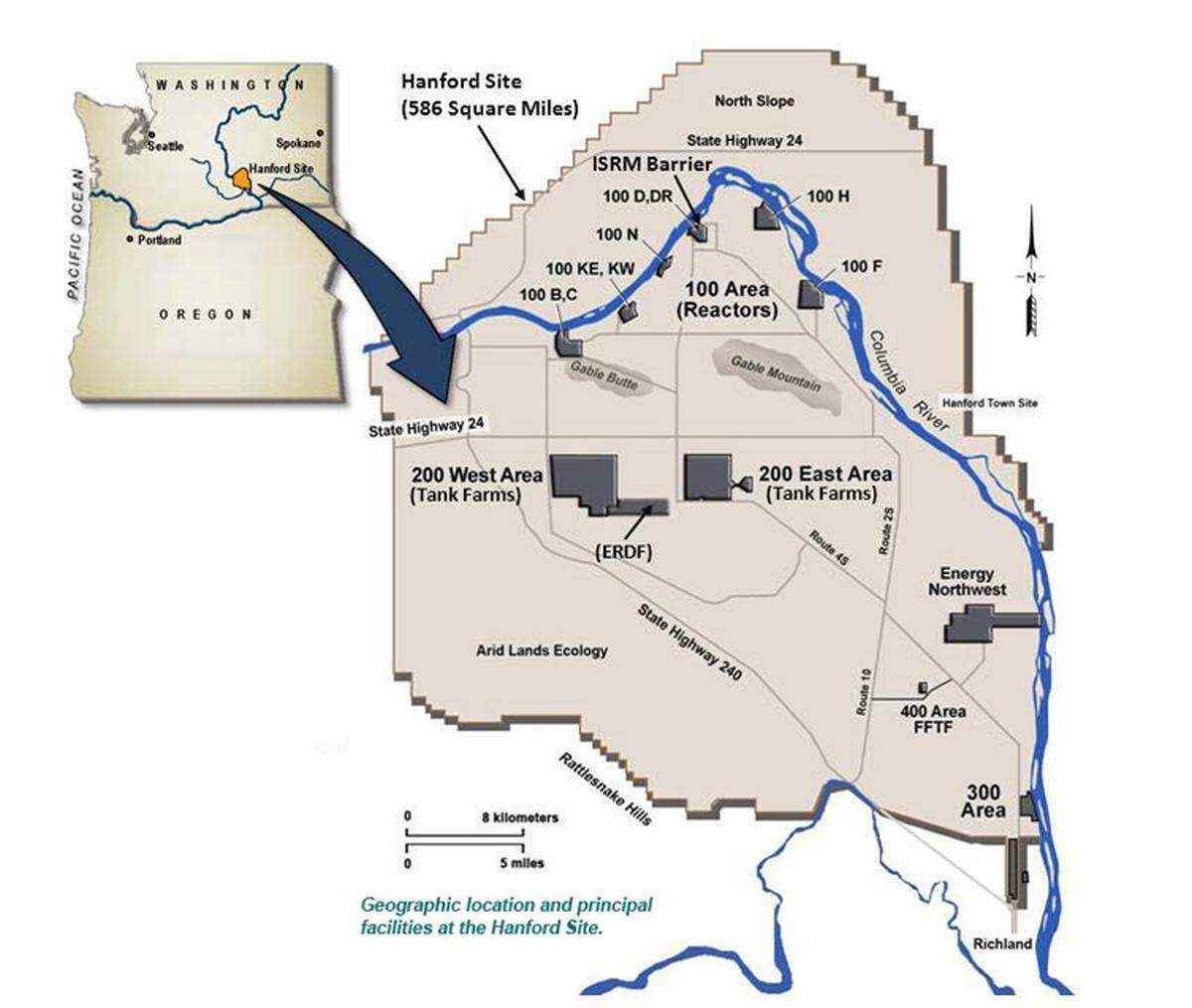
White Shield will do the engineering work and then fill two underground trenches — called cribs — and a settling tank in the center of the nuclear reservation with concrete-like grout.
The structures were all used at the site’s Plutonium Finishing Plant, where plutonium from fuel irradiated in Hanford reactors arrived in a liquid solution to be made into buttons the size of hockey pucks for shipment to nuclear weapons plants.
Liquid waste with radioactive and other chemical contaminants from the plant was poured into the cribs, with the liquids entering the soil beneath. Contaminated liquids also were sent to the settling tank to allow solid waste to settled out.
The largest of the three structures, the 216-Z-9 Crib, is contaminated with an estimated 105 pounds of plutonium.
It is a 20-foot-deep hole sloping to a 6-by-30 foot open bottom, where about 1 million gallons of waste were poured. It has a concrete roof, supported with six concrete columns.
After a partial collapse of a waste storage tunnel at Hanford’s PUREX plant in May 2017, the Department of Energy and its contractor CH2M Hill Plateau Remediation Co. analyzed other old and contaminated structures to determine if they were at risk of collapsing.
They concluded that the three below-ground structures at the Plutonium Finishing Plant posed the highest risk, requiring stabilization to prevent a collapse and a potential spread of radioactive contamination.
Onsite work at Hanford that is not essential to protect the environment, the workforce and the public has been stopped for a fourth week because of the new coronavirus pandemic.
Initial work on the subcontract that CH2M awarded to White Shield will be done by email and conference calls.
White Shield also will begin working on designs for the grout mix and the system that will be used to move grout from trucks into the underground structures.
Grouting meeting set
Once normal operations resume at Hanford, trucks will deliver the grout to be pumped into the underground structures through pipes, or risers, sticking out of the cribs and tank.
Workers will lower lighting and cameras through the riser to monitor the grout flow into the structures.
Grout has been used before to stabilize underground structures at Hanford, including the PUREX tunnel that partially collapsed and a second waste storage tunnel at the PUREX plant.
Grouting the cribs and tanks should not prevent more cleanup of the structures as future Hanford budgets allow, according to Hanford officials.
.JPG "SHi_j0083(16).JPG")
The smaller cribs will be filed with 75 cubic yards of grout and the larger crib will be filled with 4,000 cubic yards of grout.
The settling tank, which has 100 cubic yards of radioactive sludge, will have 125 cubic yards of grout added. The sludge is estimated to contain 65 to 150 pounds of plutonium.
A public online meeting is planned at 5:30 p.m. May 7 to provide information and answer questions on the grouting project. The previously announced meeting was moved online because of the COVID-19 pandemic.
Details to participate are posted at hanford.gov under the event calendar for May 7.
Public comments are being accepted on the plan through May 22, even as work proceeds toward filling the structures with grout because the work is considered critical to safety.
Comments may be emailed to AgingStructures@rl.gov or mailed to U.S. Department of Energy; Attn: Jennifer Colborn; P.O. Box 450, H6-60; Richland, WA 99352.
This story was originally published April 14, 2020 at 1:55 PM.