
New galactic discovery confirms Richland scientists’ history-making find
Gravitational waves from an apparent collision of two neutron stars may have been spotted for the second time in scientific history.
When two neutron stars spiral together, they undergo a violent merger that sends gravitational waves through the fabric of space and time.
The first detection of gravitational waves from the fiery collision of two neutron stars was made on Aug. 17, 2017, by the LIGO Hanford observatory near Richland and its twin observatory in Louisiana..
But the Hanford Laser Interferometer Gravitational-wave Observatory missed out on the more recent suspected sighting, which was on April 25. It was temporarily off line.
The recent detection, made only by the Livingston, La., LIGO, is important confirmation of the event two years earlier, said Jo van den Brand, spokesperson for the Virgo gravitational-wave observatory in Italy.
The likely neutron star collision in April, at a distance of 500 million light years, was too faint to be detected at Virgo.
It also did not result in any light being detected.
Black hole collisions
Two years ago not only gravitational waves from the neutron stars merger were detected, but more conventional telescopes also spotted various kinds of light, or electromagnetic radiation, including X-ray, ultraviolet, infrared and radio waves.
Black hole collisions, as first detected at LIGO Hanford in 2015 and since detected dozens of times, emit no light. But neutron stars merge into an ultradense object, emitting a fireball of gamma rays.
Neutron stars are the remnants of dying stars that undergo catastrophic explosions as they collapse at the end of their lives.
The announcement of the detection of gravitational waves in April was made on Monday at the meeting of the American Astronomical Society in Honolulu, Hawaii, after a study was submitted to “The Astrophysical Journal Letters.”
Scientists suspect that the gravitational waves detected in April were from neutron stars colliding. But questions have been raised because data shows the merged stars have about 3.4 times the mass of the Earth’s sun, which is greater than expected.
The known binary neutron star systems in our galaxy have combined masses up to only 2.9 times that of the sun.
The other possibility is that a neutron star and black hole collided, since black holes are heavier than neutron stars. But it would have to have been an exceptionally small black hole, according to scientists.
LIGO Hanford observatory
The LIGO Hanford observatory, funded by the U.S. National Science Foundation, has two vacuum tubes that extend for 2.5 miles across the Hanford shrub steppe at right angles. At the end of each, a mirror is suspended on fine wires.
A high-power laser beam is split to go down each tube, bounding off the mirrors at each end. If the beam is undisturbed, it will bounce back and recombine perfectly.
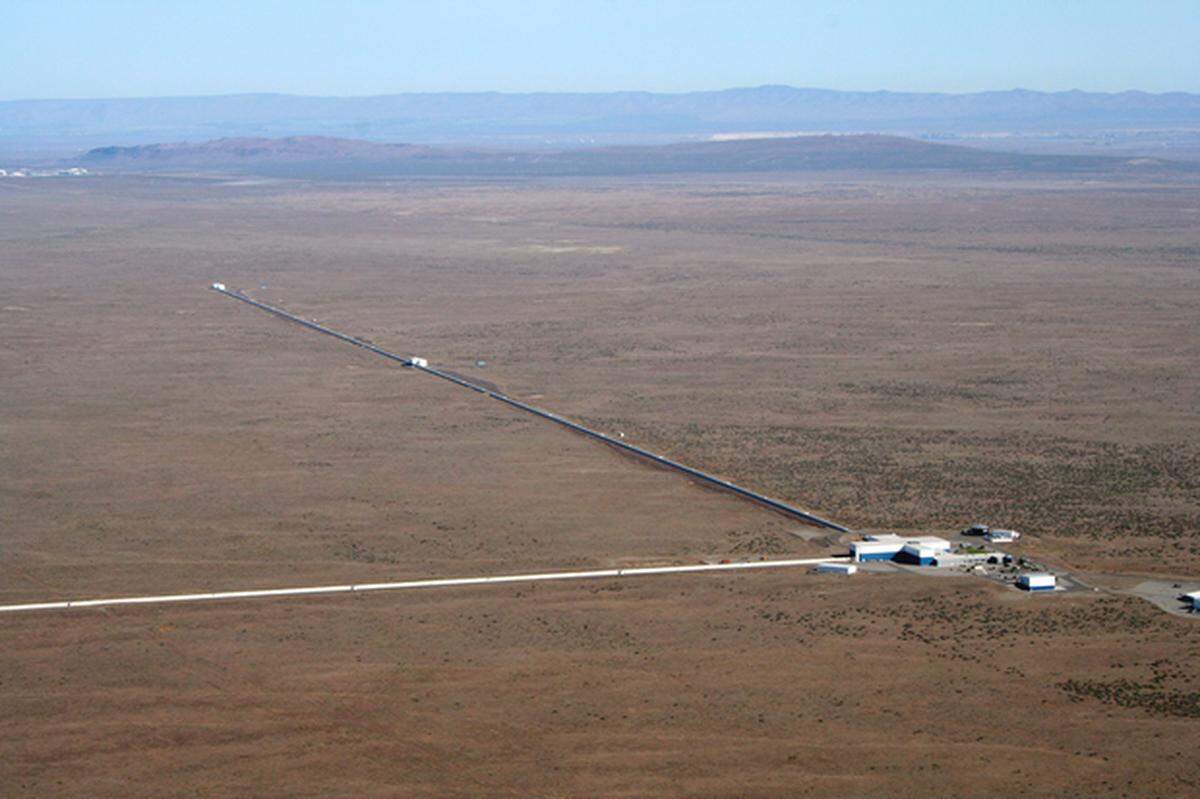
But a gravity wave pulsing through the Earth stretches objects lengthwise and causes them to compress sideways. A circle would become an ellipse.
At LIGO Hanford, one arm would become longer and the other shorter. The laser beams would no longer perfectly combine.
In most of the detections to date, data from the Hanford and Louisiana LIGOs can be compared to help confirm gravitational waves.
The April detection was the first made by the LIGO Livingston detector alone.
Although Virgo did not detect the gravitational waves it “made a valuable contribution,” said Anamaria Effler, a California Institute of Technology scientist at LIGO Livingston. “We used information about its non-detection to tell us roughly where the signal must have originated from.”
This story was originally published January 7, 2020 at 5:00 AM.