WSU program puts next gen teachers in more Tri-Cities classrooms
AI-generated summary reviewed by our newsroom.
- WSU Tri‑Cities places students a few hours weekly in local classrooms.
- Teaching labs let candidates observe practice, boosting readiness for student teaching.
- Program yields local teachers (85% stay) and supports mentor teacher networks.
An innovative program is expanding to help Tri-Cities teaching students spend more time in classrooms. Park Middle School was designated Thursday a “WSU Tri-Cities Teaching Laboratory” thanks to a new partnership with the branch campus to provide future teachers with crucial emersion in the classroom.
The early practicum program allows college students to spend a few hours each week throughout the academic year in real classrooms to observe teaching dynamics, gain instructional skills, and to build confidence going into their new career.
Alex Diaz, a junior studying elementary education, said the program has helped him differentiate expectations versus reality as he gears up to student teach. It’s also helped build that invaluable “teacher lens.”
“It really comes down to the students, because you just never know what sort of students you’re going to run into in the classroom. They’re all their own unique personalities, and no one classroom is the same,” he said.
Diaz, who has experience as an elementary paraeducator, is studying to become a middle school mathematics teacher. Alexia Jimenez, also a junior in the same program, is set on being a third grade teacher.
The passion for teaching at Park Middle Schools is palpable, Jimenez said.
“You walk through those doors and you’re welcomed. You can see that engagement with the students. Everybody cares and they want to be there, and you just see it and feel it,” she said, noting that she was inspired by her Pasco teachers to step into the field.
WSU looks at expanding teaching labs
John Mancinelli, academic director for the College of Education, Sport and Human Sciences at WSU Tri-Cities, said the program has been so locally successful that the university is looking at expanding it to other parts of its system.
He worked 35 years in public education and was the former principal who opened Ellen Ochoa Middle School back in 2002.
While teaching standards have changed over the years, Mancinelli said the idea isn’t new: The best way for many students to learn how to teach is by observing other teachers.
Their research-backed teaching labs create “purposeful” learning for future teachers by pulling them out of their textbooks. It allows them to see concepts in action, and to learn skills deeper and more thoroughly.
Even teachers being observed have taken away ideas and concepts from the lab, creating a culture of professional development.
“Eighty-five percent of our students come from the region and 85% stay,” Mancinelli said. “That means that we are filling the coffers with future teachers and have been for the past decade in our region. We don’t take that lightly. We work very hard at making sure our communities have the best teachers they possibly can.”
Success in building the next generation of the Tri-Cities’ AI workers, scientists, and energy workers starts with quality instruction, he said.
College students are also observing in Richland and Pasco schools, too. Tapteal Elementary in West Richland, Maya Angelou Elementary in Pasco, and Rosalind Franklin STEM Elementary in Pasco are also laboratory sites.
Fostering teachers in a competitive market
WSU Tri-Cities’ laboratory school partnership works in tandem with other broader efforts in the state’s universities and public schools to cultivate the next generation of teachers.
Grant-funded programs like Pasco’s Bilingual Educators Initiative Teaching Academy have received state recognition for their home-grown method of getting students interested in the profession.
It’s also part of a trend to get university students exposed to the real-classroom experience earlier.
With the rapid population growth in the Tri-Cities in recent decades came plenty of teaching jobs. This program also helps young graduates in a competitive job market.
The region has one of the highest teacher pay to cost of living ratios in the country, Diaz said.
“There’s a lot of teachers that are interested in working here. There’s a lot of competition for the different jobs,” Diaz said.
Washington’s 2025 average teacher salary, at $91,720, is the fourth-highest in the nation, according to the National Education Association. And in the Tri-Cities, the average teacher salary topped $85,300 in the 2023-24 school year, though young teachers earn much less, according to a previous Tri-City Herald report.
In an era of many online education programs where students “go online and check the box,” WSU is trying hard to stand out.
Their students clock about 1,000 volunteer hours in the classroom by the time they graduate, Mancinelli said.
Student teaching, the rigorous and mandatory capstone for aspiring educators, takes up about 600 hours of those hours. The laboratory setting provides just 120.
“We’re really trying to differentiate ourselves by making better-prepared candidates with the real world,” he said.
Diaz and Jimenez were part of the second cohort of teaching laboratory students, their group totalling about 40.
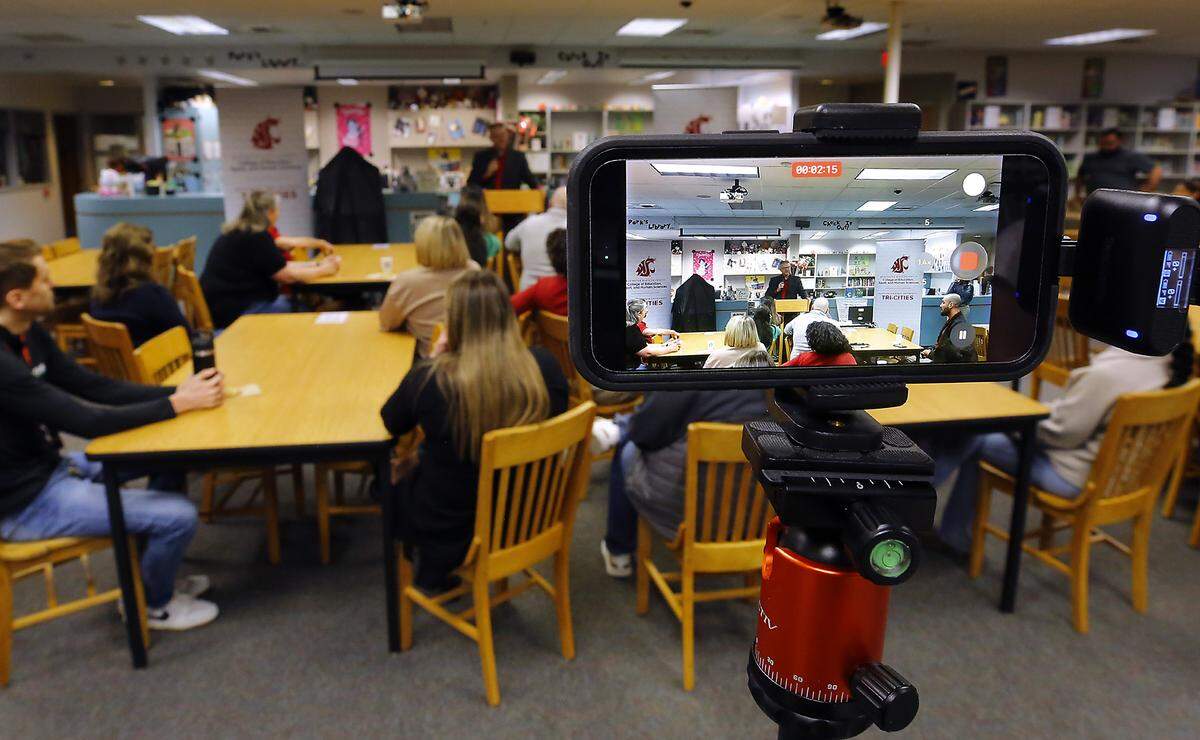
At a ceremony unveiling Park Middle School as a teaching laboratory, Alyssa St. Hilaire, Kennewick School District’s assistant superintendent of teaching and learning, thanked a room of teachers for their guidance to these students.
Hilaire said those “mentor teachers” mean the world to those just starting out, and those relationships can last years and careers.
“I just want to say thank you to all of you for becoming that person for the next generation of educators,” she said. “This is the real learning happening — it’s not the theory, it’s the practice. And you are providing that authentic, organic, what-it’s-like every day.”