From water filtration to autism research, students wow judges at Mid-Columbia Science Fair
Abigail Treml and Olivia Kreitzberg shook off the nerves as a rotating cast of judges approached them and their tri-fold display early Thursday morning.
The Christ the King Catholic School sixth graders each took turns explaining their project — titled “Glass Beads for the World’s Needs” — at the 70th Mid-Columbia Regional Science and Engineering Fair, the text of their 500-word script labeled pink for Abigail and green for Olivia.
The young scientists’ project centered around testing the efficacy of using glass beads for water filtration, and comparing those results to gravel. Beat by beat, they walked judges through their hypothesis, materials, procedures, abstract and results.
“Thank you. Do you have any questions?” the two said in a rehearsed unison.
“Yeah, I’ve got a few,” one judge said, having listened intently from his chair.
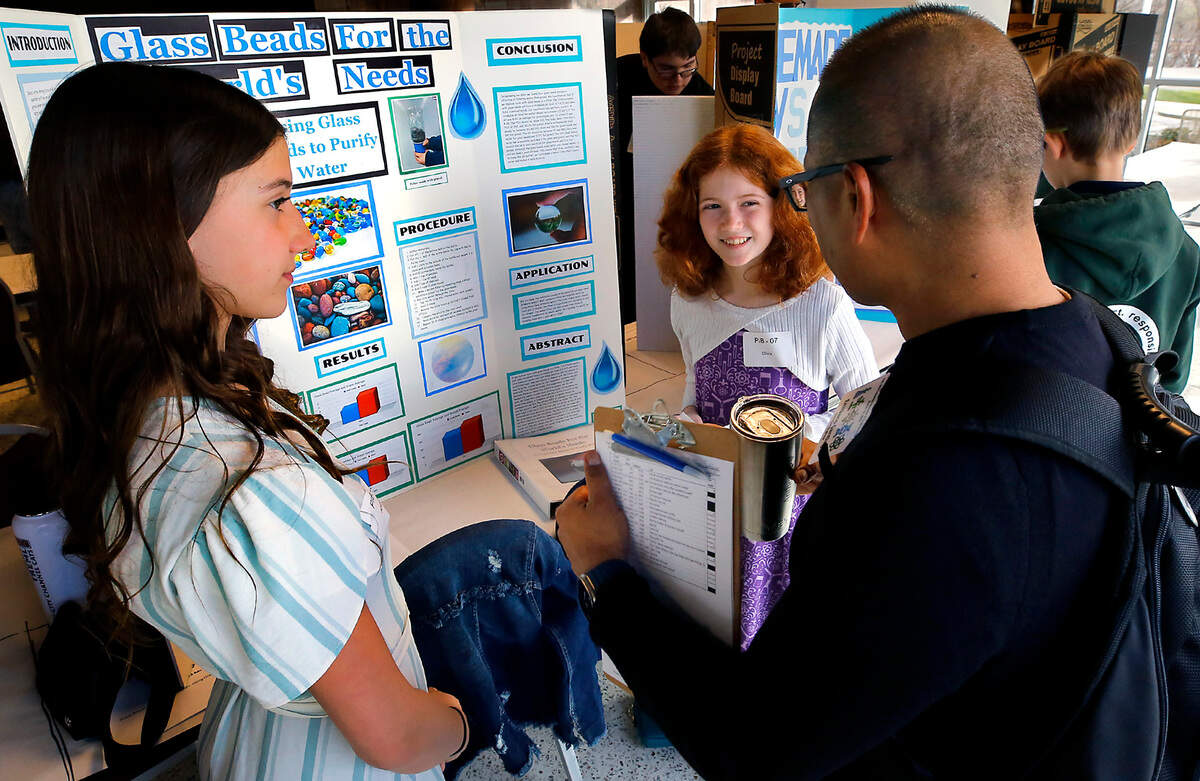
This scenario played out countlessly at this week’s Mid-Columbia Science Fair. Hundreds of middle and high school students from 14 Central Washington counties convened in the Tri-Cities to compete for thousands of dollars in scholarships and prizes, and a select few spots to attend the Regneron International Science and Engineering Fair in Columbus, Ohio later this year.
Michelle Gotthold, board president of the Mid-Columbia Science Fair Association, said this year’s fair featured 162 individual projects, as well as eight “Project in a Box” presentations each made by a middle school classroom. About 120 judges cycled in and out, volunteering their time to students and their teachers.
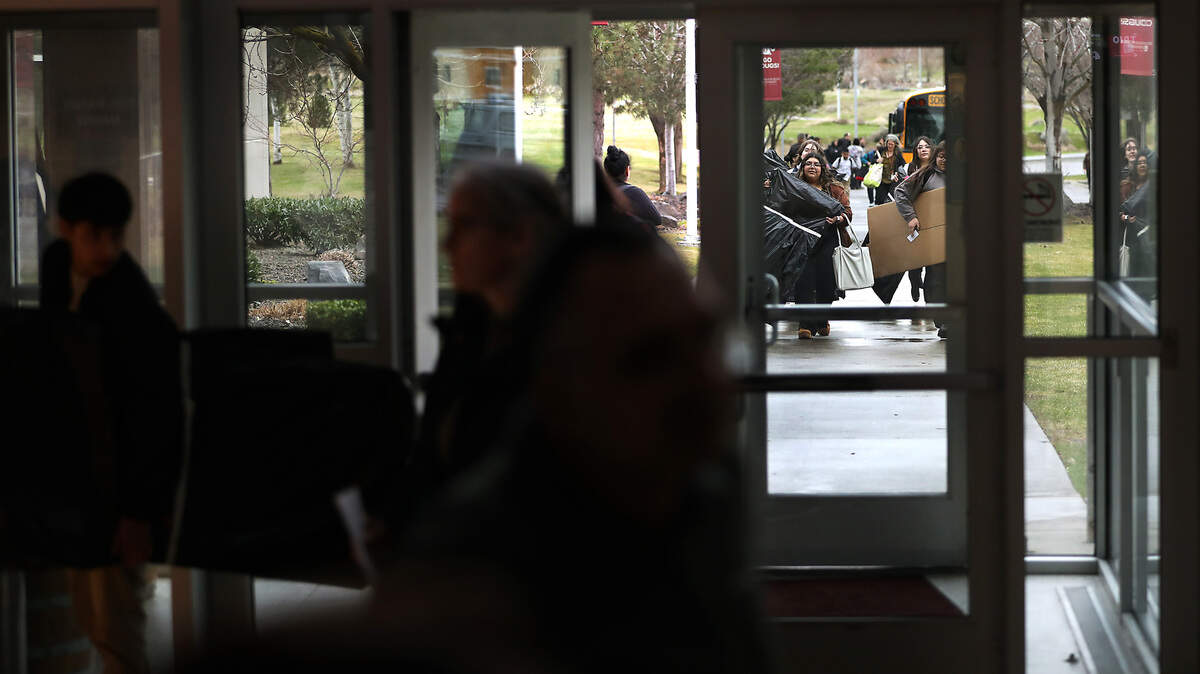
For the first time in decades, the Mid-Columbia Science Fair was not hosted at the Columbia Center Mall. The program made Washington State University’s Tri-City campus home for this year’s competition.
But the joy of scientific research, and the culture that’s built around that, is still evergreen, Gotthold says.
“It’s seeing the excitement of kids gaining that pride. They got to explore some question that they were excited about, and seeing that is pretty unique,” said the former high school physics teacher. “They get to meet other students from area schools who are also interested in science. There’s the prizes, but I think it’s about much more than that. It’s about that chance to talk with local STEM professionals.”
Gotthold got involved first as a parent, then as a judge and later a coordinator. She says participation has dropped a bit since before COVID, when they would see 200-300 projects. But they’re focused on re-engaging middle school students.
Topics and study subjects run the gamut, from dental and agriculture-irrigation, to robotics and machine learning.
“It’s kind of amazing it’s been 70 years. I think the fair is now older than all of the people involved in it,” said David Gotthold, the fair’s judging chair and husband to Michelle.
Judges will recognize winners and participants at a 1 p.m. award ceremony Saturday at Chief Jo Middle School.
‘I want to be like you’
It’s the first science fair for both Abigail and Olivia, who say they rushed last minute to finish their presentation and speech.
But after an hour of presenting, the nerves were gone and they exuded the confidence of saleswomen.
“I do get stage fright,” said Olivia, a bright-eyed redhead.
Abigail interjected: “But after practicing it, she got more comfortable in the new habitat.”
“Yes. I have stage fright that lasts until I’m actually up there,” she said.
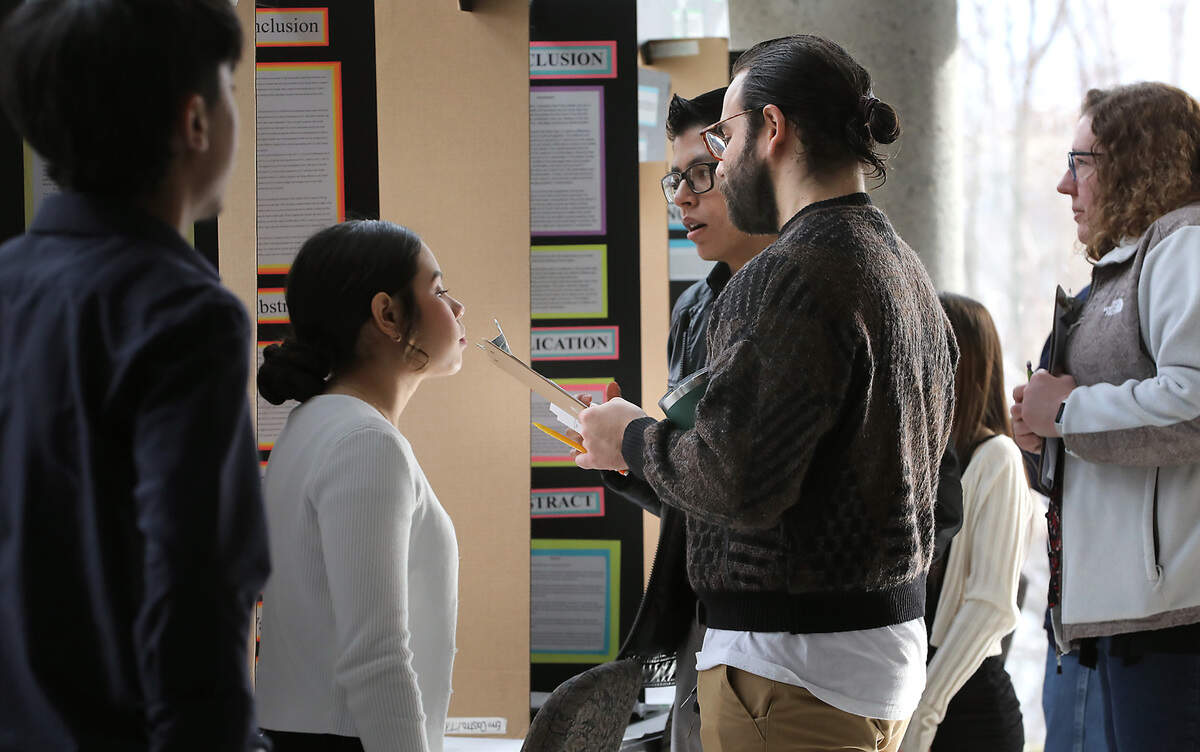
The pair said it took a few weeks to a month to put together the research, experiment and reports for their glass bead project.
Olivia says her favorite part of the fair was presenting to “actual scientists.” Her grandfather was a chemist, she notes.
“Really, just coming here and being able to talk to different people. See what everyone else had for their project,” said Abigail.
So far, Abigail, Olivia and their peers have impressed the judges.
“One of the biggest things I see every year when I come in is the complexity of the research they’re doing. It’s really high level,” said Emiliano Santiago, an electrical engineer at Pacific Northwest National Laboratory (PNNL). “I think every year, they increase it by a notch, by a level. It’s pretty amazing.”
Students’ presentation skills and professionalism have also grown over the six years he’s judged.
“Sometimes when I hear some of these kids, I’m like, ‘Oh my gosh. I want to be like you,’” he said.
Bitter-sweet end for seniors
For high schoolers, the Mid-Columbia Science Fair has been a constant in their lives. And its seniors say this year’s event has been quite bitterHSPD-12 PIVsweet.
Advaitha Motkuri, a Richland High School senior — and Eagle Scout wunderkind — says it’s something she looks forward to every year.
“The moment one ends, I just start for the next year. So it’s a little weird. After this year, it’s just off to college,” said Motkuri, who’s anxiously awaiting admission letters from universities.
Motkuri has presented at Mid-Columbia — and placed — every year since sixth grade. The last two years she’s qualified to attend the International Science Fair.
She hopes to study computer science, and recently completed a cybersecurity internship at PNNL.
Motkuri’s presentation, printed on a retractable canvas banner, was a cut above the rest.
She studied the use of artificial intelligence-based facial recognition to detect early signs of autism in children. Using code, research, a bit of engineering and model analysis, she determined the technology could be applicable for physicians.
Motkuri even outfitted a Build-A-Bear plushy with a computer-camera module as a prototype that doctors could use to capture pictures of kids’ faces to analyze.
“It’s like a nanny cam,” she said.
Roughly 1 in 36 children are diagnosed with autism, and an early diagnosis can prove crucial for providing the most effective interventions, she says.
Motkuri was inspired to research this topic last year after a conference roommate told her that doctors were unable to diagnose her with autism. Girls are more difficult to diagnose than boys because their symptoms are “masked” and not as easily identifiable.
A month later, Motkuri saw a poster that read “Autism Speaks” while watching “Grey’s Anatomy.”
“And I was, like, that’s a sign from the universe telling me to do the project,” she said.
Isabella Pinto, a senior at Hanford High School, says it’s been fun to discuss and share her knowledge with the judges the last three years.
She also attended the 2024 International Fair, and won the $15,000 Chief of Naval Research Scholarship for an eco-friendly tire design.
“I was in shock, honestly, that I won that award,” she said.
This year, Pinto showed Mid-Columbia judges how a high-temperature superconducting magnetic storage system could be used in cars and other vehicles to reduce power loss.
She says her inspiration comes from studying electrical engineering, beginning in seventh grade, and then quantum physics in 10th. She recently finished a PhD-level internship at PNNL.
“Instead of just learning about my subjects, I wanted to implement them in the real world and invent things. Because I want to be an inventor,” she said.