What rights do migrant students have? We asked one Tri-Cities school district
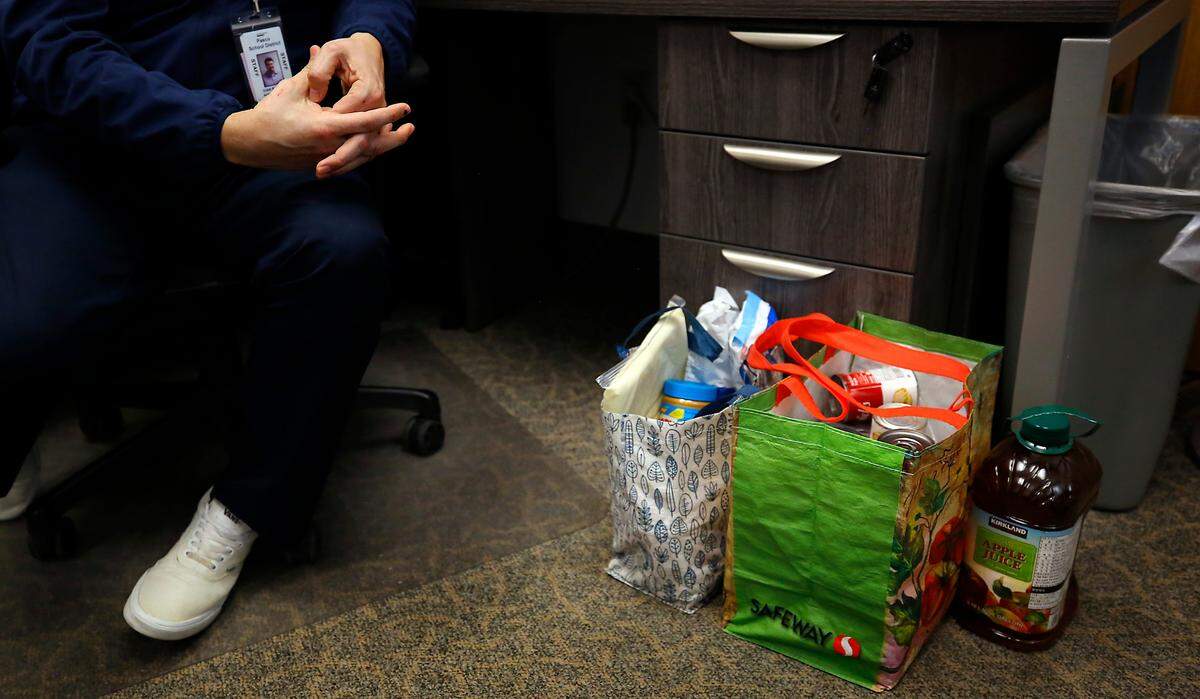
Ivan Barraza briskly walks into his closet-sized office at Pasco High School, carrying two reusable bags brimming with canned soups, peanut butter, juice and other non-perishable groceries.
But they aren’t for him.
As he sets them by his desk, he notes that the food is for a family of three from Guatemala. The family has lived in the U.S. for a few years, but still struggles with basic necessities, like furniture and internet service.
“I get to be the lucky delivery, Uber driver,” Barraza, the school’s migrant graduation specialist, says with a smile. “Food insecurity is huge. If you’re hungry, it’s hard to learn.”
A U.S. Supreme Court ruling over 40 years ago guaranteed all students — including both temporary migrant students, as well as undocumented immigrants — the right to attend public primary and secondary schools regardless of their immigration status.
Public schools do not request or document a student’s immigration status or the status of parents and other family members.
In the Tri-Cities, nearly 1 in 15 public school students are the children of migrant agriculture workers or fishers who have moved here within the past three years.
The Tri-Cities’ 3,500 migrant students qualify for the federally funded Migrant Education Program, which help them graduate and links their families with specific services. Some students work in agriculture themselves to support their families.
These students are different than those who may be undocumented and living in the U.S. permanently, and who likely qualify for the Deferred Action for Childhood Arrivals program, or DACA.
Migrant students often have difficulty receiving continuous, high-quality education because of their mobility, cultural and language barriers, health problems, social isolation and a lack of resources in the areas they live and work.
Washington relies heavily on its large migrant and immigrant work force. The Evergreen State is ranked second nationally in number of migrant students, their families contributing to agriculture, fishing, forestry and dairy industries, according to the state Office of State Public Instruction.
Nationwide, nearly 214,000 students were enrolled in the Migrant Education Program in 2021.
As the second Trump administration promises “historic” mass deportations, removes federal protections from immigration enforcement in schools and undertakes a plan to dismantle the federal Department of Education, it has also set up a battle with states and courts that could redefine the rights of students in one of the K-12 education system’s most vulnerable populations.
Some states are trying to change the federal protections that ensure all migrant and immigrant students receive a high-quality education.
Earlier this year, Oklahoma’s state board of education approved a plan to track and report family immigration status for data collection purposes and needs assessment.
And last month, Tennessee lawmakers introduced a bill that would allow school districts to deny undocumented students from enrollment.
And about 651,000 undocumented immigrant children, ages 3 to 17, were enrolled in U.S. public schools in 2019. And it’s estimated at least 6 million live in a household with an undocumented family member.
Discrimination protections
Federal protections under the 1964 Civil Rights Act prohibit school districts from discriminating students based on race, color or national origin.
Washington state also prohibits discrimination on the basis of citizenship or immigration status, and guidance from the Office of the Attorney General bars schools from initiating contact with federal immigration authorities.
State education leaders have warned public schools about actions that could inadvertently “chill” a student’s right to access school and services.
“Our public schools are a place where students from all different backgrounds come together to learn side-by-side,” Washington Superintendent Chris Reykdal said in a January statement. “This is the rich diversity that America is known for, and we intend to uphold these values in the months and years ahead.”
About 22,000 students in Washington are considered migrant — just 2% of the nearly 1.1 million total population.
Despite facing major hurdles to receive public education, the students have only slightly lower rates of regular attendance and four-year graduation compared with their non-migrant peers, according to Washington Report Card data.
Pasco’s ‘Grinch’
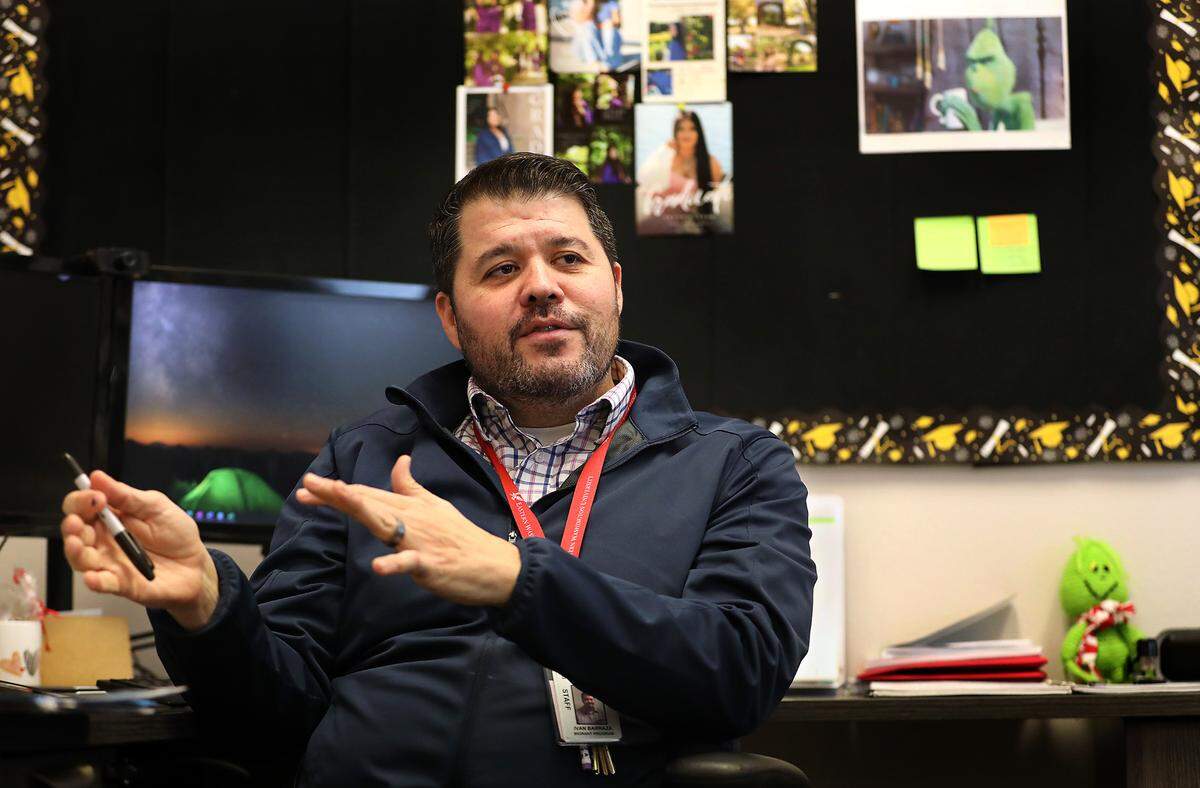
Barraza, 44, is known by some around the high school as the Grinch — but not because he doesn’t smile or isn’t welcoming.
“When you’re around high school kids enough, they’re either brutally honest or will just tease the heck out of you,” he said. “Sometimes I have my coffee cup and I’ll just be sitting here, and they say, ‘Mister, you look like the Grinch.’ And I was, like, really? Come on, I’m not really that mean. I’m not stealing your Christmas trees.”
Regardless, it’s a moniker he’s embraced with gusto. On his wall is stapled an image of the mean-mugged character from the 2018 film, and a knitted Grinch lies close by on his desk.
But Barraza is also known for being hard to find around the Pasco High School campus. That’s because he supports about 200 migrant students and their families, and makes frequent visits to classrooms to check in with students about their classes, grades, translation services, extracurricular activities and home life.
With the spring agricultural season approaching, Migrant Education Program enrollment is expected to see a noticeable bump.
Barraza says he’s helping the next generation of leaders achieve and start a path to successful careers — as doctors, architects, nurses, engineers or scientists.
That mission is the driving force behind his work to get students to the cap and gown.
But students often don’t see their professional aspirations reflected in their parent’s work or around the household. There’s a perceived gap between their reality and dreams.
“It’s hard when you grow up in that demographic and your family’s moving. Sometimes you don’t see what you can be until someone helps you. So, (it’s) just helping students paint that picture and paint it with their families,” he said.
Barraza is passionate about his work because he grew up in Pasco, graduating a Bulldog in 1999 with aspirations to become a teacher.
He went on to attend Columbia Basin College, WSU Tri-Cities and, later, Eastern Washington University. He worked in family and social work, mostly in hospitals, before coming to Pasco School District in 2019.

‘Extra layer of support’
From the time he gets in to school, to the time he leaves, Barraza is busy engaging with students and families.
“We’re that extra layer of support,” he said.
He gets in most mornings about 7:30 a.m., shortly after students arrive. After he gets to his office, Barraza is busy doing “check ins” with students, seeing if they need any academic, attendance or social support.
Barraza spoke to the Tri-City Herald shortly before the end of the trimester. He said there was a rush to get students extra tutoring before taking their final exams. Plus, going into the final months of the school year, they’re also talking with students about applying for college financial aid.
“There’s a lot of stress right now in the building,” he said.
Migrant students are always integrated into the general education population.
They also focus on a “theme of the month” program. This month, they’re focusing on getting students information on enrollment in Tri-Tech Skills Center and Running Start for next year.
Barraza opens his doors to students for Pasco High School’s lunch periods. About 12:30 p.m., the father of four eats leftovers for lunch.
The afternoon is filled with more student and family check ins, but he emphasizes that every day is different. Students’ needs vary.
“It’s been as simple as a backpack, shoes. Lot of times students want to get involved in sports, and that’s a big thing with being in the high school — being in the high school, being a part of (athletics),” he said.
Barraza and Crystal Nuñez, the school’s migrant student advocate, have their office set up in the high school’s old student store, near the cafeteria.
They try to make the space comfortable for students to do their work. A large charging bank with phone cords lies on a table nearby, as well as space heaters.
“Sometimes students forget the power of their own lived experiences and the strength that comes from that,” he said. “Just making sure to sometimes revisit history a little bit. Like, yeah, you’ve been through hard things, and you’ve done hard things, and you’ve done well and you’ve advanced. Sometimes they just lose sight of that.”
Students can have weeks where it feels like their entire world is crashing down, like the sky is falling in “Chicken Little,” Barraza says.
But he nudges them to act more strategically and methodically, to take one thing at a time. Some students need a simple push, others need a whole lot more.
“Sometimes it’s just that slowing down, outlining — like, OK, let’s work on these three things, get that done, let’s get that caught up and then we’ll focus on something else,” he said. “Sometimes students want to do everything and we know they get overwhelmed and focus on the wrong thing.”
Safe place at school
Barraza says the new presidential administration has concerned many students, regardless of status. Some tell him that their parents were detained by Immigration and Customs Enforcement.
“They’ve been pretty honest to say that, when they go to the store, maybe dad drives but he stays in the car,” he said.
But Pasco remains a safe space, Barraza says, and the school going to ensure all students remain in a safe and sound educational environment.
“We don’t ask any information in that essence, so everybody has a right to attend public schools,” said Alma Duran, Pasco School District’s director of special programs.
She said Pasco’s $1.2 million Migrant Educational Program also organizes and collaborates with college campus visits, summer school and evening parent education classes.
But the strength in the program also relies on its ability to bridge the divide — both culturally and socially — between U.S. and Latin America.
“One of the challenges is helping our parents and students navigate the educational system in the United States because it’s totally different from where they’re coming from,” Duran said.
Duran herself grew up a migrant student. Her father instilled in her the belief that “education is going to break the cycle of poverty.” During the winters, her family would return to Mexico to be with her grandparents.
She worked the same orchards and fields that many Pasco students do to this day, evident by a left-hand scar she got from cutting onions during harvest — a reminder that some things come full circle.
Lawmakers look to strip precedent
In 1982, the U.S. Supreme Court guaranteed undocumented children the right to public education in the Plyler v. Doe case.
The landmark ruling stemmed from a law passed by the Texas Legislature in 1975, which authorized local school districts the ability to deny enrollment to students not “legally admitted” into the country.
Two years later, the Tyler Independent School District adopted policy requiring foreign-born families to pay tuition — $1,000 a year — unless they had legal immigration documentation or were in the process of obtaining them.
A group of Mexican students, unable to establish their legal admission, eventually brought a class action lawsuit challenging the policy. A district court ruled the policy had violated the U.S. Constitution and was “preempted” by federal immigration law.
After an injunction in a federal appeals court, the Supreme Court agreed to hear the case. Its 5-4 ruling was ultimately based on the “Equal Protections Clause” of the 14th Amendment, which says that no state can “deny to any person within its jurisdiction the equal protection of the laws.”
It also upheld a belief that education is vital for sustaining democratic institutions and commerce.
“By denying these children a basic education, we deny them the ability to live within the structure of our civic institutions,” the court wrote, ”and foreclose any realistic possibility that they will contribute in even the smallest way to the progress of our nation.”
Dissenting justices agreed the students should be able to attend class, but argued the Constitution didn’t prevent discrimination against unlawfully present immigrants.
Over the decades, lawmakers have tried to test the limits of Plyler or outright demolish its precedent.
In 2007, a quarter century after the landmark ruling, James Plyler, the former superintendent of Tyler schools, whose name bears the weight of the Supreme Court decision, said he was “glad” they lost the case and that uneducated students would have cost Texas more.
“I’m glad we lost the Hispanic (court case), so that those kids could get educated,” he told Education Week.