4 years after COVID, what new WA test scores tell us about Tri-Cities students
The share of Tri-City students exceeding state standardized testing hasn’t changed much since last year, a sign that recovery from pandemic-era learning loss may be slowing.
Tri-City schools have caught up about halfway to 2019 scores, but there’s still improvement to be made. This is evident when comparing the percent of students on track for college-level learning in math and English between 2019 and 2024.
Richland remains about 9 points behind in both subjects from where it was before COVID.
Kennewick is behind by 10 points in English and 9 points in math, while Pasco is behind by 7 points in English and 8 points in math.
Many Mid-Columbia districts also remain behind statewide averages in math, English and science.
The state last month released results from the Spring 2024 Smarter Balanced Assessment, known as SBA, and the Washington Comprehensive Assessment of Science, known as WCAS.
The Smarter Balanced test measures the grade-level proficiency of students who take it from the 3rd grade to 8th grade, as well as in the 10th grade. The science test is taken in the 5th, 8th and 11th grades.
Students cannot pass or fail the test. Instead, the score is used to measure the college readiness of a student and proficiency in the subject without the need for remedial learning.
Spring 2024 testing data is available to view online and can be sorted by the state, district and school levels.
Here’s how many students in each school district were on track for college classes without needing remedial learning.
- Washington state: 50% in English, 40% in math, 44% in science
- Kennewick: 47% in English, 33% in math, 37% in science
- Pasco: 32% in English, 22% in math, 31% in science
- Richland: 54% in English, 41% in math, 38% in science
- Columbia-Burbank: 35% in English, 26% in math, 24% in science
- Finley: 27% in English, 14% in math, 20% in science
- Kiona-Benton City: 22% in English, 14% in math, 20% in science
- North Franklin: 34% in English, 26% in math, 26% in science
- Prosser: 35% in English, 25% in math, 34% in science
Nearly all the school districts scored similarly to 2023 Smarter Balanaced and the Washington Comprehensive Assessment of Science results, landing within a percentage point or two, suggesting a possible plateau after two years of solid growth.
Of these districts, only Columbia-Burbank, Kiona-Benton City and Prosser increased their share of students on track for college-level English and math.
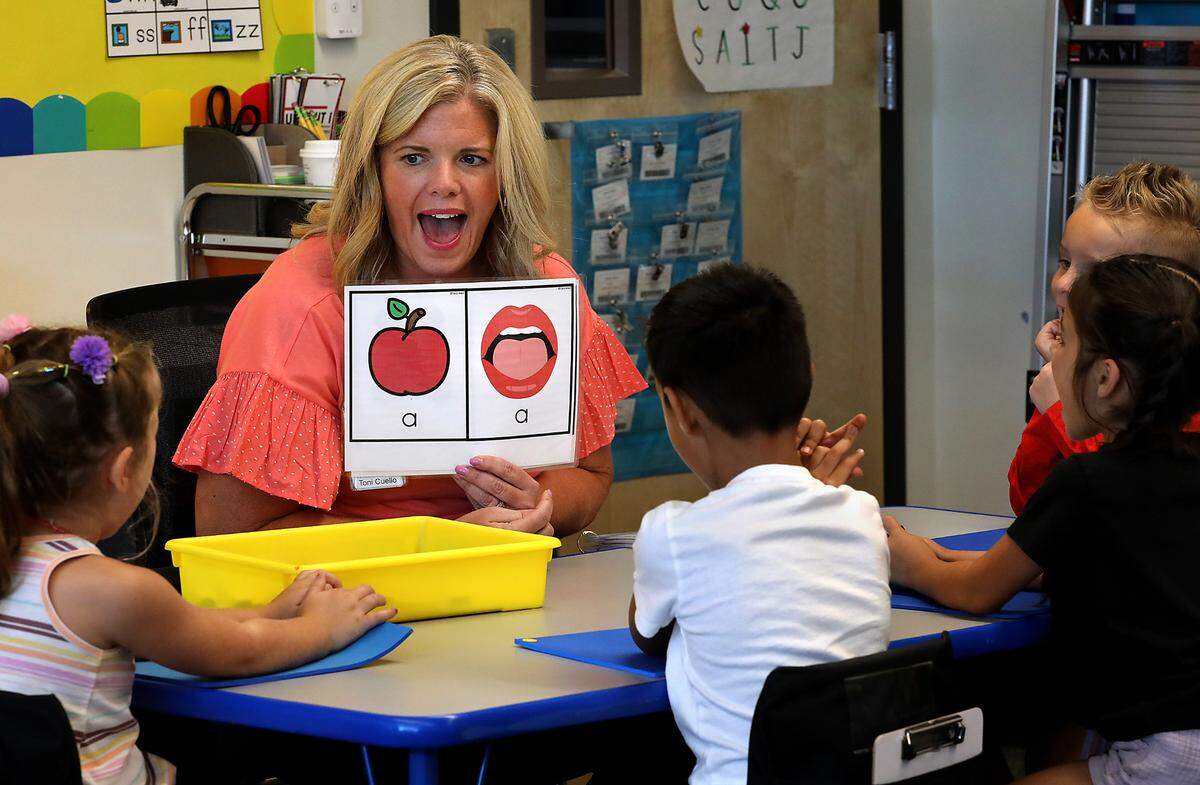
WA state releases new data
For the first time this year, Washington Office of Superintendent of Public Instruction also provided data showing the percent of students who meet foundational grade-level knowledge (Level 2) or who fell below grade-level knowledge (Level 1).
That is different from the students who are on track for college learning and show consistent grade-level knowledge or above (Levels 3 and 4).
Here’s how many students in each district had grade-level knowledge or higher (Levels 2, 3 and 4):
- Washington state: 71% in English, 63% in math, 62% in science.
- Kennewick: 69% in English, 59% in math, 56% in science.
- Pasco: 56% in English, 45% in math, 54% in science.
- Richland: 72% in English, 63% in math, 51% in science.
- Columbia-Burbank: 63% in English, 57% in math, 51% in science.
- Finley: 56% in English, 36% in math, 46% in science.
- Kiona-Benton City: 48% in English, 39% in math, 43% in science.
- North Franklin: 60% in English, 50% in math, 48% in science.
- Prosser: 61% in English, 52% in math, 56% in science.
“It is helpful that the state began reporting scores in a new manner this year, which clarifies what the Smarter Balanced Assessment data actually means in terms of student learning,” said Kennewick Superintendent Traci Pierce in a statement.
State officials warn families, policymakers and community members about using the state test score data as a “primary indicator” of student learning and growth. It’s one data point that represents the results of a single test taken at one point in time.
Administrators and teachers also rely on attendance records, class engagement, grades, classroom-based assessments, diagnostic testing and other variables to help paint a more detailed portrait of a student’s progress or challenges.
Another issue with the Smarter Balanced state assessment is that it is only given in English, a hurdle for the more than 11,000 Tri-Cities students who are listed as English Language Learners.
But OSPI argues the state-level data shows that students are continuing a “strong recovery in math,” as well as the need for “a continued focus on literacy.”
Washington students continue to perform similar to or better than other public school students across the U.S. on the National Assessment of Educational Progress, also known as NAEP.
Those scores show Washington’s 8th grade students placed in the top 15 in the country for their math and reading abilities.
“While NAEP data have shown a steady decline in reading performance across the nation since 2017, the data continue to show that Washington’s students make gains in both math and English language arts as they progress through the K-12 educational system,” said an OSPI news release.
“On the NAEP assessment, by the 8th grade, only seven states and the Department of Defense schools are statistically significantly outperforming Washington students in math and only two states and the DoD schools are statistically significantly outperforming Washington students in reading,” the release said.
Tri-City pandemic learning recovery
Standardized test scores saw a dramatic dip between the 2018-19 and 2020-21 school years.
Due to remote learning mandated during the pandemic, student’s weren’t able to take the SBA in the spring of 2020.
“At the height of the COVID-19 pandemic, in fall 2021, assessment scores in Washington dropped by several percentage points, mirroring declines across the nation,” OSPI said. “While test scores are not yet back to what they were pre-pandemic, the recovery in scores since 2022 are evidence of the diligent efforts by Washington’s students, educators and families.”
Approaches to teaching after the COVID pandemic are also changing to better approach students’ mental health and social-emotional learning, said Enid Flynn, Richland School District’s director of K-12 instructional technology and assessment.
It isn’t about “sitting down and getting it” anymore.
“Now more than ever, students do need opportunities to demonstrate their learning in different ways. We call that multimodal,” she said. “How can we empower them to demonstrate their learning in creative ways that keeps them engaged in what they’re actually learning about?”
Richland is also diving deeper into its “science of reading” efforts by implementing a new K-5 English arts curriculum, called Amplify Core Knowledge Language Arts, to all students this year following a pilot project a year earlier.
They’ve also expanded their elementary literacy training, LETRS, to include secondary teachers.
That means 70 special education teachers, intervention specialists and multilingual learning specialists are learning a more effective way to teach their students how to read, speak and write.
Flynn says SBA remains an important health check on the system, but other variables like attendance and iReady scores, help diagnose a student’s trajectory.
“All of those little pieces that happen more frequently is what helps us grow our overall outcomes. It’s really about growth, right?” she said.
New math curriculum, dual languages
Pierce says Kennewick implemented a new K-5 mathematics curriculum this school year after a pilot showed “a positive correlation between the use of the materials and the state assessment results for those students.”
“Assessment data helps teachers and schools determine which skills and concepts students have learned and which skills and concepts need attention. At the district level, scores help to inform program-related improvements, curriculum efforts and professional development,” Pierce said.
Pasco administrators attribute gains in state test scores at the elementary level to the strength of its dual language program, new instructional strategies and the dedication of its educators.
“This year also marks the third year of using the American Reading Company Core curriculum, and our Smarter Balanced Assessment scores align with the improvements we’ve observed in K-5 common formative assessments,” says Anna Tensmeyer, director of public affairs.
Three of its elementary schools — McGee Elementary, Ruth Livingston Elementary and Emerson Elementary — were recently recognized by the Washington School Recognition Program for closing achievement gaps and demonstrating growth for certain student groups.
Stevens Middle School also was recognized recently for its growth in English and math scores as students performed higher than the state average in growth percentiles.