‘Segregating’ students? Here are Pasco’s divisive 3 options for high school boundaries
Roman O’Donnell knows the value that struggling kids place on sports and after-school activities.
“I’m one of those kids who grew up in poverty,” says O’Donnell, 37, a proud Pasco High School graduate.
“I grew up rough. I grew up with gang members. I grew up with all those things. ... I wasn’t the rich, white boy people looked to me as,” he told the Pasco School Board on Tuesday.
That’s why the Bulldogs assistant football coach went to bat this week for his alma mater. He says he doesn’t want to see the state’s seventh largest high school fall more into poverty and disinvestment.
He believes a negative stigma of Pasco High persists among wealthier parts of the city.
“It’s very easy (for kids to be negatively influenced) when their parents are working 12 hours a day to support their kids,” he said.
Tuesday night’s intense discussion focused on where the district’s high school boundaries will be drawn when it opens it’s third comprehensive high school, Sageview High, in fall 2025 in the northwest part of the city. The new boundaries will redistribute students from Pasco High to the east and Chiawana High to the west.
Parents, educators and others pleaded with the board to adopt a plan that would better diversify Pasco High School’s student body and keep its share of high-poverty students low.
Currently 83% of Pasco High School students identify as Hispanic or Latino, and 74% come from a low-income background.
But two scenarios proposed by district staff would increase the high school’s share of Hispanic/Latino enrollment — in one case to as high as 95% — and increase the number of low-income students by about 10 percentage points.
A dozen public commenters, including O’Donnell, argued that those decisions would disenfranchise student opportunities and academic outcomes.
But some school board members maintained the boundary scenarios would keep high school students closer to home and better reflect the feedback they’ve received from families over the last nine months.
The discussion came down to a battle of priorities. Which is more important to families: school proximity or a less impoverished school?
Pasco School District staff considered how far students would have to travel to get to school, neighborhood demographics, feeder schools, enrollment numbers, safety and transportation as guiding principles to draw up three scenarios.
Izmael Mercado, 26, of Pasco, says two scenarios would “segregate” students based on race and their economic status.
“Segregating students denies them diverse learning opportunities essential for empathy and understanding,” he told the board. “It limits exposure to different perspectives, hindering their ability to thrive in an inter-connected world. Moreover, it perpetuates cycles of poverty and inequality, denying marginalized students necessary support and opportunities to break free.”
But board President Amy Phillips called it a “huge jump” to equate the proposed boundary revisions to racial segregation.
“There is not segregating here. We have diversity in every school, in every scenario,” Phillips said.
The board reviewed the maps at this week’s meeting and plans to make a decision at its June 11 meeting.
Board disagreement
The school board appeared divided on which boundary map is the best one to adopt, even after Tuesday’s discussion.
About three in every four students attending class in the Pasco School District identify as Latino and/or Hispanic. So, no matter the scenario, students of Hispanic/Latino descent will make up a majority at each high school.
Here is what the racial makeup of each school would look like under the three proposals.
Pasco High School
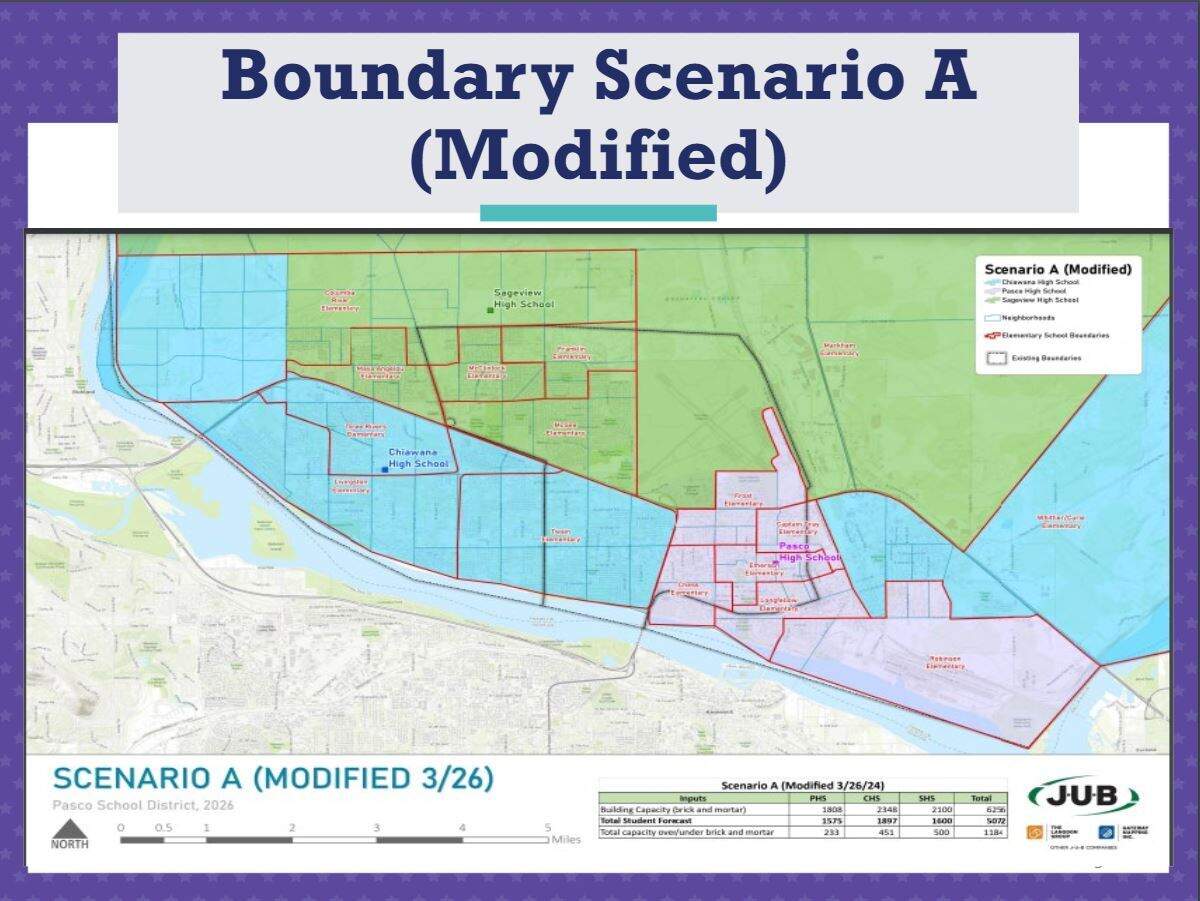
- Modified Scenario A: 95% Hispanic, 3% White, 2% other. Low income: 86%.
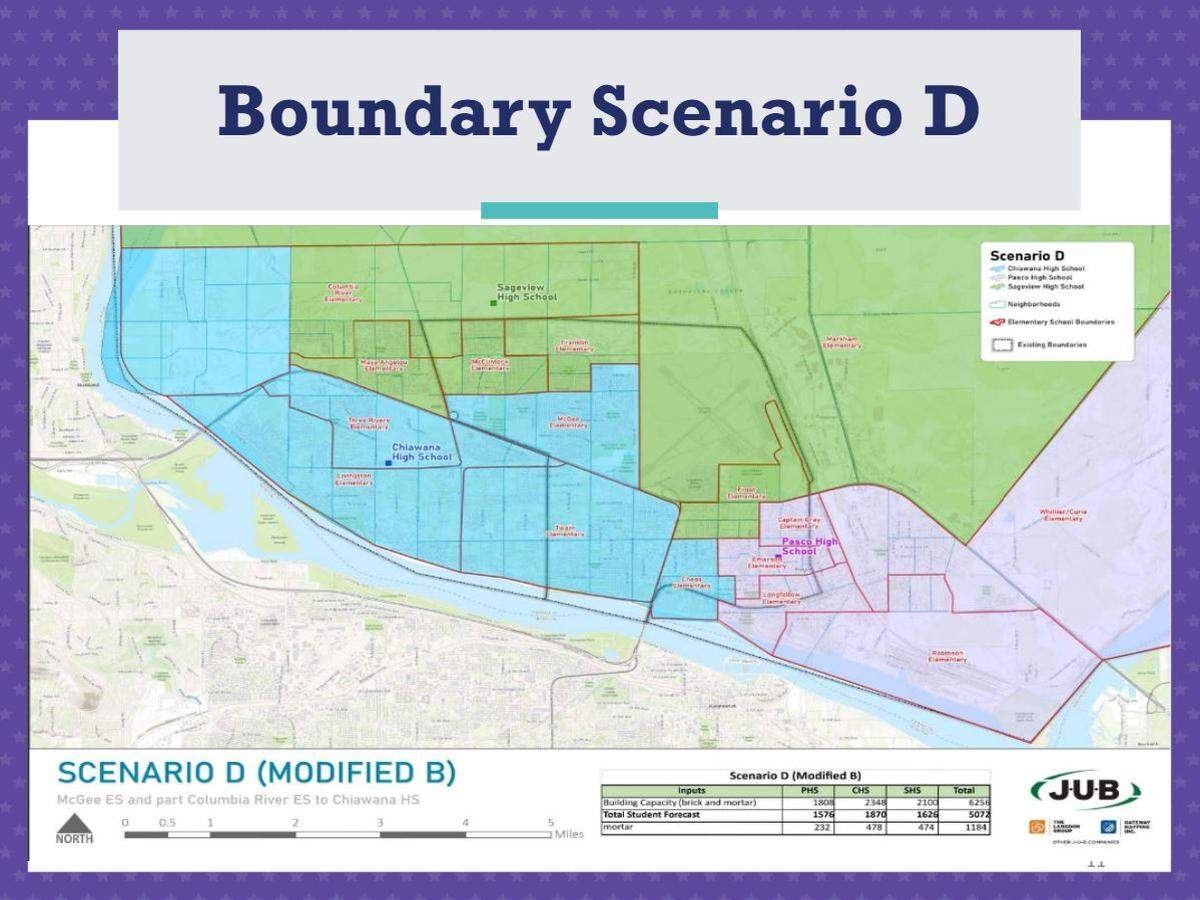
- Scenario D: 93% Hispanic, 3% White, 4% other. Low income: 86%.
- Scenario F: 85% Hispanic, 11% White, 4% other. Low income: 75%.
Chiawana High School
- Modified Scenario A: 68% Hispanic, 25% White, 7% other. Low income: 57%.
- Scenario D: 63% Hispanic, 30% White, 7% other. Low income: 51%.
- Scenario F: 72% Hispanic, 21% White, 7% other. Low income: 61%.
Sageview High School
- Modified Scenario A: 56% Hispanic, 35% White, 9% other. Low income: 49%.
- Scenario D: 62% Hispanic, 31% White, 7% other. Low income: 54%.
- Scenario F: 62% Hispanic, 31% White, 7% other. Low income: 54%.
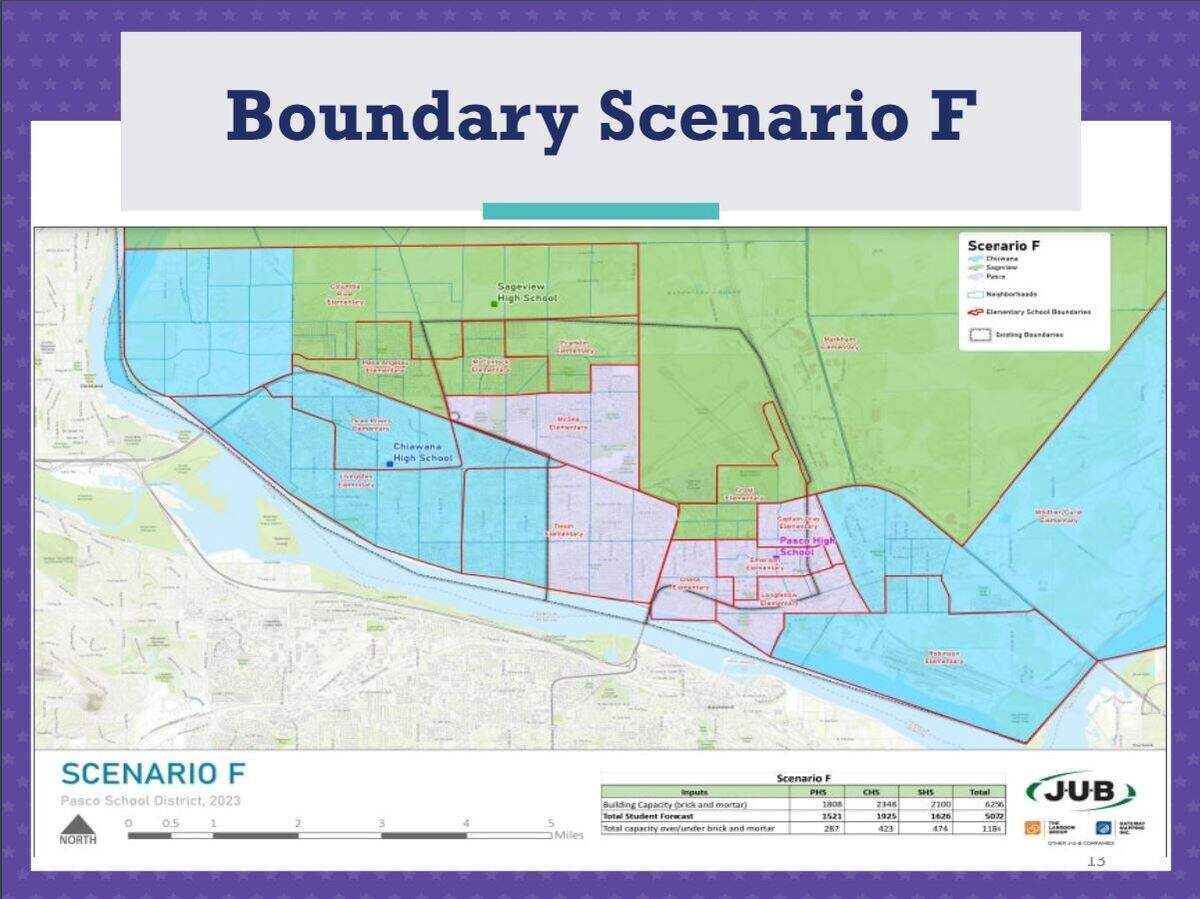
Phillips said she has some “real problems” with Scenario F — the option that would give Pasco High School more diversity — because it doesn’t place enough students in the school.
The difference in poverty level between Scenario D to F is about 10 percentage points, something she says is “not a huge amount.”
“I am strongly against Scenario F. It’s not what the community wanted and it’s not even what the people in those areas wanted,” she said.
Vice President Amanda Brown preferred Scenario F.
She said high-poverty schools have higher dropout rates, wider achievement gaps and lower test scores. Substitute teaching fill rates could also be negatively impacted by increasing school poverty.
High-poverty schools often have younger, more inexperienced teachers, too, which affects academics and outcomes.
“To me, the data and the conversations I have are straightforward in that I don’t see how we could go with anything other than F,” she said.
Board member John Kennedy said he could not support Scenario A because it was the only one where Sageview’s population of low-income students dipped below the 50% threshold needed to qualify for high-poverty lap funds and other Title I programs.
Roughly 800 students at the school would be cut out from those high-impact special programs funding if that scenario was adopted.
“It undermines one of our strategic goals and it would also, in effect, further inequity at Sageview over time because these programs would not receive this necessary funding,” Kennedy said.
Board member Steve Norberg said it was important to re-emphasize Phillips’ point that Scenario D — the most transportation-efficient option — was the clear favorite among surveyed stakeholders.
Since boundary revision work began at the beginning of the school year, district staff have hosted 67 different in-person and online community events and have collected 5,000 feedback responses.
But neither Norberg nor board member Steve Simmons voiced a clear preference for any of the maps on Tuesday.
Student board representative Kimberly Joya Manzanarez, a Pasco High senior, said Scenario F is the most equitable option to students.
Parents may prefer closer schools, Manzanarez said, but most students would rather commute to a school across town that sets them up for success. She argued the other two scenarios would dampen student hope at the district’s oldest high school.
“I know the district is aware of the stigma that follows us, but I’m not sure how aware you all are. Students are laughed at, called names and are being outright disrespected on the daily because they go to the ‘poor school’ — but we are rich in culture. The ‘rich school, poor school’ labels is a hard pill to swallow, but ignoring them will do no good,” she said.
“I am a proud Bulldog, but I can’t help but wonder how much more I could have achieved had I had more resources — more AP and higher level classes, more opportunities to participate in music and music competitions. We want more opportunities for sports and clubs, things that will help students find themselves and their passions. We have a hardworking staff who is doing the best with what they have. Pasco High offers so much and I would hate to see it all taken away,” she continued.
Dual language, transportation costs
District staff and the school board also discussed the transportation costs of implementing the new high school boundaries, as well as the feasibility of expanding two-way dual language classes out into Sageview.
Effective dual language programs draw from a large base of families that speak the targeted languages, in this case Spanish, in their home.
Scenarios D and F would ensure that all three high schools have a sufficient number of Spanish-speaking students — about 22% — to allow for a program. Meanwhile, Scenario A only provides for 17% of the population at Sageview High School.
Buses currently put on more than 250,000 miles annually delivering students to and from Pasco High and Chiawana.
Scenario A would add 42,000 miles to that number, while Scenario D would add 18,000 miles and Scenario F would add 40,000 miles.
This story was originally published May 29, 2024 at 12:14 PM.