Will Tri-Cities schools see expected ‘financial crisis,’ layoffs other WA districts face?
It’s been a treacherous budgeting season so far for many Washington school districts.
Across the state, schools that banked on student enrollment rebounding after COVID are now making sweeping cuts to staff as they spend the last of the federal cash they received during the pandemic.
It’s a shadow that’s sure to loom over local Tri-City school districts, most of which have only just begun to draft budget documents and understand the fiscal impacts of the last legislative session.
This past week, the Yakima School Board approved a plan to trim more than 100 positions — mostly paraeducators, academic specialists and counselors — from their payroll in an effort to save $19 million in next school year’s budget. Yakima’s enrollment has dropped 9% over the last five years.
Up north, the Wenatchee School District is considering cutting 63 jobs in an effort to save nearly $9 million next year. With enrollment expected to continue declining there, the district might also close an elementary school.
And further down the Columbia River, the Vancouver Public Schools board this month approved $35 million in budget cuts for next school year that will see 262 jobs — including 113 classroom teaching positions — vanish.
“The financial crisis facing our schools is entirely avoidable,” said Larry Delaney, president of the Washington Education Association teacher’s union, in a statement to the Tri-City Herald. He also called on the Legislature to “step up and fully fund public education” for the benefit of its students.
School enrollment is important because it dictates how much funding the state allocates to each school district. Local levy funds and other federal programs help fill in the gap.
Several variables — including families switching to home school or private school programs during the pandemic, as well as demographic shifts and rising chronic absenteeism — are to blame for declining enrollment in public schools.
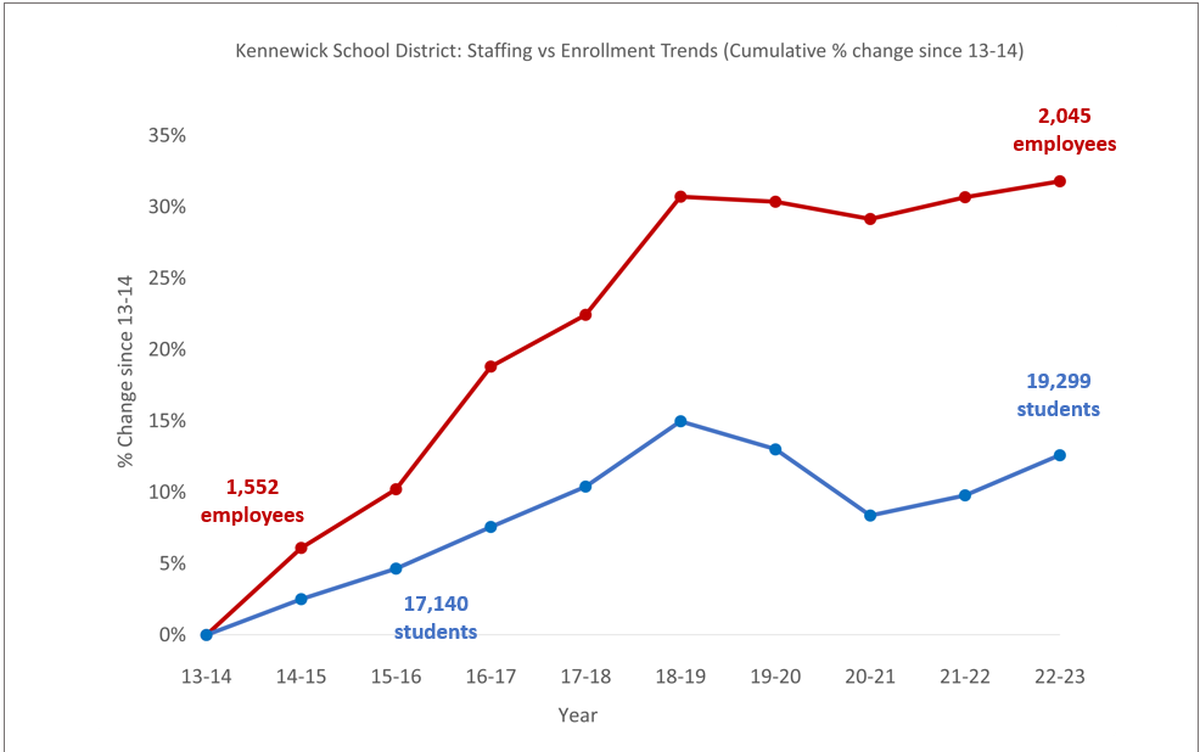
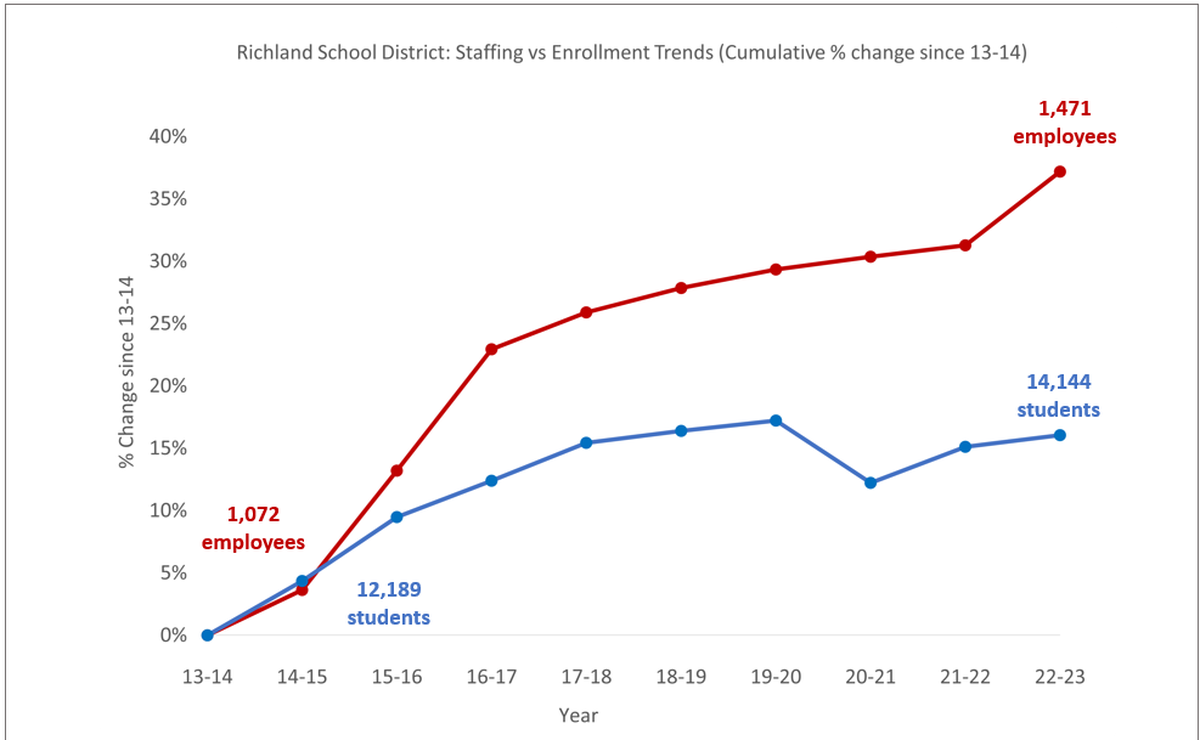
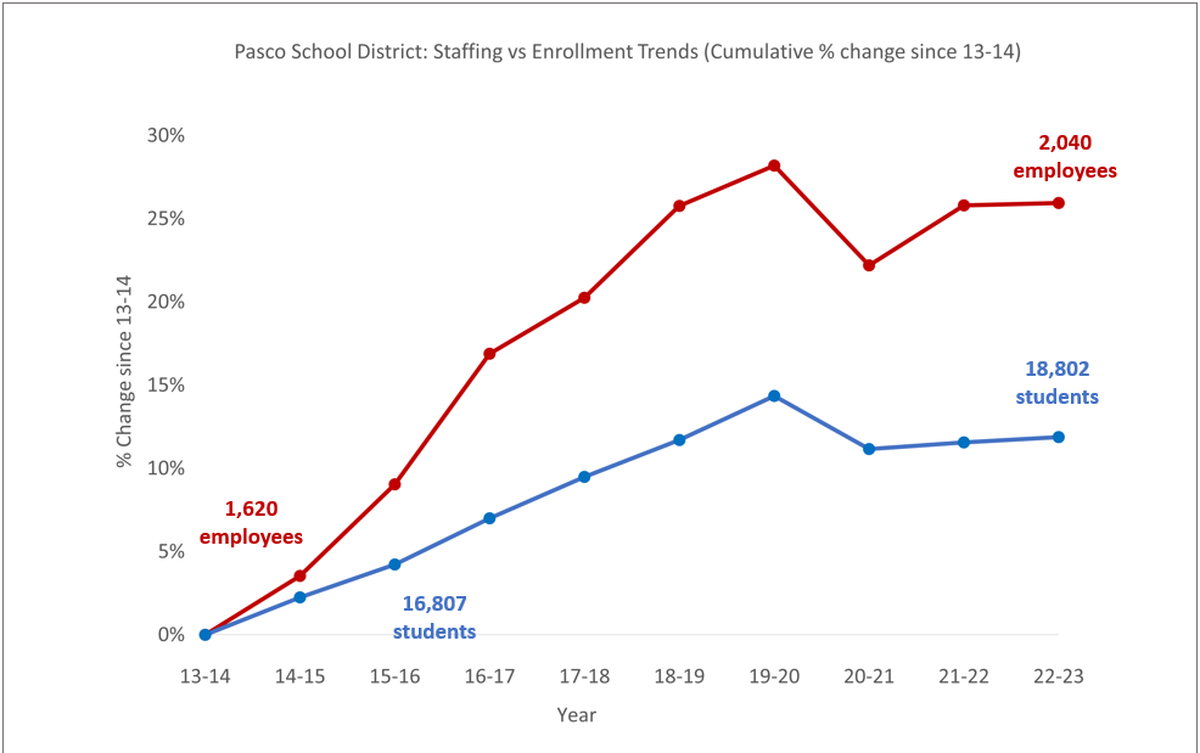
But even as attendance began to plateau before the pandemic, many school districts have continued to hire more staff and accrue more expenses.
Kennewick staff reductions
Districts in the Tri-Cities have already begun drafting their budgets and are beginning to hold workshop meetings with their local school boards. As legislative revenues and classroom expenses become finalized in the coming weeks, a clearer picture of the fiscal health of local schools will begin to emerge.
Many local school boards will pass their 2024-25 budgets before the end of summer.
The Kennewick School District administration is already working through staff reductions for the next school year, but it’s currently unclear which positions, and how many, will be impacted. Additional staff reductions are expected for the 2025-26 school year, too.
These layoffs likely include staff who were hired to keep classroom sizes small during the pandemic and whose salaries were funded with one-time COVID dollars, known specifically as the Elementary and Secondary School Emergency Relief (ESSER) funds, as previously reported.
The Tri-City’s largest school district has been under severe financial stress lately. It started with enrollment decreases during the COVID pandemic and was exacerbated greatly after voters rejected two levy initiatives in 2022.
As a result, the district didn’t collect a local tax at all during 2023 and it now plans to operate on an annual budget deficit of about $5 million to $10 million over the coming years.
The district used about one-third of its ESSER — roughly $20 million of its total $59 million allocation — covering programs, teacher salaries and other expenses that should have been covered by levy dollars.
Voters eventually passed an operations levy in February 2023, which went into effect this year.
Kennewick operates on a $320 million general fund budget. It’s one of the largest employers in the Tri-Cities, with more than 3,500 employees in more than 30 schools. More than 18,000 students attend Kennewick schools.
Tremors in Richland, Pasco
Krista Calvin, president of Richland Education Association teachers union, told the Tri-City Herald that she met with school district administrators and has been told there will be no teacher layoffs this year.
But that doesn’t mean the district will be without any shakeups in the new school year.
“In Richland, there are a number of teachers who will be displaced from their current teaching assignments and will need to be administratively reassigned or transferred to a different position within their school or the district,” Calvin said in an email.
“REA and RSD are working together to make sure that displaced teachers are placed into positions they are qualified for to ensure that students get the education and support they need,” she continued.
The Richland School District operates on a $215 million budget that pays the salaries of more than 1,400 employees working in 12 elementary schools, four middle schools, two comprehensive high schools and a number of other choice schools.
More than 14,000 students attend class in Richland schools. It’s the only Tri-Cities school district that has fully recovered the enrollment it lost during the pandemic.
Kevin Hebdon, Pasco School District’s executive director of fiscal services, said he plans to present a budget overview at the school board’s April 23 meeting. A draft budget, including revenues and expenses, will be available closer to the May 28 meeting.
“I don’t see anything that would give us concern,” Hebdon said.
He notes that their district trimmed expenses last year by not rehiring for certain staff positions and by not renewing some COVID-related positions that were contracted, such as additional school nurses.
Pasco operates on a $313 million general budget that supports about 2,400 staff and teachers working in 17 elementary schools, four middle schools, two comprehensive high schools, two alternative high schools and the district’s online learning alternatives. More than 18,000 students attend Pasco schools.