Year-round school in the Tri-Cities? Why 2 districts are considering making the change
Some Tri-City area school districts are studying a shift to a “balanced calendar” schedule in hopes it will improve student outcomes and lessen the summer learning slide.
The Richland School District has been studying the model for several years now. But last month, a proposal to begin the 2024-25 school year on a balanced calendar fell flat after a survey showed little appetite for such a fast change.
As a result, no substantial changes are expected for Richland’s calendar next year, said public information officer Shawna Dinh.
In Burbank, Wash., the Columbia School District is making a similar proposal, hoping for “increased student engagement, improved academic performance, and reduced burnout among both students and educators.”
The district is hosting several community forums and is soliciting community feedback to determine how it will proceed.
What is a balanced school calendar?
A traditional school calendar in Washington concentrates 180 days of instruction into nine months with a 10-12 week summer break.
But a balanced calendar — or “year-round schooling, as it’s sometimes called — takes that long summer break and spreads those days off evenly across the school year. Summer break on a balanced calendar ends up lasting 5-7 weeks, while the total days of instruction time remains the same.
Schools will often use breaks to host “intersessions” — opportunities for students to participate in educationally relevant activities or use the time to catch up on class work.
Research has shown that schools following a balanced calendar tend to have higher achievement scores since shorter breaks mean more consistent student-teacher instruction and less learning disruption, according to the Washington Office of Superintendent of Public Instruction.
It’s also shown to lower the rates of chronic absenteeism in schools and can have a positive academic impact on low-income students.
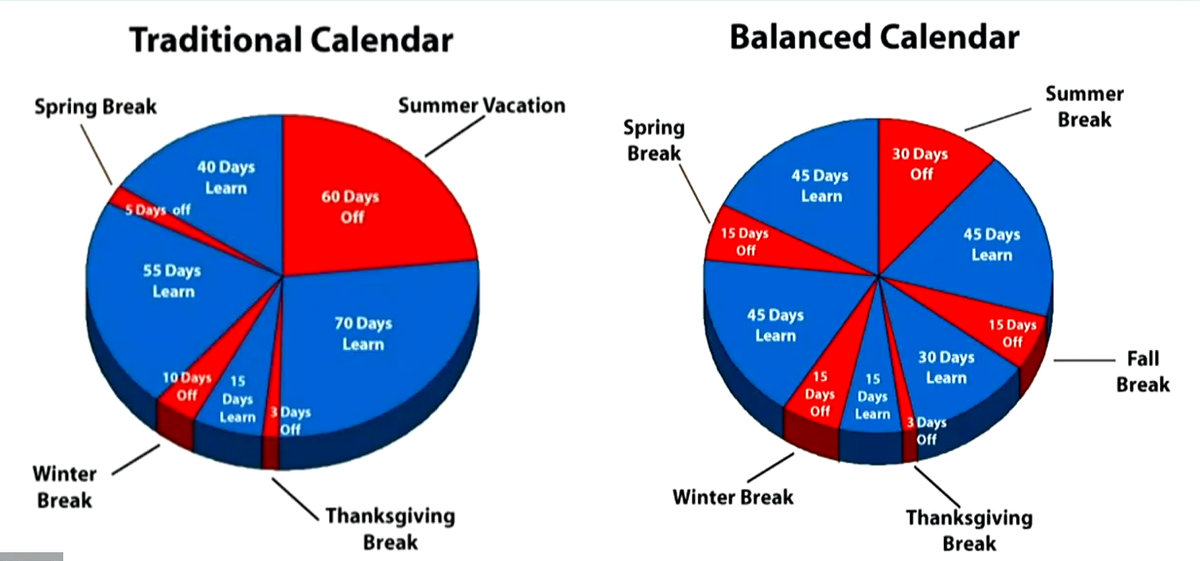
Balanced calendars aim to reduce the “summer slide” to ensure students retain skills and knowledge learned more consistently between calendar school years. Shorter breaks mean teachers can spend less time catching students up at the beginning of the year and less learning disruption.
The change could also positively impact absenteeism, specifically days that students drop around the Thanksgiving holiday, winter and spring breaks.
“Shorter strategically placed breaks provide students and teachers with opportunities for rest and rejuvenation, fostering a healthier, more sustainable learning environment,” writes Columbia Superintendent Todd Hilberg. “This approach can lead to increased student engagement, improved academic performance, and reduced burnout among both students and educators.”
Some educators warn, however, that the calendar change is not a silver bullet and may not be well suited for every community.
Schools have traditionally used balanced calendars as a way to ease overcrowded buildings by rotating students and teachers on different schedules, but the COVID pandemic and its associated student learning losses has led many schools to consider wider systematic changes that could improve student learning and catch students falling through the cracks.
“We’re always looking at ways to improve the learning of our students. This was just one of the options that came forward,” said Tory Christensen, assistant superintendent of secondary education in the Richland School District. “I don’t know if this is the best way to go and nobody was proposing that this was the best way to go.”
The calendar can also create some scheduling headaches for agriculture families, students who take on summer jobs, students who take Advanced Placement courses or sports schedules.
Supporting student success
Winlock, a rural community in Southwest Washington, where 800 students attend the local school district, has been the state’s poster child for its balanced calendar initiative.
The district has been operating on either a modified or balanced calendar schedule for the past two years and has found tangible success with it.
Special programs director Michelle Jeffries says the shift has been “transformative in our students’ lives.”
“It has made some students love school again,” she tells the Tri-City Herald.
Throughout the school year, the district hosts three intersessions where students can participate in activities and field trips, or catch up on school work. Jeffries said data from last year shows that students who attended every intersession made significant growth by the end of the school year and experienced little-to-no summer learning loss when they came back in the fall.
Students are drawn to intersession because they get to socialize with their peers and engage in fun activities. Many students would rather attend intersession than attend class, Jeffries said. It also keeps students off their electronic devices.
“Rumors spread and students have been wanting to attend,” she said.
Balanced calendar has benefited Winlock students who need the extra classroom support. But there are other students and parents who say they don’t feel they need the extra days at the end of the school year.
The calendar change was a big adjustment at first for parents, but they’ve since adapted and are enjoying more frequent opportunities to take time off.
Richland, Columbia would lead Tri-Cities
No school districts in the Mid-Columbia region currently operate on a balanced calendar schedule.
Richland or Columbia would be a leader in the Tri-Cities if it chose to adopt the new schedule. Current calendars for the “Big 3” school districts — Richland, Kennewick and Pasco — mostly are not in alignment, aside from spring break.
“This is not an area that the district has investigated or researched, so I am not able to comment on whether our schools would benefit from a balanced calendar,” Kennewick Superintendent Traci Pierce told the Herald in a statement. “We are aware that RSD is looking into this, and we look forward to learning from their efforts.”
There are currently 45 school districts across Washington that are either studying calendar alternatives or have one implemented. Only the state’s smallest school districts — Highland, Mt. Adams, Oakville, Union Gap and Winlock — currently operate under a balanced calendar model.
Shifting school districts to a balanced calendar has been a priority of Washington Superintendent Chris Reykdal’s for several years now, with the goal to redesign the school year to substantially shrink summer learning loss in the long term.
In 2021, the state Legislature directed $200 million in state and federal COVID relief funds to Reykdal’s office for learning recovery, and the balanced calendar initiative was one of them.
The state then began offering local school districts the chance to apply for funds to study how modifying their calendar would impact students and instruction.
This story was originally published February 28, 2024 at 5:00 AM.