Exclusive | Why one Tri-Cities school campaign is using apps and Facebook to target voters
If you receive a Facebook message or text from a neighbor this week about the Pasco school election, this may be why.
Campaign supporters and volunteers are taking an innovative tech approach to encouraging voting by using a smart phone application to target people who are most likely to vote “yes” on the measure.
The campaign group Pasco Votes for Schools is trading traditional yard signs and phone calling for smartphone technology in its all-digital canvassing.
Hundreds of personalized messages are being sent out by volunteers this week to urge friends, relatives and co-workers to get their ballots turned in for the Feb. 14 special election.
The campaign has identified nearly 7,500 likely supporters and about 1,600 confirmed supporters by looking at their publicly posted Facebook “likes” and responses to school district events.
The app — only available to the campaign and its supporters — also has information on its thousands of supporters, including if they’ve turned in their ballot yet, if they’re involved in school-related Facebook groups and if they live in a household with other registered voters.
It’s a simple strategy, as described by Pasco Votes treasurer David Jones, who created the app.
“Rather than having a small group making cold calls to strangers, our goal is to have a large group of volunteers each contacting a small number of friends,” Jones says in a video explaining the app.
Feb. 14 bond election
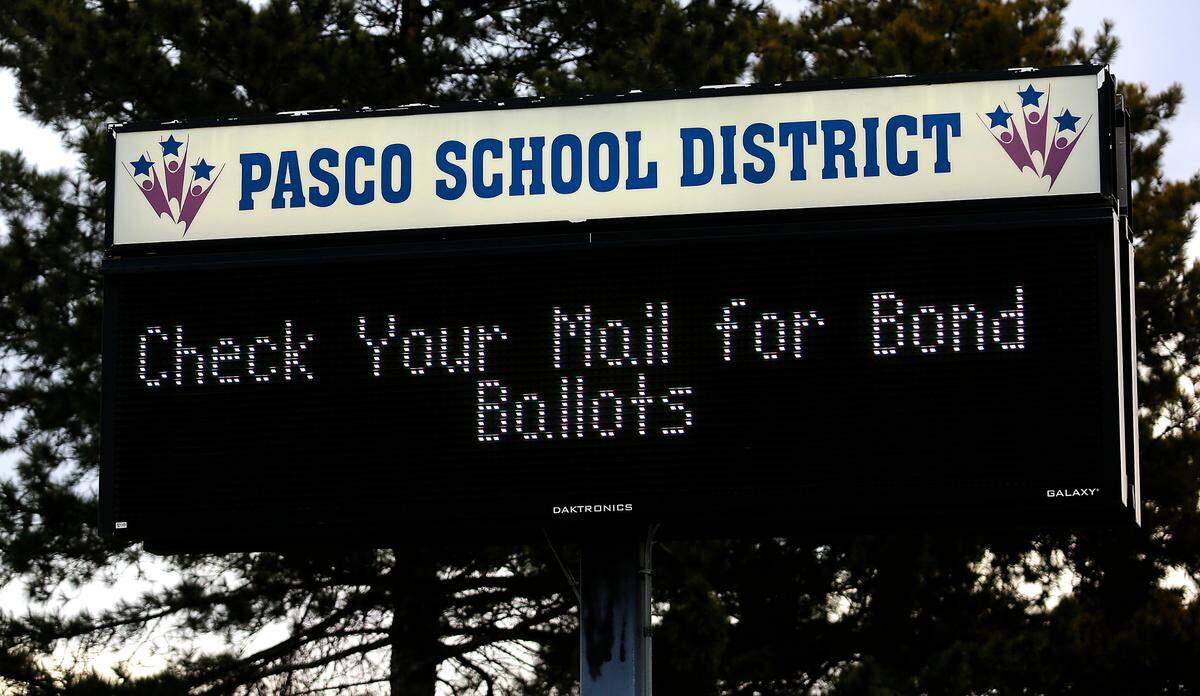
Pasco School District is asking voters to pass a 21-year, $195.5 million bond on Feb. 14 to build a third comprehensive high school and other projects. The annual annual cost would be about $93 on a home valued at $300,000.
Bonds are for constructing new buildings and require 60% approval to pass. They are different from levies, which are for learning and operating schools.
Since 2000, student enrollment in Pasco schools has more than doubled. And the district’s two high schools, Pasco and Chiawana, are being hit especially hard by overcrowding, say school leaders.
But it’s been 17 years since Pasco passed a construction bond the first time it was given to voters.
Jones said bond supporters are betting their strategy to microtarget “yes” votes may break the trend — at least this year.
“We want most people to forget that the election is happening,” he said, adding later: “It takes three ‘yes’ votes to cancel out two ‘no’ votes. So, we have to be really careful about who we’re reaching out to and who we’re waking up.”
But, statistically, the bond is more likely to fail than pass, Jones admits.
“It is anything but a given. This is an uphill battle,” he said.
Slim margin victories
Pasco’s previous bond measure — a $99.5 million measure to build two new elementary schools and two new middle schools — passed in 2017 by just seven votes.
Jones also was on that campaign, Pasco Citizens for Better Schools, which is credited with helping pass the measure by making sure that faulty ballot signatures questioned by county officials were fixed by voters.
Special election measures can pass or fail by slim margins because voter turnout tends to be low, between 25-30%. As of Monday morning, 10.6% or about 4,200 ballots had been returned in Franklin County, according to the Washington Secretary of State.
Jones said the campaign will need to pick up more than 1,200 “yes” votes to reach the 60% threshold to pass.
Using publicly available voting data and information — Facebook interactions, volunteer lists, staff directories, or county matchback data — isn’t a novel campaign strategy. But the organizing of all this info can have a big impact on low turnout elections, Jones believes.
“I’m very, very aware that putting all this data together and making it easily accessible definitely means that we need to take privacy and security very seriously,” he said, noting that the application and website use encryption.
Privacy concerns
But previous campaigns, including Pasco Citizens for Better Schools, had a history of ruffling feathers by using public voter data.
During the 2018 campaign to replace the school district’s expiring levy, the group paid for a mailer “report card” to be sent to voters, detailing their record for submitting their ballot and assigning them a “score.”
It did not include any information on which candidates or measures voters supported or opposed.
Still, the mailer, which was meant to drum up support for the levy, instead rankled many voters, who feared privacy concerns.
But Jones reassures folks — even members of his own group of about 80 volunteers — that all the information is public.
Jones, a father to five who attend Pasco schools, has a modest history of public school involvement in the Tri-Cities, starting out as a social media volunteer on the 2015 Kennewick bond to rebuild schools. His father also worked for a time as the principal at Desert Hills Middle School.
The campaign tradition of waving signs and slinging TV and newspaper advertisements didn’t go far enough, he thought.
“To me, the solution to every problem looks like software. That’s the way my brain operates, for the most part,” he said. “I thought, we need a much more data-driven approach.”
The strategy for canvassing has been to knock on doors in neighborhoods that support school bond and levy measures by double-digit margins.
But that risked reminding voters opposed the measure to circle “no” on their paper ballot. If you ask Jones, that hurt them in the 2017 campaign.
Last year’s measure to renew Pasco’s operating levy passed with about 55% approval. Levies need only a majority over 50% to pass.
Jones said Pasco Votes for Schools did not campaign in order to gauge general community support. The campaign will need to pick up more than 1,200 “yes” votes to reach the 60% threshold to pass the Pasco bond.
Jones said the peer-to-peer outreach has likely had an impact. As of Tuesday, about 14.6% of their list of 7,500 likely supporters had returned their ballots.
Campaign strategy
The Pasco Votes for Schools campaign — made up of community members, parents and volunteers — is a separate entity from the school district. It’s primary role is to advocate for the passage of school taxing measures that come in front of voters.
Under state law and oversight from the Washington Public Disclosure Commission, school districts and their administrators cannot participate in campaigning for or against a measure. They can’t persuade voters, but they can give voters information.
Pasco Votes for Schools has so far raised about $6,395 in cash contributions for this year’s election.
The district’s teachers union, Pasco Association of Educators, contributed $6,000 of that.
The campaign has spent $3,400 alone so far on “data mining” subscriptions and contracts. Pasco Votes for Schools has contracted with Dill Pixel, the business software company owned by Jones.
Dill Pixel provides “custom web and mobile software development services to a wide variety of clients, from startups to Fortune 500 companies,” according to Jones’ LinkedIn profile.
The campaign also has spent about $270 on Facebook advertising.
Jones said he’s gained “absolutely nothing” from campaign contributions, asserting that he’s put “about 100 hours” into developing software. Most expenditures have gone entirely to digital advertisements and data scraping.
“I don’t have anything coming in to me, but I have a lot going out,” he said.
This story was originally published February 8, 2023 at 5:00 AM.