
Will Tri-Cities schools reopen as virus hits plateau? Kennewick votes to delay start
In 10 days, some of Kennewick’s 19,000 students were supposed to arrive back in classrooms for the first time since March.
They were going to attend classes in-person two days a week and then continue their online schooling the other days.
The plan was laid out a few weeks ago when the head of the local health district announced that COVID-19 infection numbers had sharply dropped since July and that “hybrid learning” could start as soon as Oct. 1 in Benton County and Oct. 15 in Franklin County.
But new COVID cases appear to be plateauing in the Tri-Cities at a rate higher than the state goal for reopening schools.
And Wednesday night, after a more than three-hour discussion, the Kennewick School Board voted to delay its in-person reopening. Not necessarily because of the numbers, but school officials want more time to get ready.
Earlier this week, the Walla Walla School District did the same, canceling plans to start its in-person teaching because that county’s new case numbers aren’t low enough.
That has some Tri-Citians wondering if the reopening of schools in our area is in doubt.
The Richland School Board expects to unveil its plan on Thursday, Oct. 1. And Pasco will look at the issue again Oct. 13.
Neither Pasco nor Richland has set a date for going back to school.
But as of Wednesday, Dr. Amy Person, head of the Benton Franklin Health District, was still believing the Tri-Cities school kids can attend school safely.
“When our case rates were at 400 cases per 100,000 people in Benton County and 900 cases per 100,000 people in Franklin County that did pose too high of a risk,” she told the Herald. “There isn’t a lot of information about what happens in the 100 to 200 cases per 100,000 people range.”
Returning to school
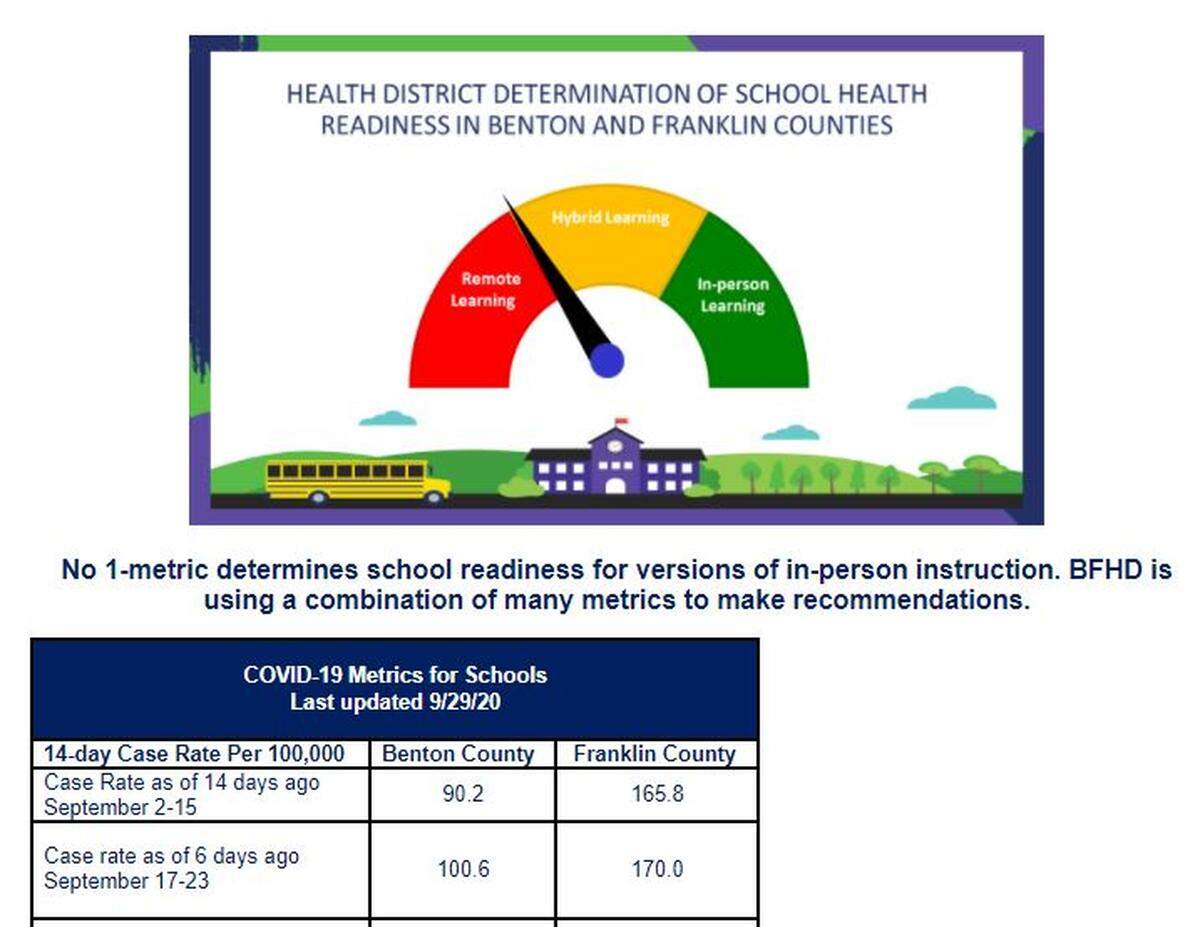
Looking at the return-to-school meter on the local health district website, the dial shows the two counties are on the edge of remaining in remote learning.
The line that separates them is based on a state recommended rate of 75 new cases per 100,000 people over a two week period.
The most current confirmed numbers for Sept. 5-18 put Benton County at 95 cases per 100,000 and Franklin County at 158 per 100,000 people.
But Dr. Person says other things should be taken into consideration, including the fact that school is more than just a place to learn for many students.
“I’m evaluating both the risks related to COVID, as well as the risks related to children not being in school,” she told the Herald. “We have both of those things playing off of each other.”
Many students rely on a host of programs that are only available at school for their physical and mental well-being. And Person said not having access to those puts them at a greater risk than COVID does.
She compared it to when the stores opened. It ended up being better for the community to open the stores, even if the transmission rates were too high initially. It motivated people to take precautions, as a result, the number of new cases dropped.
Person would feel comfortable with her recommendation if the rates stay in the 90 to 100 cases per 100,000 people.
Much of the current research shows hybrid learning doesn’t pose a greater risk as long as parents, teachers and students are cautious, she said.
They should still wear masks, keep 6-feet of distance, alternate schedules and stay away from others if they develop symptoms.
The disease is much less likely to be passed between young children than it is to be passed from an adult to a child, Person said.
There are some concerns about middle and high school students because they don’t stay in a single group. While younger students may not be as susceptible to the disease, high schoolers are similar to adults, Person told Kennewick school officials.
Unlike influenza, teachers and students are not any more likely to catch COVID-19 in schools than they would be in a grocery store, she said.
“We fully presume that if schools do reopen, we will see cases in students and teachers because schools aren’t any different than any place else in the community,” she said. “We also know that if schools don’t open we will still see cases in students and teachers because we already see cases in students and teachers because school is not the only place where a student and teacher might be exposed to COVID.”
The health district has another point of information giving Dr. Person the confidence in that decision. Private schools have been open for nearly a month without an outbreak.
“Our decision is not being driven by public pressure or politics, it is solely base on that emerging research is saying about COVID and schools,” she said.
Schools districts
While the health district’s recommendation hasn’t changed, the decisions by the schools could. Deciding to reopen school will be in their hands.
They have been working on the process for how teachers and students will report potential symptoms, developing schedules and preparing masks, gloves and other protective equipment.
So far, Kennewick is the only Tri-City school district to set a solid date for when students will return. Some special education and at-risk students are already attending some in-person classes.
And on Wednesday, the board voted to delay the return of kindergarten through fifth-graders until Oct. 19 for hybrid learning and middle and high schoolers until Nov. 2.
The decision came at the end of a more than three-hour meeting where board members heard from Dr. Person and the public
Many of the teachers and parents who spoke during the online Zoom session were concerned the district was moving too quickly, though a few wanted the district to open.
Board members said they had received hundreds of emails as well, which were mostly split on the issue.
While board members had some concerns about the safety of middle and high school students, they decided on the delay after learning some of the schools hadn’t ordered personal protective equipment from the district’s central warehouse.
“I personally like a staggered approach, and that’s just because we’re throwing so much change at one time,” said board President Dawn Adams. “We will have implementation problems. There is no way to avoid it.
“I would just as soon stagger it, so you can concentrate your energies and do it right with the elementary (schools).”
Board member Ron Mabry asked for schools to put together reports on how prepared they are.
Board member Mike Connors didn’t vote Wednesday night. But earlier, he said he was willing to delay the opening by a week to give staff the time to prepare, but he wanted students back in class.
“I think we’re suffering from a bit of paralysis from analysis,” he said.
In Richland, while an initial plan estimated the start of in-person classes in mid-October, the official plan is expected to be presented during a special meeting Oct. 1.
Pasco, at the moment, is waiting for the case rate to drop below 75 cases per 100,000 people over a two-week period before opening. Superintendent Michelle Whitney has been providing the board an update during each meeting, said Shane Edinger, the district’s Director of Public Affairs.
They will need to notify the teachers two weeks before they begin to start class. And they are working with the various union leaders on what hybrid learning will look like in their schools.
Parents across all of the districts have been divided about opening.
Many want the districts to open immediately, and don’t believe COVID is enough of a threat, while others are concerned there will be another spike in cases if schools open too soon.
This story was originally published September 30, 2020 at 6:46 PM.