
Tri-Cities kids aren’t returning to schools but teachers might have to
Tiffany Chadha is ready to go back to class in Pasco this year.
She said it doesn’t matter whether she teaches from her home or from her Longfellow Elementary classroom — but teachers must have a choice.
“There are advantages to both settings,” she said. “I think it’s most important that we preserve the ability to teach from home for staff that have safety concerns due to being high risk.”
It’s unclear whether Chadha will have the choice.
While Tri-Cities school districts have decided most students will start the school year online at home, it’s less clear whether teachers will be required to lead those lessons from their classrooms. They ended the last school year teaching from their spare bedrooms, garages and kitchen tables.
The districts, teacher unions and educators are struggling with balancing access to technology, teaching materials and IT help with problems such as childcare for teachers and safety from the coronavirus.
The Pasco School District expects to have teachers work from their classrooms unless they are “high risk or require reasonable accommodations.”
“We’ll work with employees who have unique circumstances on a case-by-case basis, but certainly we want to support our employees in feeling confident and comfortable that they can do the job,” Superintendent Michelle Whitney said during a recent school board meeting.
The district’s goal is to gradually bring staff back on-site over a period of time with safety protocols in place, officials said.
The expectation has created concerns among teachers who are eyeing the continuing high rates of COVID-19 transmission —particularly in Pasco where the rate has been triple the transmission rate in Richland — and wondering why they need to return in person when it’s not safe for students to be there.
The Pasco Association of Educators President Scott Wilson said they are still negotiating about whether educators are required to start the year teaching from their schools.
“Sadly, our community has not achieved the steps necessary to create a safe environment for schools. Our local transmission and cases make any gathering a risk and especially for those individuals who are personally in a high-risk category,” he said.
The union wants to keep staff and students safe while delivering the best education they can, he said, adding they will continue to work toward those goals.
Across the river, Kennewick school officials have not laid out a public stance on whether teachers will be returning to empty classrooms or not but some teachers say they’ve initially been told that’s the expectation. Negotiations are ongoing with the teachers union.
Kennewick Education Association President Rob Woodford said the discussions have gone well. The circumstances around this fall are different then when teachers were sent home in last spring, and the plan will be different as well, he said.
“The key issue for the KEA is the safety of educators — and, by association, the safety of students and their families. We believe both teams will develop a solution to provide the flexibility necessary to keep everyone safe in Kennewick as they deal with the worst health crisis in recent memory,” Woodford told the Herald.
In Richland, officials shut down the schools this spring and limited the number of people who went in and out of buildings.
District spokesman Ty Beaver said some teachers are interested in returning to teach from their classroom this fall, and the district is working with them.
Teachers in empty classrooms
It’s a discussion taking place in school districts nationwide.
Education Week, a publication that focuses on K-12 education, said teaching in the classroom is attractive to about 10 percent of teachers who don’t have reliable internet access.
This has driven some teachers to work from their school parking lots or buy expensive equipment, said the report. Some also worry working from their houses blurs the line between home and work time.
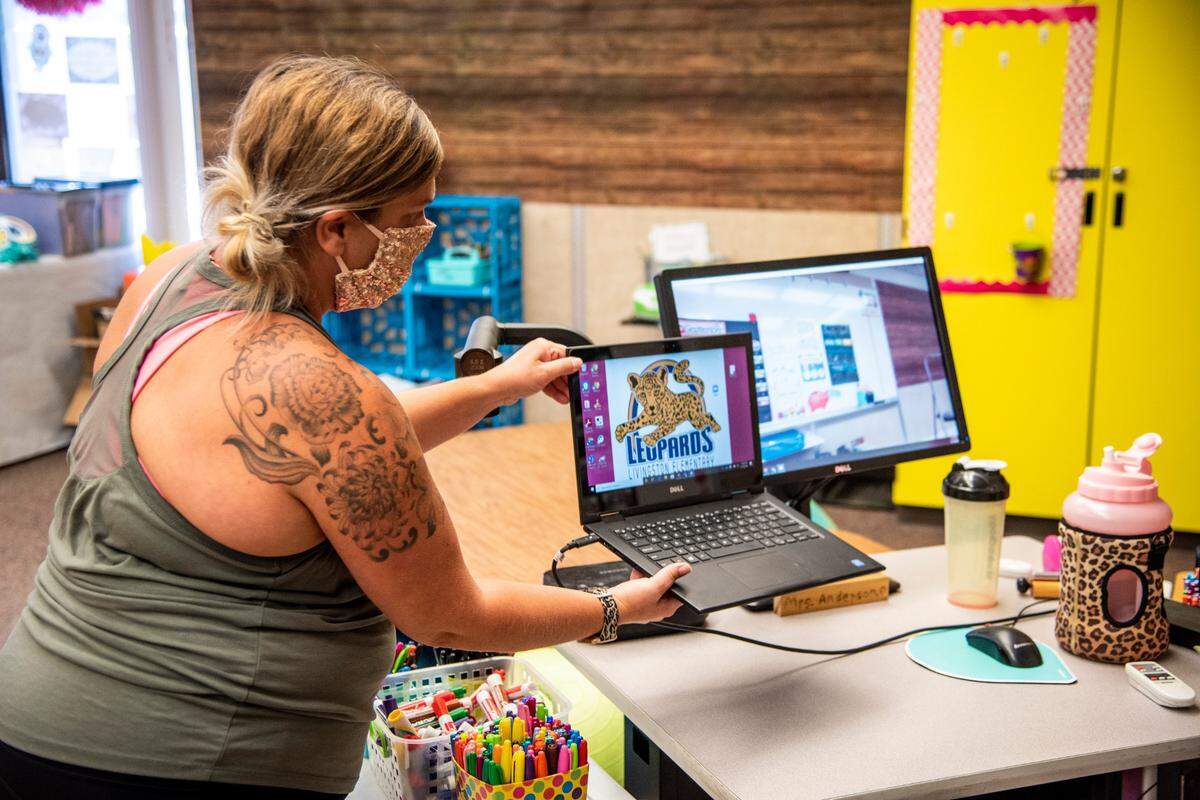
“With the virtual, I feel like you’re always ‘on’, if that makes sense,” said Alicia Anderson, a first-grade teacher at Livingston Elementary School in Pasco. “That’s another reason I like to be in the classroom to teach from here, because it will give me that separation.”
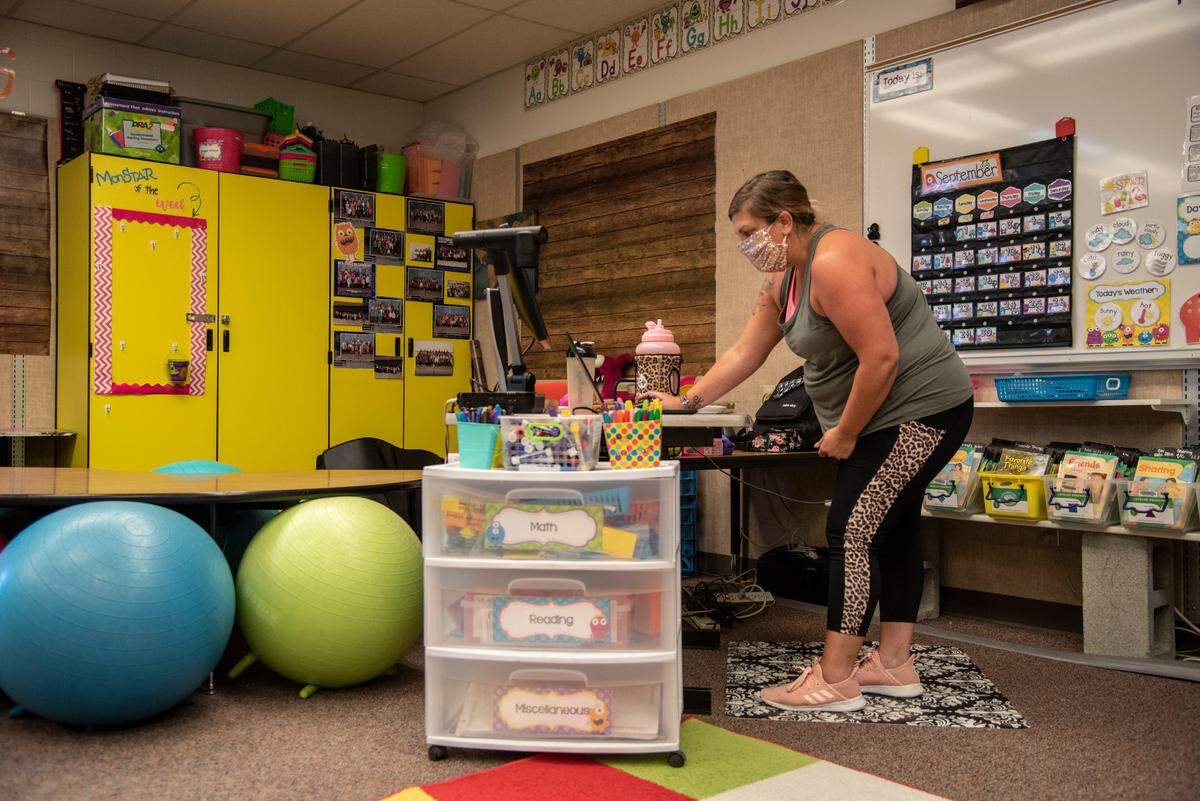
By working from their classrooms, Pasco teachers also have access to all of their equipment, technology and resources, said district spokesman Shane Edinger.
“We are planning for staff to be able to work from their buildings during distance learning,” he said. “Staff members will be required to follow guidelines for social distancing, face coverings and hygiene.”
But for teachers with autoimmune diseases or other risk factors, or with family members with those risk factors, returning to public buildings is a real concern.
Teachers in Los Angeles successfully lobbied against a requirement to return to class.
Childcare concerns
In Kennewick, childcare is a major worry. In a recent survey, more than 38 percent percent of teachers responded to say they would need someone to watch their children if they returned to class, according to a recent union newsletter.
By comparison, about 8 percent of the teachers said they’d need childcare if they had to teach from home.
The negotiations come after every Tri-City school district decided most children will start their classes online when school starts about Sept. 1.
Only small groups of students with special needs are going to be brought in for face-to-face learning.
Each of the school districts has come up with a plan that combines lessons taught in real time with prerecorded lessons.
This comes along with promises to have better outreach with parents and consistent times for classes.
And districts are promising to use a consistent set of computer programs to interact with students.
Most Tri-Cities teachers supported starting the year teaching students online, with many wanting to wait until the counties were in Phase 3 before they brought students back, according to surveys done by the area teacher unions.
While most were in favor, some teachers believed it was the right time to return to class. About 60 teachers in Kennewick suggested letting kids return to class with teachers who are comfortable.
There is a steep learning curve for the redesigned distance learning approach, but Chadha said she believes they can make it work.
“This year, the work is a little different, but still requires the same mindset as any new school year,” she told the Herald. “I think there will be some shifts in how we teach students virtually that will persist even when we are face-to-face.”
This story was originally published August 17, 2020 at 12:57 PM.