
What Tri-Cities schools are doing now to prepare for the coronavirus
Tri-City Herald and McClatchy news sites have lifted the paywall on this developing story, providing critical information to readers. To support vital reporting such as this, please consider a digital subscription.
-------
The novel coronavirus may already be circulating in Benton and Franklin counties, and schools are already preparing.
Pasco and Kennewick custodians are making extra trips through classrooms, restrooms and cafeterias, wiping down doorknobs, handles and counters, while Richland employees are using equipment to test surfaces.
Richland school workers are already dealing with cold and flu season by making sure the areas most likely to be touched are cleaned thoroughly.
They also are using a device that detects cells and spot checks to make sure the areas are sanitized.
The school districts are in contact with officials at the Benton Franklin Health District as they wait and prepare for a student or employee with COVID-19.
There were no confirmed cases of novel coronavirus in the Tri-Cities on Wednesday and no people under investigation, according to the Benton Franklin Health District.
School officials were reviewing response plans before last weekend’s news about the spread of the virus in Western Washington and that a Wildhorse Resort and Casino employee is being treated in Walla Walla.
It comes as a handful of schools across the state have shut their doors so they can do a deep cleaning of their classrooms.
Richland officials reached out of the local health district, state Department of Health and the state Office of Superintendent of Public Instruction to see if they needed to do more.
Officials said to keep doing what they were doing.
At this point, there is no evidence that shows children are more vulnerable to the virus compared with the general population, according to the Center for Disease Control and Prevention.
Rather, state officials warn that people over age 60 and those with underlying health conditions are most at risk for a severe infection, though certain populations of kids, such as kids with underlying health conditions, could be at increased risk.
Still, schools, where scores of children and adults have close contact and share supplies and tight spaces, can play a big role in prevention, according to CDC’s website.
The schools and districts in Washington state that have closed for intensive cleaning were being cautious and were not required to close, Superintendent of Public Instruction Chris Reykdal said at a news conference.
The Tri-City school districts continue to spread the message from local and state health officials — wash your hands thoroughly, cover your mouth with a tissue not your hand when you cough or sneeze, and stay home if you feel sick.
Pasco warning
After this week’s news about the casino employee, staff and community members reached out to Pasco School District concerned that they had visited the casino recently.
School officials were told the risk to the public was minimal because the employee worked in a security area away from the public.
But parents continue to be concerned where those Pasco employees worked and the district continued to reassure them that they are taking steps to make sure that the schools are safe.
“It is natural to feel apprehensive when facing a challenge like this one,” the statement said. “Thank you for working with us to keep our students and families healthy.”
Richland, Pasco and Kennewick reported that attendance this week remains at normal levels.
And, so far, the schools haven’t canceled any events.
Preparing in Kennewick
Robyn Chastain, Kennewick’s executive director of communications, said any time a school reports student absences of 25 percent or more from a similar kind of illness they “deploy a full-spectrum fogger that disinfects the entire room.”
This process takes about an hour, and they can teat 30 to 40 rooms each day, she said.
Depending on the severity of the outbreak or the recommendations of health officials they also can upgrade air filters in rooms or buildings.
Chastain said the district also is developing contingency plans to be ready to respond if a widespread illness causes greater problems and requires closing a school.
WSU preparation
Washington State University began its preparations ahead of this weekend’s news, said Phil Weiler, the university’s vice president for marketing and communications.
A systemwide committee has been tracking the advance of COVID-19 for five weeks. As it began to appear more imminent, they started ramping up their response.
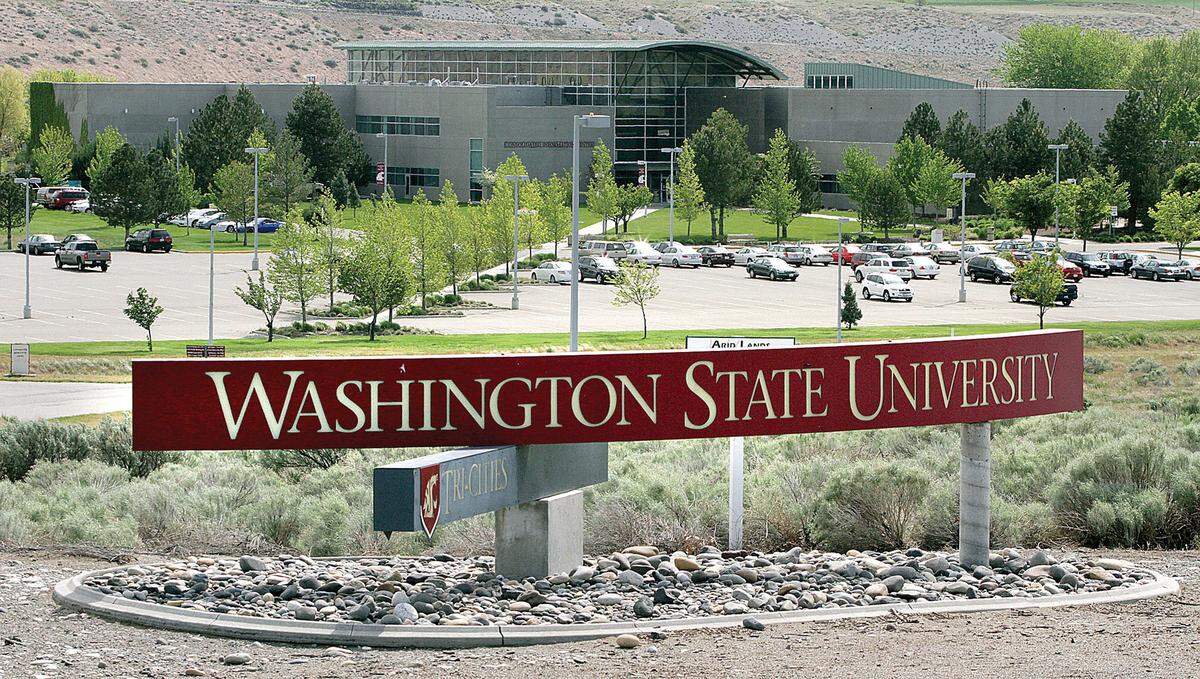
Late last week, the university started a central incident command center to handle the university’s response to the virus. The center allows the system to have a central place to coordinate the response at all five campuses.
The university, much like the local school systems, is taking their advice from the state and the Centers for Disease Control and Prevention.
WSU officials also set up a COVID-19 website with detailed information at wsu.edu/covid-19/.
WSU has 71 students in Italy for a study abroad program and they were brought home when the travel ban was put into place last week. It’s not clear if any students were from the Tri-Cities.
About half of the students were in the northern part of the country, where there were coronavirus cases.
“We don’t want a student to get stuck in the country if the travel restrictions were to tighten,” he said. “Also their healthcare system is taxed all ready. ... It’s a better idea to have people back home.”
If the virus starts to affect the campuses, many of the classes can be taught online.
“Virtually all of our students take some online classes,” he said. “It will represent a disruption, but we want to make sure we are as prepared as possible to minimize as many disruptions as possible.”
Closing schools
When district and school officials are making these decisions, they have a lot to consider on whether they should shut their doors. For one, some students rely on school meals for basic nutrition — a factor included among planning considerations in an OSPI bulletin to district and school officials sent Feb. 28.
The agency is waiting on guidance from the U.S. Department of Agriculture. Typically, there would be community feeding sites, OSPI spokesperson Katy Payne told The Olympian in a phone interview. That may not be recommended in this situation.
Another factor: equity in alternative learning options. Some students may not have access to technology at home if distance learning is considered.
“For most of you, it will likely make more sense to cancel school and/or district services and make up or waive missed days than to deploy a distance learning model that can be accessed by some, but not all, of your students,” OSPI guidance reads.
Under state law, school districts have to offer 180 school days and make a certain average number of instructional hours available to students, according to OSPI. But the agency can waive those requirements — which are tied to funding — if there’s an emergency district-wide or school closure.
If a school district is required to close or decides to close in response to the COVID-19 outbreak and they make every effort to make up that time, but still fall short of requirements, the agency offered a solution in a bulletin sent to district and school officials Tuesday.
If it’s necessary, OSPI says it will file an emergency rule so it can waive days and instructional hours the districts can’t make up. The agency will likely require schools to extend their years through June 19, and the rule would only apply to the 2019-20 school year unless the state gets guidance otherwise.
“There’s not a situation we can think of where we would deny that waiver,” Payne said.
Districts will need to submit applications for a emergency waivers to OSPI, like they do in the case of snow days and other emergency closures, but this year OSPI is developing a web-based application for COVID-19-related school closures.
“Districts should feel confident in knowing that if schools are closed for an extended period of time, they will not be required to make up missed days and instructional hours beyond June 19,” the bulletin reads.
The agency’s guidance on how schools should handle individual students’ absences is less prescriptive. That’s because OSPI has authority over the waivers, but not over student attendance, according to Payne.
Essentially, districts and schools can decide how to handle cases where students hit their maximum number of absences, Payne said.
“I think it’s 100% case-by-case,” she said.
The most recent OSPI bulletin does include that school administrators can excuse absences due to student safety concerns, illnesses, health conditions, or medical appointments, and that state law allows districts to come up with more categories for excused absences as needed.
The truancy process in state law is based on unexcused absences, according to information relayed by Payne from Krissy Johnson, OSPI’s Lead Attendance Program Supervisor. Districts and schools, though, might have policies that limit the number of excused absences a student can have before absences start to be unexcused.
“Please exercise great caution before deciding not to excuse absences related to COVID-19 and starting the truancy process because of them,” it reads.
When asked whether it was a concern that an extended individual absence might interfere with a senior’s graduation plans, Payne said she would imagine that scenario would be rare. Say, if a student was already lagging behind and needed that time they missed to complete make-up work.
In the most recent bulletin, Reykdal said OSPI expects districts to maintain their graduation timelines.
This story was originally published March 4, 2020 at 3:30 PM.