
Tri-Cities teacher raises are still up in the air. Will they reach deals in time?
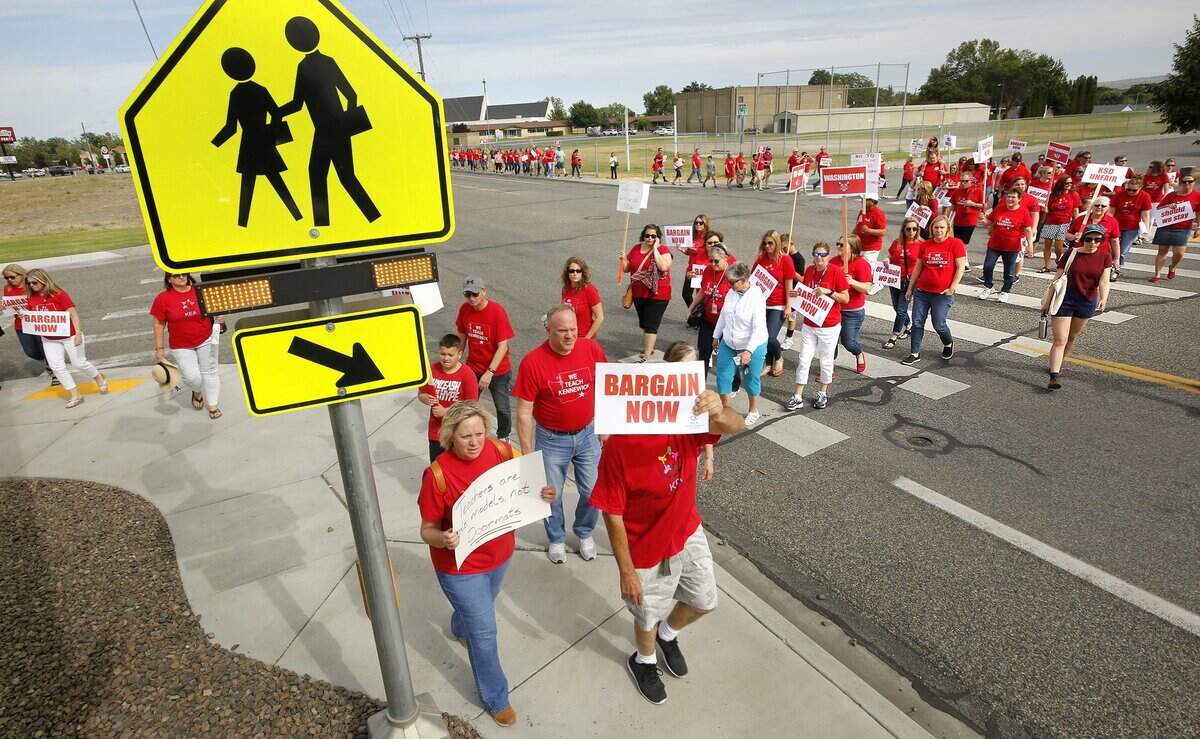
Richland teachers plan to rally Monday as contract negotiations with the school district over raises stretch toward the start of the school year.
Meanwhile, Pasco and Kennewick teachers and administrators also are grappling over the same issue — with Pasco union and district officials headed back to the negotiating table and Kennewick bargainers wading to mediation.
It’s not just a local issue — far from it.
Across Washington, wage negotiations are happening in numerous districts, spurred by an overhaul of the state education funding system and an accompanying $2 billion infusion for educator pay.
As the new school year approaches, the urgency grows. Classes are scheduled to start the last week of August in the Tri-Cities.
Richland teachers want to reach a settlement with the district soon, said Ken Hays, president of the Richland Education Association. It represents about 820 teachers, counselors, school nurses and other certificated workers.
“The last thing we want to do is walk out on the community and our kids,” he said.
But the funding overhaul provides a rare opportunity to raise teacher wages — something that’s worth fighting for, he said.
Rallies also have been recently held in Kennewick and Pasco.
Sticking point
In Kennewick, the teachers union and district have agreed to joint mediation through the state Public Employment Relations Commission. Pasco teachers and district officials return to the bargaining table Monday after days of exchanging proposals.
That district saw a teacher strike delay school by nine days in 2015. In that case, lack of curriculum and materials was a top issue.
This year, pay is the key sticking point in negotiations across the state.
The Washington Education Association has encouraged local unions to push for double-digit raises.
So far, nearly 20 contracts have been settled meeting that goal, the group said.
Othello teachers, for example, negotiated a 17 percent raise.
Under the overhaul — prompted by the state Supreme Court’s 2012 McCleary decision, which said Washington was failing in its constitutional duty to fully fund basic education — all schools districts are seeing net revenue gains, said Rich Wood, WEA spokesman.
The amount varies district to district, but “that’s always the case,” he said.
And it means districts have the money to increase teacher pay, he said.
“The kids in Kennewick, Richland and Pasco deserve to have qualified, experience teachers. ... If a district doesn’t provide competitive compensation, teachers will leave for another district or profession,” Wood said.
New formula
But some school district leaders have said it’s not that simple.
The overhaul includes tossing out the old salary formula, capping the amount of money districts can collect through local property tax levies and restricting what that levy money can be spent on.
It all adds up to an inequitable system, some district leaders said.
Districts with a lot of experienced teachers, for example, may not fare as well because the new salary formula gives a flat allocation instead of taking tenure and education level — and therefore a higher spot on the pay scale — into account.
In districts with a less experienced workforce, the flat amount goes farther.
Some districts qualified for extra money — called “experience factor” and “regionalization” — to make up for differences in experience and cost of living, but almost no local districts made the list.
Richland is the exception; it’s getting some “regionalization” help.
In Kennewick, which has an experienced teaching force, the district is getting about $65,200 from the state per teacher — or about $3,100 less than the actual average wage for a teacher in the district, according to information presented to the school board last month.
The district has about 1,140 teachers, so that amounts to a negative difference of about $3.5 million. And only some of that can be made up with local levy dollars, according to the presentation.
Double digits
The Kennewick Education Association has questioned the district’s figures and said a raise for teachers is long overdue.
The district has said it’s committed to bargaining until an agreement is met.
In Pasco, “the talks have been going well. We just continue to move forward, hoping to reach an agreement soon,” said Shane Edinger, district spokesman.
A representative with the district’s teachers union couldn’t be reached.
In Richland, the union seeks a double-digit raise, Hays said.
The district is set to get about $18.3 million more in net revenue in the coming school year compared to last school year, he said.
“At the end of the day, the district is going to be getting more than they were in the past, and it’s a matter of priorities,” Hays said. “It comes down to doing what’s best for students.
“Retaining the best teachers and providing teachers with the working conditions they need to do their jobs — that makes for successful students. Our working conditions are students’ learning conditions,” he said.
The district has said it still is talking with the union as it seeks “an equitable and sustainable contract for teachers.”
“While there are issues we continue to work through, there also have been many agreements so far in our discussions,” the district said. “We look forward to the successful conclusion of negotiations so teachers and the whole district can focus on the coming school year and serving students.”
This story was originally published August 10, 2018 at 5:12 PM.