
School starts in 3 weeks. Will Tri-City teachers get the raises they want?
Kennewick School District administrators and teachers were back at the bargaining table Tuesday, negotiating over teacher raises.
They didn’t reach an agreement and will meet again Thursday.
Earlier in the week, Superintendent Dave Bond said the district is committed to bargaining and exchanging proposals with the union until an agreement is met.
Janet Bell, president of the Kennewick Education Association, said she’s “always hopeful” progress will be made.
KEA, which represents about 1,200 teachers, counselors and other certificated workers, is pushing for a double-digit pay increase for its members after a $1 billion allocation for teacher salaries statewide.
That allocation was part of an overhaul of Washington’s education funding system touched off by the state Supreme Court’s 2012 McCleary decision, which said the state was failing in its constitutional duty to fully fund basic education.
The school district — which has said it’s hamstrung by the funding changes — has offered a roughly 6 percent raise.
Kennewick isn’t alone in grappling with teacher pay — far from it.
The funding changes have brought districts and unions to the bargaining table in unusually high numbers.
About 150 teacher and support staff contracts usually are open for negotiations during a given summer, but this summer has seen more than 250 contracts fully or partially open, The Olympian recently reported.
Like Kennewick, the Richland and Pasco districts also are in the midst of negotiating.
In a post late last week, the Richland Education Association called its district’s latest offer a “turd wrapped up in a bow.”
The offer amounted to a roughly 2 percent raise, after factoring out a “regionalization” stipend that expires after two years, the post said.
REA’s response to the offer was to “Go back and sharpen your pencils,” the post said.
Richland Superintendent Rick Schulte said his district is continuing to meet with the union to seek an “equitable and sustainable” teacher contract.
“While there are issues we continue to work through, there also have been many agreements so far in our discussions. We look forward to the successful conclusion of negotiations so teachers and the whole district can focus on the coming school year and serving students,” he said in a statement.
In Pasco, which had a teacher strike in 2015, the district and teachers union bargained Monday and Tuesday without reaching an agreement.
They are scheduled to head back to the table Thursday.
“Both sides are working diligently to reach a resolution,” the district said in a statement, adding that, “we trust that the bargaining teams will work collaboratively together to reach an agreement that is satisfactory to both sides.”
School is scheduled to start the last week of August in the Tri-Cities.
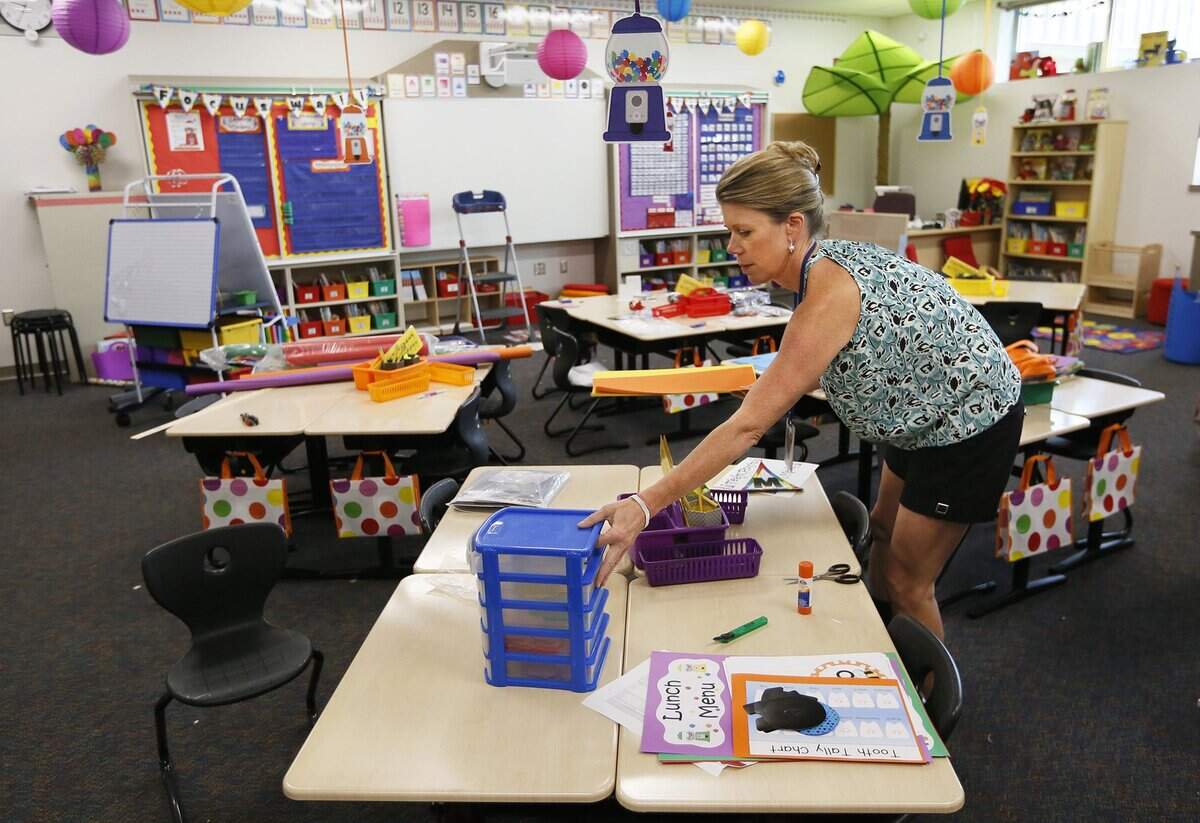
.jpg "school (2).jpg")
At a Kennewick School Board meeting last month, Bond described challenges posed by the funding overhaul. It sets up a system of inequity, he said.
All told, Kennewick is getting about $65,200 from the state per teacher — or about $3,100 less than the actual average wage for a teacher in the district, Bond said.
Kennewick has about 1,140 teachers, so that means a negative difference of $3.5 million.
Some of that difference can be made up with local property tax levy dollars, but not all of it, Bond said. As part of the overhaul, legislators capped the amount districts can bring in through local levies while also limiting what the levies can pay for.
Legislators also threw out the old way of paying for teachers, jettisoning the “staff mix” formula that factored in experience and education and instead giving a flat amount. That’s hard on districts like Kennewick, with many teachers who land high on the pay scale due to their years of experience and advanced degrees.
In districts with less experienced teaching forces, the flat amount goes farther.
The state is giving some districts extra money— called “regionalization” and “experience factor” — to make up for varied cost of living and teacher experience. But Kennewick didn’t get either.
Bell said her group “would argue with some of (the district’s) figures.”
The district has money for raises — it’s getting millions specifically for teacher pay, Bell said.
It comes down to will and priorities, she said.
“The bottom line is, either your staff is a priority or it’s not,” Bell said.
She also said a meaningful raise for teachers is “way overdue,” and is critical to retaining teachers and attracting new ones to the district.
“There is a teacher shortage, and we can’t attract the young bright people to teaching because wages aren’t competitive with other fields,” she said.
This story was originally published August 7, 2018 at 12:18 PM.