
Report reveals what happened just before deadly Columbia River float plane crash
AI-generated summary reviewed by our newsroom.
- Pilot of crashed plane called to ask about refueling in Tri-Cities before flight
- Pilot Randy J. Peterson and passenger Eric Wayne Houston died in the June 24 crash.
- Wreckage detailed in preliminary NTSB report
A float plane that crashed into the Columbia River near the Tri-Cities cable bridge apparently was attempting to land in the water when it hit a high tension transmission line, according to information in a preliminary report of the National Transportation Safety Board.
Pilot Randy J. Peterson, 64, and his passenger Eric Wayne Houston, 50, both of Sonoma, Calif., died in the June 24 crash.
Peterson, who was an owner of the plane, had called the Port of Kennewick before the flight to ask about buying fuel at the port’s marina at Clover Island in Kennewick just west of the cable bridge, the report said.
On the day of the crash, Peterson contacted the air traffic control tower at the Tri-Cities Airport when he was about 14 miles south of Pasco, the report said. The pilot said he was flying a float plane and intended to land on the Columbia River.
The controller said that landing would be at the pilot’s own risk and transmitted the Tri-Cities Airport’s wind and altimeter setting. There was no wind that afternoon and visibility was about 10 miles, according to the NTSB report.
The controller asked that Peterson report when his landing was assured and Peterson agreed, but that was his last transmission to the control tower.
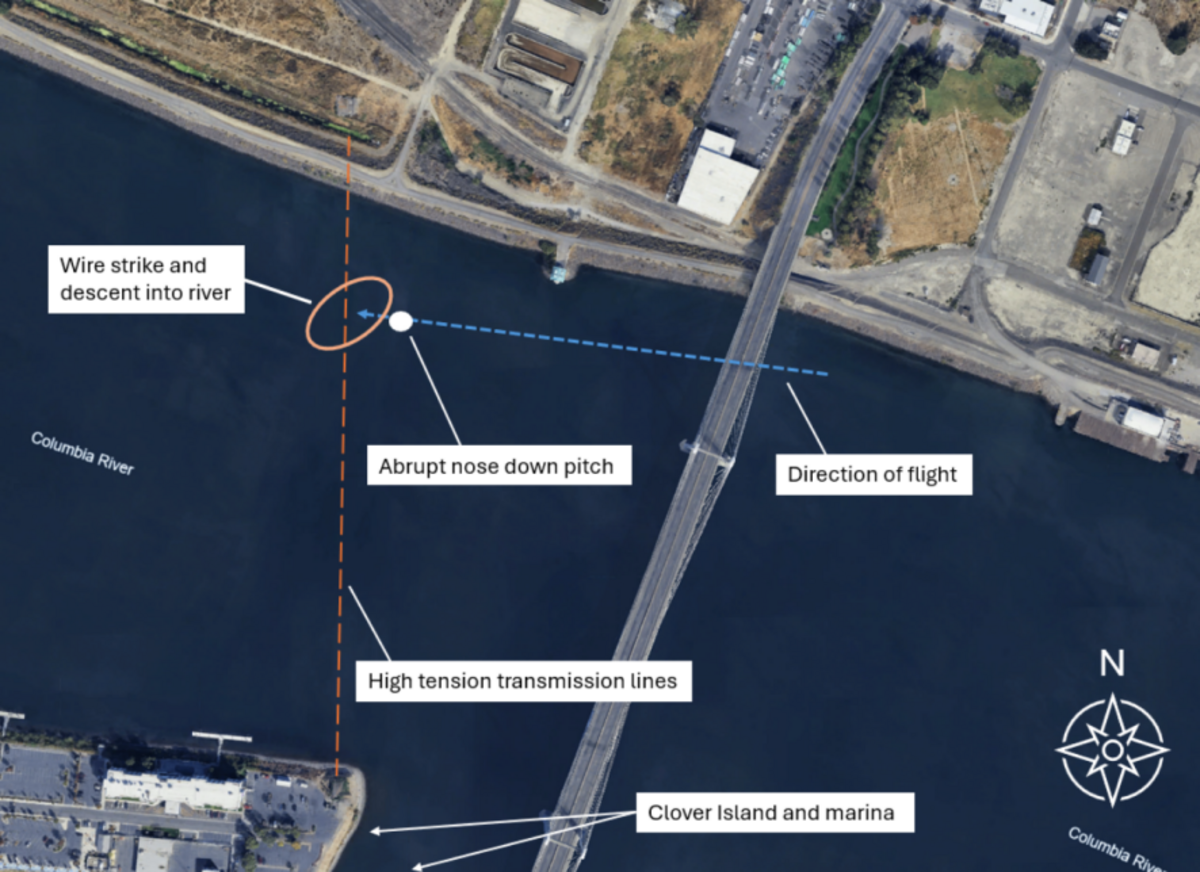
The NTSB collected multiple witness accounts and videos, showing that about 2:30 p.m. the Cessna 195 equipped with floats flew over the cable bridge from east to west and continued for about nine seconds, before its nose abruptly pitched down.
One second later it hit a Benton PUD transmission line across the river about 1,040 feet west of the bridge, the report said.
A witness to the crash told the Tri-City Herald that the pilot appeared to dip to try to avoid 140-foot-high transmission lines, but one of its wings hit the bottom line.
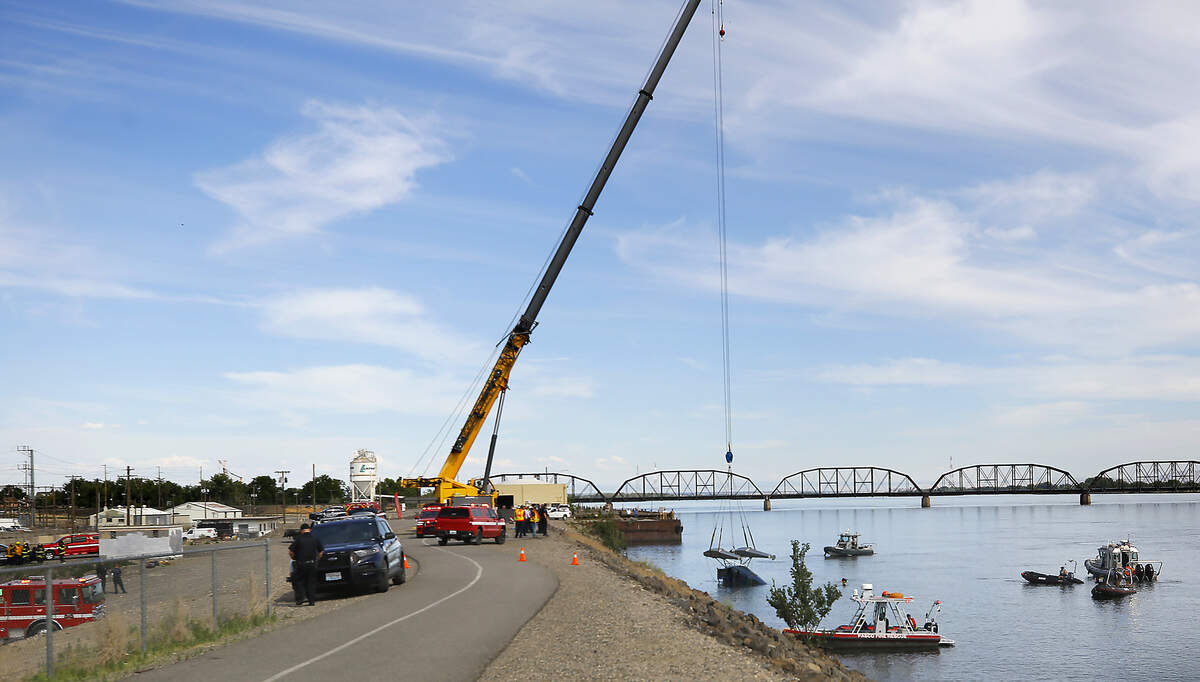
The plane plummeted into the water and came to rest about 100 to 200 feet from the river’s Pasco shoreline, according to the NTSB report.
When Peterson had called the Port of Kennewick, he had been given information about the port’s dockside fueling station plus information about mobile fueling services if more fuel was needed than the port could provide.
The plane had taken off from its base on the Napa River near Napa, Calif., on the morning of the accident on its way to the Tanglefoot Seaplane Base at Priest Lake’s Cavanaugh Bay in Idaho. A gathering of seaplanes was planned there.
No flight plan was filed, but Houston’s family provided information about his plans to the NTSB.
Damage to crashed plane
The crashed airplane was removed from the river by a Lampson crane and set down on its right side about 1,500 feet downriver from where it went into the water, according to the NTSB report.
The floats and float struts, the tail, propeller and engine all remained attached to the fuselage.
However, both wings were separated from the fuselage at their roots and had crushing and denting, with the left wing having additional crushing and tearing at mid span, the report said.
Both wing flaps were in the extended position, but the left wing’s aileron, a hinged flight control surface that helps control a plane’s rolling or banking, was no longer attached to the plane when it was lifted out of the water, the report said.
Mid-Columbia Dive Rescue and the Benton County Sheriff’s Office Marine Unit searched the river for the aileron, but it was not found.
The wreckage has been secured for further examination.
Because the NTSB report is preliminary, some details it includes may change, NTSB said.
This story was originally published July 14, 2026 at 4:36 PM.