600+ Tri-City properties have race restrictions. Is your house on the map?
AI-generated summary reviewed by our newsroom.
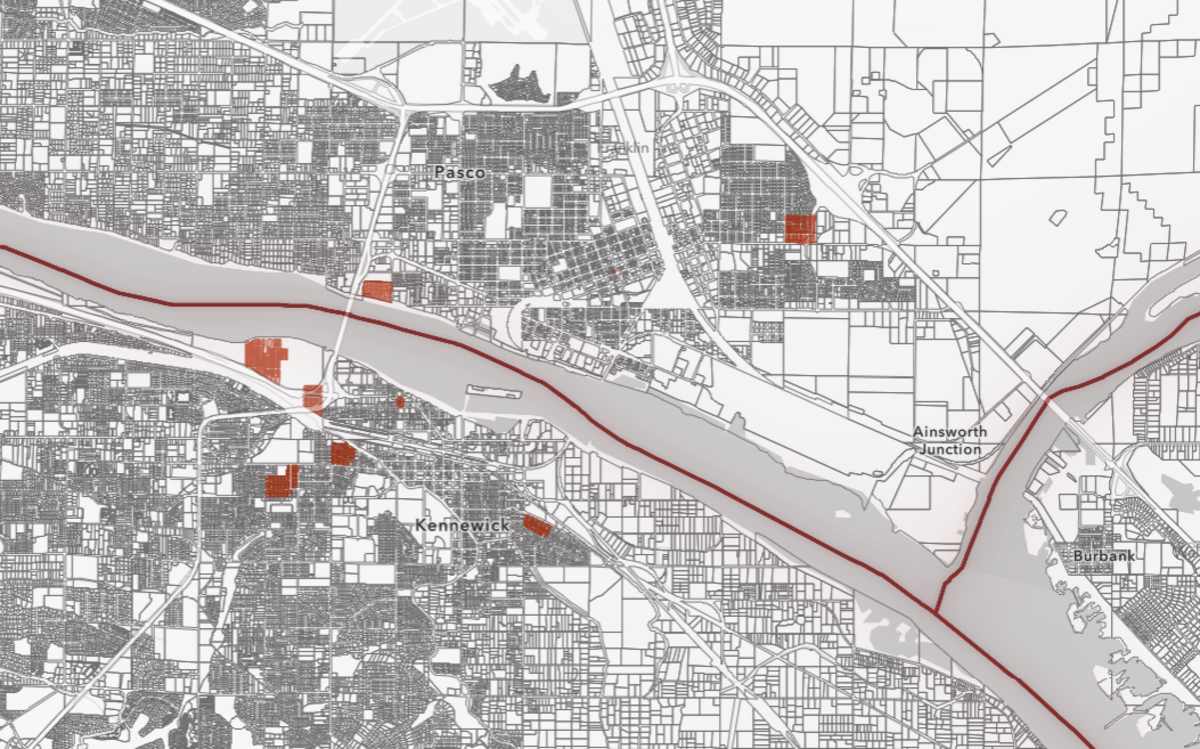
- Washington mapped 539 Benton County and 90 Franklin County parcels with racial covenants.
- Evergreen State will be first in the nation to trace and map non-enforceable covenants.
- State law allows homeowners to amend/remove covenants via county auditors or court action.
Tri-City residents can now verify if their property is tied to any covenants that historically prevented non-white residents from buying or living on the land.
A final tally by the Washington State Racial Restrictive Covenants Project identified 539 parcels in Benton County and 90 in Franklin County that had some form of racial covenants attached to them. Washington will soon become the first state in the nation to have identified, documented and mapped all of its racial covenants.
Tri-City property owners can access a map of the affected properties online.
These clauses — non-enforceable under today’s laws and legal interpretations — are typically found on plat maps, HOA bylaws, deeds or other publicly available property records. They’re a product of 20th century housing discrimination, and were used to segregate and bar people of color from owning property in certain neighborhoods.
Many property owners whose property is tied to a covenant do not know they exist. That’s partly why the Legislature created the project through House Bill 1335 in 2021, and tasked two universities with tracking down and documenting every covenant in the state.
Stacy Warren, a professor of geosciences at Eastern Washington University and a lead project cartographer, says their multi-year work documenting every covenant in the 20 counties east of the Cascades will come to a close this summer. Work is wrapping up on the final two counties: Yakima and Asotin.
Research teams at University of Washington finished their work, and documented covenants affecting more than 100,000 properties across 19 Western Washington counties.
Warren said this project ensures that a really important era of American history and discrimination is not forgotten, and that it’s brought to the surface for homeowners, historians and the public to scrutinize.
“Bringing that history to life and making sure that we always have access to that information is important,” she said.
“It puts information in people’s hands that they can use right now, and they can move forward and understand how decisions made in the past that were ultimately and completely racist are still affecting how urban landscapes have developed, and what opportunities people have today,” Warren continued.
Covenants found in the Tri-Cities
Researchers initially believed covenants would be found on thousands of Tri-City properties. But some subdivisions were never built or were later demolished, while other property was later consolidated or altered.
For example, the Flamingo Village Mobile Home Park in Pasco is currently divided into three parcels, but a 1940 plat included a covenant on dozens of properties that barred “no person of any race other than the Aryan branch of the Caucasian race” to use or occupy the buildings.
An exception was made for “domestic servants of a different race” who would live with the white tenant.
The appearance of racial covenants in property documents peaked in the 1930s, 40s and 50s in Washington, said project managing director Larry Cebula.
In 1948, a U.S. Supreme Court decision, Shelley v. Kraemer, found that racially restrictive covenants in property deeds violated the equal protections provision of the 14th Amendment and were unenforceable.
But developers kept writing covenants well into the 1960s, since placing them in property records still wasn’t illegal. That practice changed with the 1968 Fair Housing Act. Covenants in Washington have been void since 1969.
In the Tri-Cities, covenants, paired with the especially potent tool of redlining and other discriminatory housing practices, stymied generational wealth for generations of Black Americans, researchers say.
Today, white Washingtonians are twice as likely to own a home than Black families. But the state is taking reparative actions to help families affected by the discrimination through programs such as the Covenant Homeownership Program.
Kennewick, a prominent sundown town of the time, was deemed the “Birmingham of Washington” by a former northwest branch president of the NAACP. Prior to the civil rights movement, most Black Tri-City families lived in east Pasco, which was underdeveloped and saw little economic investment.
Don’t ‘excuse the dead’
More than 250 homes in the Glenn Memorial Park neighborhood in West Richland required “land use and/or occupancy to be limited to members of the white or Caucasian Race” at one point.
And in Kennewick, the Vista Homes subdivision — south of the Zintel Creek Golf Course — restricted nearly 150 homes with similar language seen on the Flamingo Village properties.
Covenants have also been found on properties in Nob Hill in East Kennewick and Hatfield Park in Kennewick. The old downtown Hotel Pasco property also restricted certain tenants.
“They’re kind of a reaction to an influx of diversity,” said Cebula, referencing the migration of workers from the South to the area during the top secret Manhattan Project. “In the Tri-Cities, these covenants were never the standard operating procedure.”
The associate professor of history at EWU explained that applying a racial covenant to homes was almost always a strategic choice and never the “default option” for many developers or homeowners.
Across Eastern Washington, researchers found covenants on whole cemeteries and even town plats. Though they found none in six of the region’s least populated counties — Okanogan, Ferry, Lincoln, Pend Oreille, Columbia and Garfield.
Each mapped covenant often leads to more questions and rabbit holes for researchers, Warren said. She said she’ll keep researching covenants even after the project ends.
“I have no interest in stopping,” she said. “It’s too exciting.”
The total number of affected parcels in Eastern Washington is hard to predict since so many are still yet to be processed in Yakima County. Spokane County alone has about 5,700 properties identified.
“It tells me they’re racist,” Cebula said of the individuals who placed these clauses. “It’s not complicated here, and we shouldn’t bend over backwards to excuse the dead.”
How to remove a racial covenant
“We have uncovered an untold chapter in Washington state history, but also provided a tool for homeowners who want to remove or amend these covenants,” Cebula said.
State law provides two ways for homeowners to amend or remove covenants found on property documents.
They can be modified through the county auditors office in Benton and Franklin counties. This route essentially adds a statement to strike all “void and unenforceable” provisions within the document, and provides notice in the land title records to deem them useless.
It does not delete or physically erase the language within the historical record, though.
Removing the racial covenant from a property document is trickier and require an attorney.
This process allows the owner, occupant or tenant to have it stricken from the document by bringing an action in superior court of the county in which the property is located. EWU researchers are working to build a connection with a nonprofit legal firm that could provide this service.
Despite the non-enforceable nature covenants hold today, Cebula urged property owners to amend or remove any that they may find on their property documents. Civil rights can be eroded by courts and legislation, he argues.
“If you’ve got one of these, do something about it,” Cebula urged. “You’ll feel better.”