Verdict in on multimillion dollar lawsuit over ‘tyrant’ ex-Benton sheriff
AI-generated summary reviewed by our newsroom.
- Jury awarded damages to six deputies for Hatcher's intentional abuse.
- Jury allocated separate economic and non-economic awards across plaintiffs.
- County’s attorney has said they will likely appeal
After a monthlong trial detailing the abuse deputies suffered at the hands of former Benton County Sheriff Jerry Hatcher, a Walla Walla County jury has awarded the men about $1.4 million total.
The jury’s decision came Friday afternoon after more than four hours of deliberation.
The county’s attorney Andrew Cooley told the Tri-City Herald that they were pleased with the outcome and didn’t anticipate an appeal.
Cooley said the county made multiple attempts to settle before the trial, but they couldn’t find an agreeable settlement amount.
“This was a case the county wished and wanted to settle, it was a shame we couldn’t settle it and the jury had to sit through four weeks of testimony of things that were not material,” he said. “We think their veridct reflected the actual damages and is a just result.”
The group of current and former employees asking for millions in damages include Commander Mat Clarke, Lt. Jason Erickson, Undersheriff Jon Law, Lt. Erik Magnuson, Steve Caughey and Todd Carlson. Caughey and Carlson alleged they were forced out of their jobs.
How much did each deputy get?
The jury made their decision based on two categories, economic and non-economic damages. The jury found that Hatcher intentionally inflicted emotional distress on five of the six deputies.
Jason Erickson - $21,495 in economic damages. $200,000 in non-economic damages.
Erickson was the department’s public information officer and self-demoted to a patrol position to get away from Hatcher.
Steve Caughey - $120,000 in non-economic damages. $365,000 for constructive discharge.
Caughey was a commander before being forced out of the department. He ended up working for a cable company for less than half his sheriff’s office salary and lost access to future contributions to his law enforcement retirement account.
Erik Magnuson - $50,720 in economic damages. $235,000 in non-economic damages.
Hatcher was accused of going after Magnuson’s wife’s businesses and of forcing another deputy to violate whistleblower protections to identify him as a complainant.
Jon Law - $250,000 in non-economic damages.
Law was the highest ranking member of the command staff for most of Hatcher’s tenure.
Mat Clarke - $155,000 in non-economic damages.
Clarke was the only other member of the command staff that did not self demote or resign, leaving him to deal with Hatcher daily.
Todd Carlson - The jury did not award Carlson damages. They found that his treatment did not rise to the level of constructive discharge.
He was the only member of the group of defendants that wasn’t part of the command staff, but was in charge of training for the department. His involvement came after he investigated ammunition allegedly stolen by Hatcher. The former sheriff tried to manipulate Carlson’s answers during a later interview about the case.
Prior attempts to settle
Cooley said Benton County leaders made several previous attempts to settle, including an offer of $1.5 million just before the trial began.
He said those negotiations had fallen apart because the settlement the deputies were asking for, $34 million in earlier negotiations and a later request of $19 million, was just too high and would have left the county in a position where it would need to sell bonds to cover the costs.
The county also tried offering to settle with everyone but Clarke and Carlson for $2.4 million, Cooley said.
“Our offer was met with silence. They didn’t respond, they didn’t say we’ll settle at $19 million,” he said. “So we went into this trial with a gun to our head ... we went in with no offer, no ability to negotiate it.”
Cooley said the county would have been happy to have settled earlier, and the deputies could have walked away with a still life-changing amount of money.
“This is a slam dunk win for the county, this is a stunning result,” Cooley said.
“While Hatcher had done some bad things to these plaintiffs, the jury found their testimony exaggerated, would be my read of their decision,” he said.
With this verdict, the Washington Counties Risk Pool should help Benton County cover the expense of the jury’s decision.
Cooley said he was glad to have the years-long case behind them, and was looking forward to beginning his retirement.
$36 million question
The deputies’ attorney, Eron Cannon, said in his closing statements Friday morning that the jury should consider awarding not only lost wages, but $2 million to $6 million each in non-monetary damages. That put their potential total award at $36 million, plus $2 million to $3 million more in lost wages.
Walla Walla County Superior Court Judge Brandon Johnson told the jury that damages for each of the plaintiffs had to be considered separately, based on the extent of the fallout. For Caughey and Carlson they were told to consider the impact of being forced out of their jobs had on the men.
The deputies allege that Hatcher’s “tyranny” cost them jobs or promotions, damaged their careers, destroyed their home lives, left them with PTSD and nearly drove some to consider suicide.
It was the deputies themselves who eventually forced Hatcher out of office, after they organized a successful recall election. He was the first sheriff in the state’s history to be removed from office by voters.
Carlson’s damages also were to include consideration for whether the treatment he was subjected to made worse his PTSD from his military service. When he took the witness stand in November, Carlson broke down while talking about the horrors he witnessed as part of peacekeeping forces deployed to Mogadishu, Somalia and Kuwait in the early 1990s.
Carlson told the jury he was a military police officer in the U.S. Army when he was deployed to Somalia as part of a United Nations peacekeeping taskforce amid the fallout of a civil war where millions were at risk of dying of malnutrition. The country began to descend into chaos while he was there.
Just months after Carlson left the country, the escalating civil war led to events later immortalized in the film “Black Hawk Down.” He was later sent to Kuwait as part of the reconstruction efforts following the Gulf War.
Cannon said that in an ironic twist, these officers who were accustomed to dealing with criminals on the street found themselves with one as their boss.
Law told the jury last week that Hatcher admitted to the crimes, and was proud of them. He said his inability to protect his fellow deputies from Hatcher nearly drove him to suicide.
“It took courage to stand up against a tyrant at great personal expense to themselves and their families,” Cannon said. “What if they did turn a blind eye or worse were complicit in covering up his crimes?”
He reminded the jury that their instructions are to consider the county responsible for anything Hatcher did.
“Hatcher is the county, any attempt to put daylight between them is inappropriate and against the law of the case,” Cannon argued.
He closed by pointing out that Hatcher’s actions were so egregious that he left for Montana before the recall process was over and hasn’t been heard from since. When considering damages, they were tasked with weighing whether Hatcher’s behavior would be tolerable in a civilized society.
“I hope he stays deep in the woods of Montana, and he is a dictator for one,” Cannon said. “That would be good for a civilized community.”
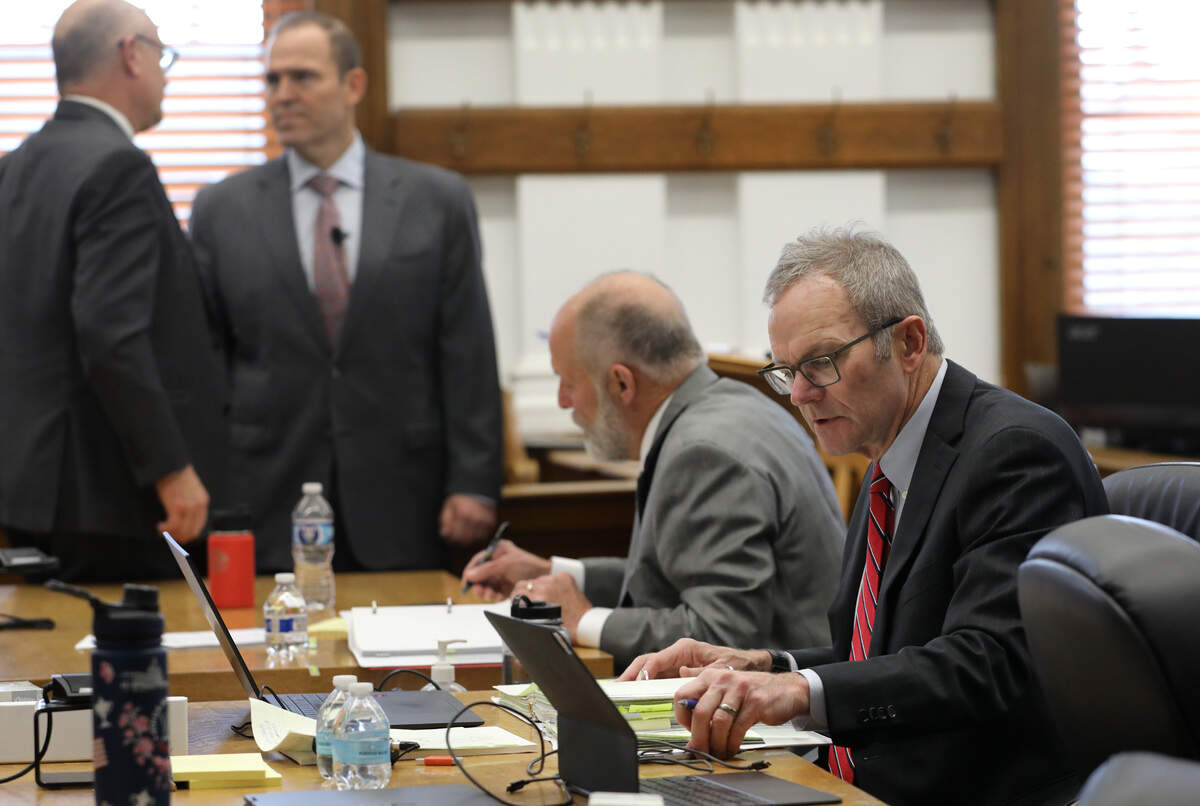
Benton County leaders didn’t sit idly by
However, Cooley contended no one outside the group fully backed up their account of the extent of the abuse.
He said Benton County leaders did everything they felt they legally could to limit Hatcher’s power.
The jury was not told that there was another defendant, Tom Croskrey, who dropped out of the case before trial because he took over the office and was elected sheriff after Hatcher was ousted.
They saw in depositions that Hatcher went so far as to threaten Croskrey’s son, who was a deputy, with an internal affairs investigation.
They heard from county leaders that Hatcher was a bully, how he mistreated people around him and that some in human resources were concerned for their safety.
But also heard the unprecedented steps those leaders took to try and rein in Hatcher.
“When this case started it was all about Jerry Hatcher, he’s an ammo stealer and a wife beater,” Cooley said before he reminded the jury that despite the many instances of evidence and testimony that Hatcher may have committed crime, the jury was not deciding if a crime happened.
He told the jury that during deliberations they should be ready to remind each other that they’re only allowed to evaluate the alleged crimes as to how it impacted the deputies.
“Why are we talking about that if we aren’t deciding crimes? What difference does that make?” Cooley asked.
He said that if the testimony about Hatcher’s potential crimes were stripped away, the jury would have participated in a much different trial.
“We would have had a three- to five-day trial about long meetings, glares in the hallway and empty threats. And that isn’t gonna get you 36 million bucks,” he said.
Cooley said the deputies should be thanked for their role in getting Hatcher removed from office, but the jury shouldn’t consider that in their calculations.
Cooley told the jury he believed the men should receive $2,000 to $10,000 in non-economic damages, with the exception of Magnuson. He claimed Magnuson misled the jury about Hatcher threatening to hurt his wife’s security business.
He closed by telling the jury that the only way to achieve justice was by closely following the law and the instructions laid out by the judge. He also said the jury should consider a verdict in favor of the defense.
Cannon shot back that Cooley was trying to save the county money by mocking the deputies and minimizing their experience, such as questioning their choices when it came to attending therapy.
“Predictably there was a denial of responsibility and denial of reality, lying liars is what they all are (according to Cooley),” he said.
Hatcher investigations
While the first few weeks of the trial focused on emotional testimony about an out of control sheriff, the last week examined the complexity of trying to deal with an elected official accused of committing crimes and abuses of power.
The case focused on actions by Hatcher from 2019 to late 2021.
The trouble began shortly after Hatcher was elected to a full term as sheriff. In 2019, he was accused of domestic violence by his ex-wife Monica Hatcher.
During the course of that investigation the deputies detailed how Hatcher’s behavior escalated, with demands for loyalty and threatening anyone who spoke to his ex-wife.
Hatcher allegedly forced Monica Hatcher to retract her domestic violence claims, according to multiple investigators. He was subsequently investigated for witness tampering, but charges were never filed.
Hatcher then began trying to put the deputies on the “Brady List” to effectively kill their career in law enforcement.
The potential impeachment disclosure list, more commonly known as the “Brady List,” contains witnesses whose integrity and trustworthiness could be questioned if they were called to testify that is normally kept by the prosecutors. It’s often considered a “career-ender” for law enforcement.
He was stopped by now-retired Prosecutor Andy Miller, who had the final say on adding officers to the list. Miller told the jury Thursday that he threatened to strip Hatcher’s legal protections so he could be personally sued if he continued to retaliate against county employees.

Miller later placed Hatcher on the Brady List.
He also helped ensure an outside non-criminal investigation took place and later worked with Washington State Patrol to open another investigation into the alleged theft of more than 14,000 rounds of ammunition.
County leaders testified in previously recorded depositions that they had Hatcher locked out of certain areas of the building, because human resources employees worried he would get violent once he was recalled by voters.
The criminal investigations didn’t result in any charges, but they were used as the basis for the recall petition deputies later filed.
The Washington state Supreme Court said it was likely Hatcher had committed crimes, in a 47-page document explaining their decision to allow the recall election.
County leaders have acknowledged Hatcher’s behavior was egregious and abusive, but have maintained they did everything they legally could to stop him.
Commissioner Jerome Delvin testified that they worked to ensure the deputies knew the county was willing to help pay for any mental health resources they needed.
This story was originally published December 5, 2025 at 5:31 PM.