New basalt rocks appear in Columbia Park and along the river. What are they for?
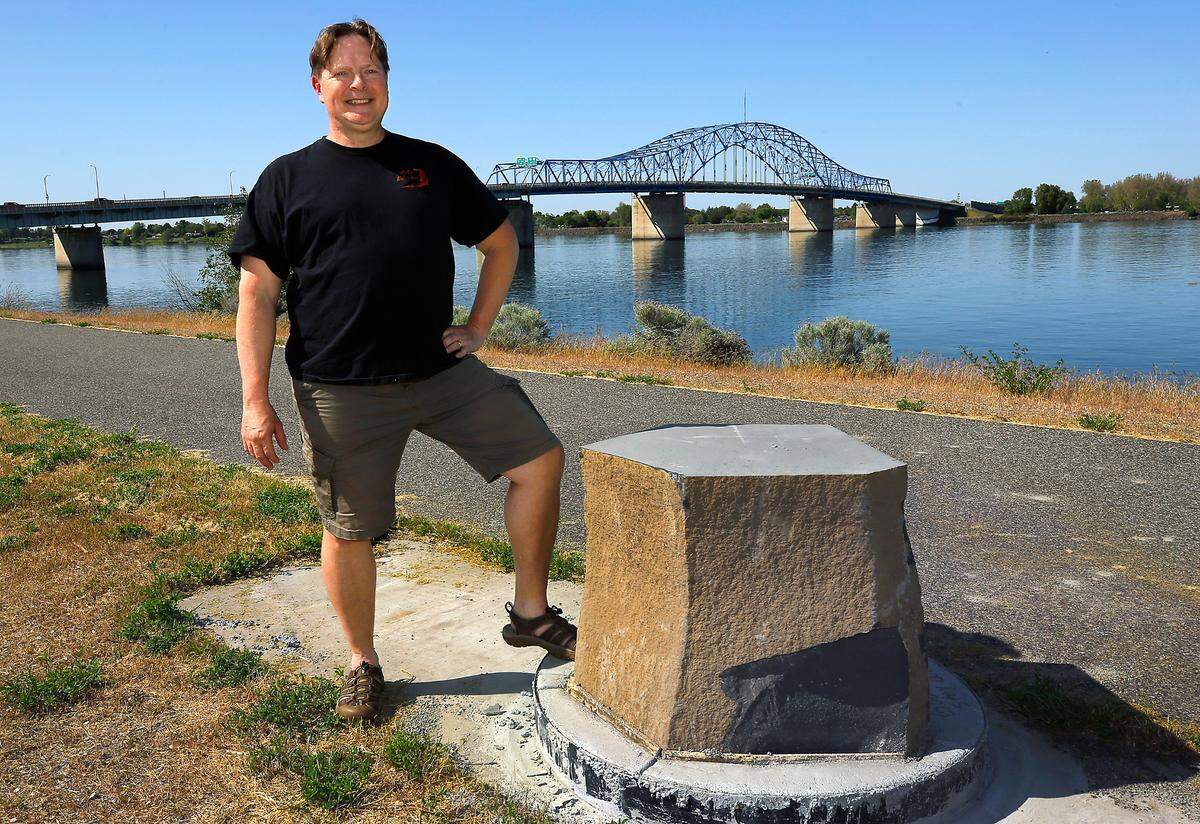
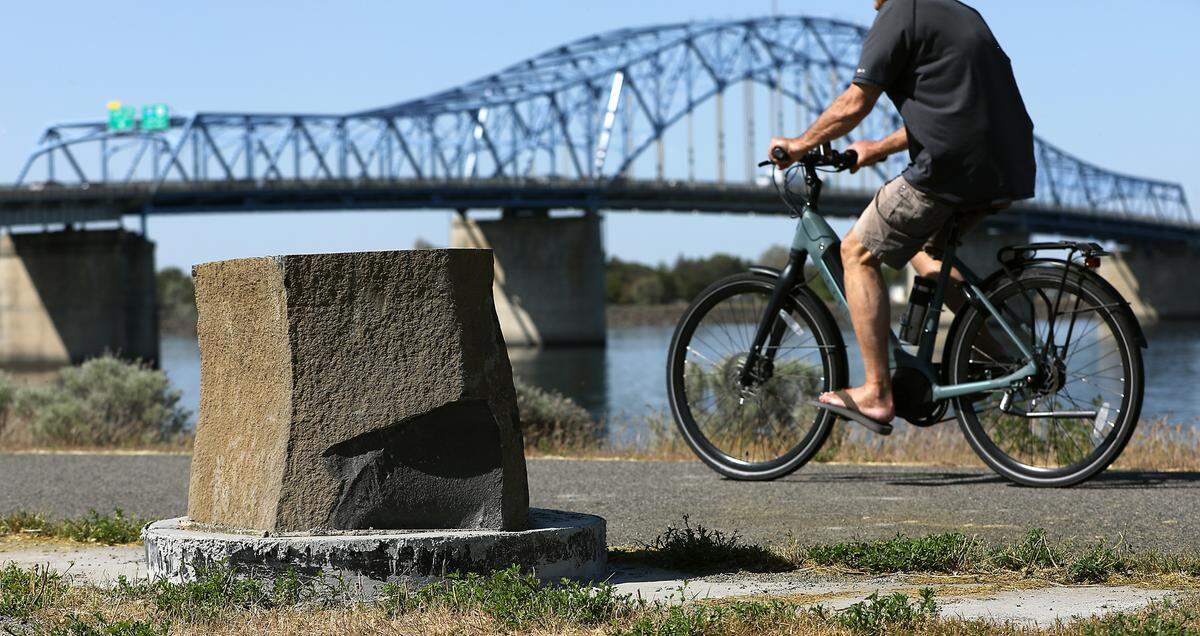
Runners, bicyclists and walkers in Columbia Park have probably noticed a couple 1,500-pound basalt slabs installed along the path in recent days.
Those are part of one local teacher’s decades-long project to educate young and old about the size and scale of our solar system.
Trevor Macduff, 51, of Pasco, says collaboration has been at the core of the Hanford Reach Solar System project — whether it’s organizations, cities, federal institutions or shop workers, many have lent a hand in the past decade.
“The people have been the journey,” said Macduff, community learning coordinator at Rivers Edge High School. “It’s gotten to the point where I go, ‘I don’t know how to do something. Let’s go find out.’”
The project is a scale replica of the solar system nearly 80 miles in diameter, spanning the Mid-Columbia — from Boardman, Ore., to Connell.
Every one mile traveled away from the sun is equal to about 114 million in the actual solar system. In real life, the sun and Pluto are nearly 4 billion miles apart, according to NASA — but in the Mid-Columbia, just 32 miles separates them.
“We’re building an adventure, not a picnic,” Macduff said.
Hanford Reach Solar System
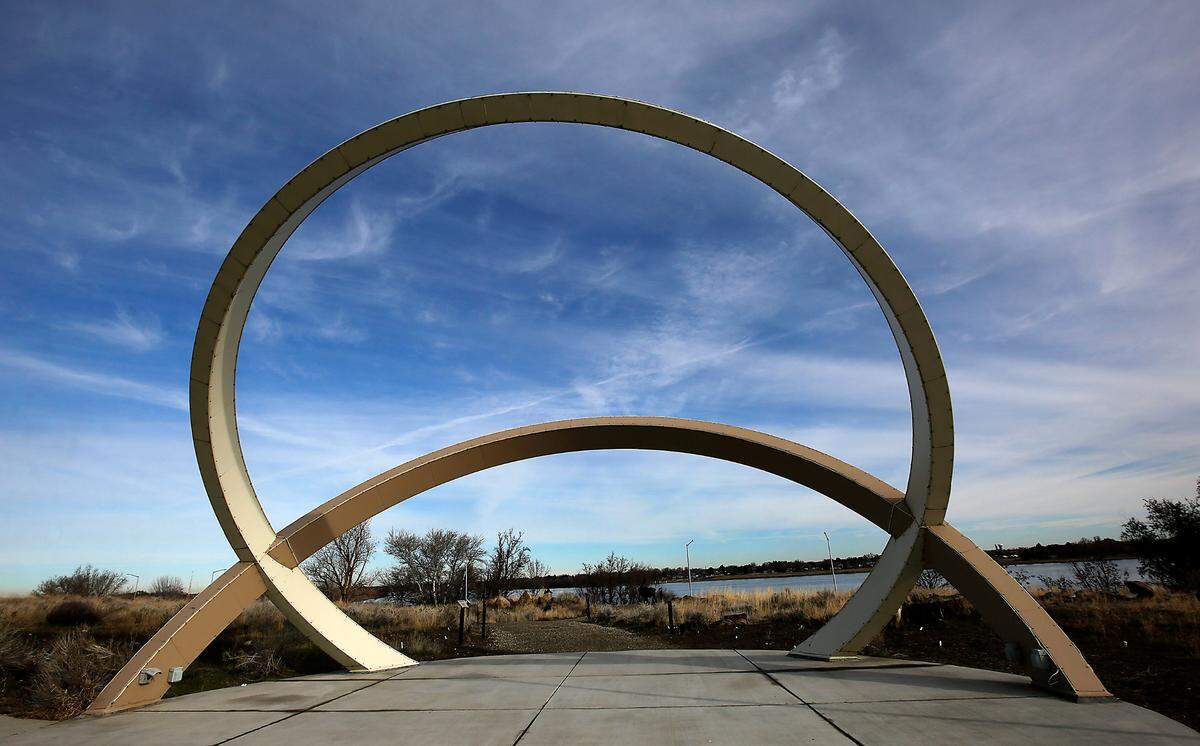
The center of the model system is a unique 40-foot arching sundial designed by Macduff’s students to represent the sun. The arches align during the summer solstice and both equinoxes.
The sundial at the REACH Museum at 1943 Columbia Park Trail in Richland. Its closest neighbor is Mercury, just west of the Columbia Park Marina.
Go a little further and you’ll find Venus at the Wye Park boat launch. Earth is just 0.8 miles away from the sun and can be found west of Wye Park along the Tapteal Greenway Trail.
And Jupiter is at the north end of Howard Amon Park near the Richland Rotary Centennial gazebo.
Saturn is at the USS Triton Sail in north Richland, and Uranus lies along a walking trail west of 14th Street in Benton City.
Neptune has been installed at the Prosser Wine and Food Village.
Pluto will eventually be in the Hanford Reach National Monument.
When it’s done, more than 40 markers and planets will be scattered around the region, each playing a celestial role to connect students on the ground with the stars above.
Macduff met the Herald this week at the Jupiter basalt marker along the Columbia Park Trail, just east of the blue bridge.
It’s incomplete but meant to represent the orbital path of the gas giant, and is about 4.4 miles as the crow flies from the Reach Museum sun.
Macduff said he’s been working in collaboration with the U.S. Army Corps of Engineers, which controls the Columbia Park shoreline.
He installed six new rocks in the park on April 11. Then, he and crews laid concrete around the Kennewick pieces and four others recently placed in Richland.
By the end of May, he will be finished installing all the solar markers in Richland. Then, in November, he plans to come back to finish the new additions in Kennewick.
He expects to eventually hold a ribbon cutting ceremony.
“The beautiful thing about the Columbia Park stretch is it’s the longest stretch of the whole project where you can see this many planets on one road,” Macduff said.
“I can actually fund a student classroom field trip to go visit the REACH (museum), learn about the sun, and then start heading east here through the park. They’ll visit Mercury, Venus, Earth, Mars, Ceres and end here at Jupiter and then be on their way,” he continued.
New basalt markers
East of the Jupiter marker would be a slab in Two Rivers Park in Kennewick representing Saturn. Then, a Uranus marker around Ice Harbor Dam.
He started talking with U.S. Fish and Wildlife last fall to begin work on Pluto, and has since received some seed money from 3 Rivers Community Foundation.
But the feds tell him it will be 15 to 18 months before they can get approval for the beloved dwarf planet.
All told so far, at least $100,000 has gone into the Hanford Reach Solar System project. Macduff said the project has been led, designed and built by local organizations, like the REACH Museum, which installed the sun, and Leadership Prosser, which spearheaded Neptune.
Macduff operates a STEM education nonprofit called SILAS Education, which he incorporated in 2018. Most of the $35,000 in donations he’s received has been in in-kind donations like labor and materials.
He got inspiration for the model in 2001, during a professional development meeting at Western Washington University. He was making a miniature model of the solar system out of Play-Doh when he had an epiphany.
“The sun was 1-inch diameter, and from there the rest of the planets were microscopic. But I was inspired, going, ‘There’s a lot of empty space out here. This is interesting.’”
Textbooks and TV shows rarely show the scale of both the system’s size and orbital distance. The amount of empty space and difference in size, he says “is just kind of crazy.”
“With how small we are compared to how big this planet is, but how small this planet is compared to the solar system, it really starts to make you think about our role — let’s take care of each other, let’s take care of this place we live on, let’s see if we can’t show a little more love to people,” he said.
“That scale, it’s just — well, pun: It’s astronomical.”
This story was originally published May 5, 2025 at 5:00 AM.