
Franklin PUD sued over its elections. Latino citizens shut out of choice, lawsuit says
The Franklin PUD has been sued by two Pasco residents over an election system that they say unfairly and illegally dilutes the vote of Latino residents.
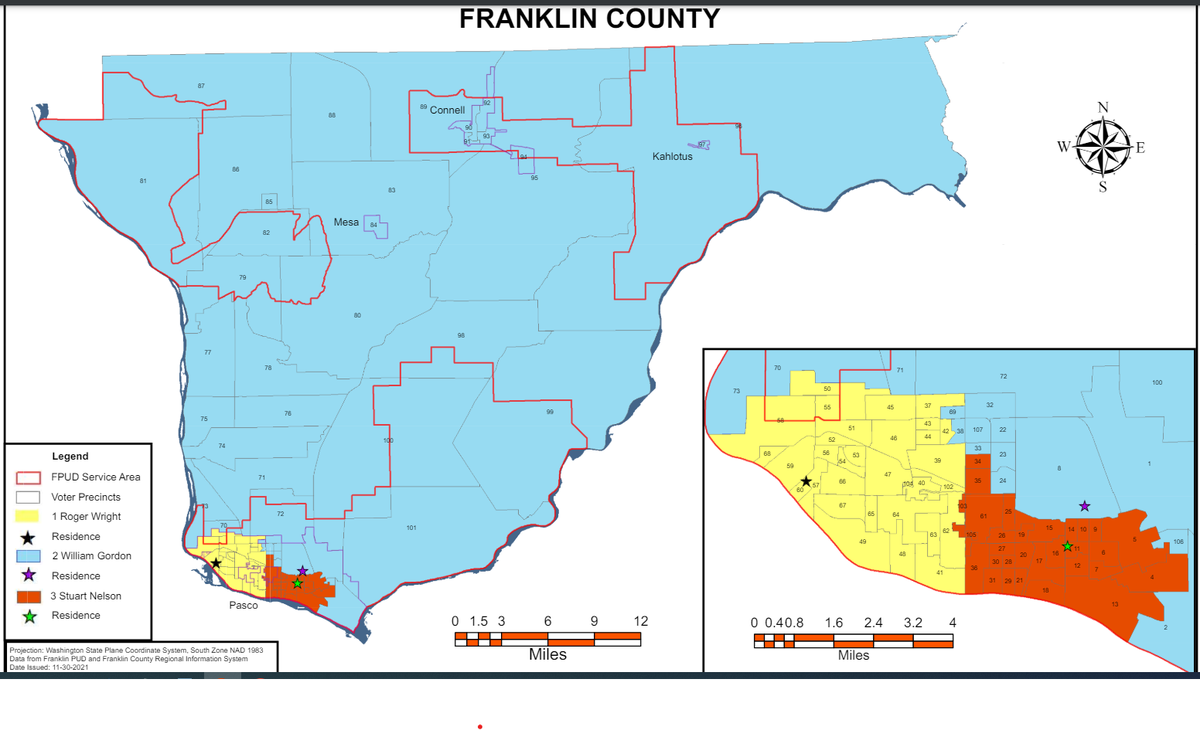
The current district map “prevents Latinos from being able to successfully elect candidates of choice to the commission in primary elections because the district map cracks the Latino population of East Pasco,” the lawsuit said.
“Second, due to strong racially polarized voting in the area, the at-large method of general elections prevents the Latino minority from having a meaningful opportunity to elect candidates of choice,” it said.
The lawsuit was filed this week by Jose Trinidad Corral and Gabriel Portugal, members of the of the League of United Latin American Citizens, just days after the Franklin Public Utility District Commission directed the PUD general manager to take steps to change to a district general election system.
Currently, the Franklin PUD is divided into three districts for the PUD commissioners. Only district residents vote in the primary to narrow the field of candidates to two. But in the general election, all residents of the PUD vote on any commission seat up for election.
Three months ago the UCLA Voting Rights Project and Morfin Law Firm notified the public utility district based in Pasco it had 90 days to respond to its challenge of the PUD election system. If the response was unsatisfactory, it was prepared to take further legal action, it said.
The lawsuit said the PUD voting system needs to be replaced with an entirely district-based system and for the three districts to be configured to provide Latinos with an equal opportunity to elect candidates of their choice.
“The current voting system not only contravenes the Washington Voting Rights Act, but also contradicts the democratic values of equal and fair representation,” said Sonni Waknin, program manager at the voting rights project.
The lawsuit seeks a declaration that the current system violates the law and a court order to adopt a new election system that ensures Latino voters can elect candidates of their choice.
Pasco, Franklin County changes
Hispanics make up 37% of the voting age population of U.S. citizens in Franklin County, but no Hispanic person has been elected to the three-person commission in at least 20 years, according to the UCLA Voting Rights Project.
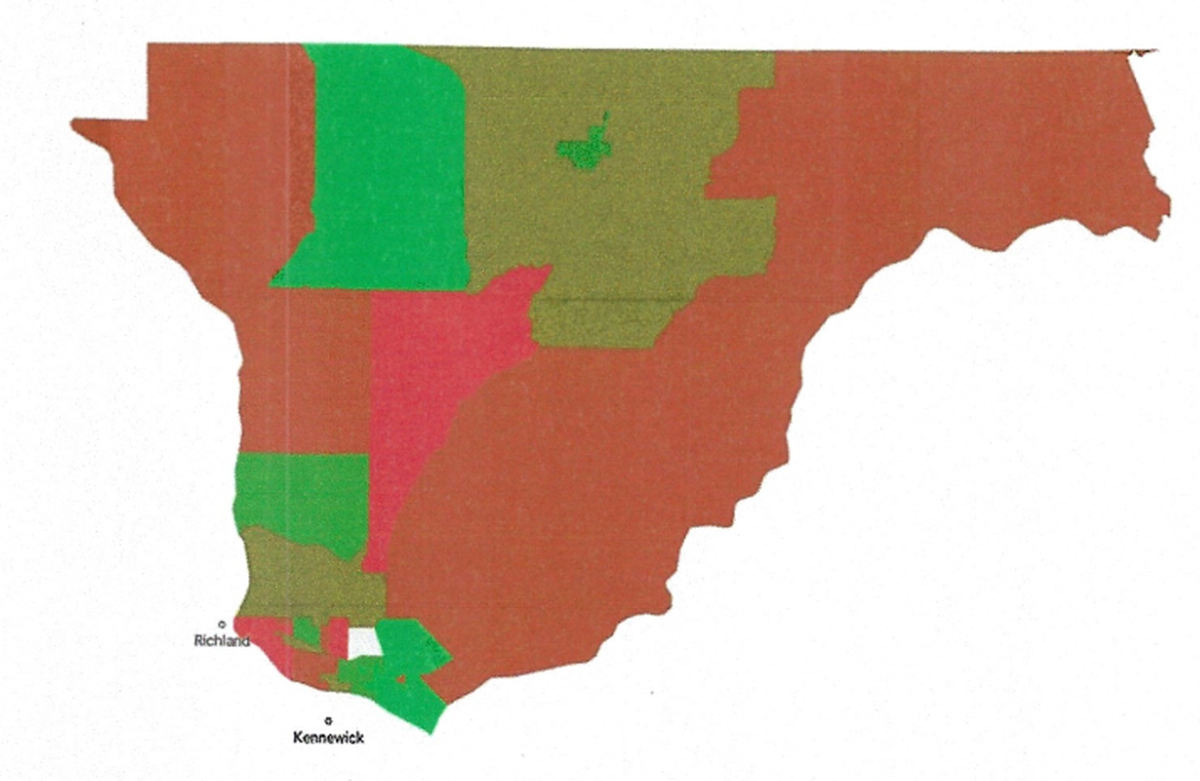
The UCLA Voting Project says that in the 2018 election for Franklin PUD Commission Position 3, Cynthia Parker had the most votes in precincts with a high density of Latino voters but the least in precincts with a high density of white voters.
The position is again on the ballot in November, with PUD Commissioner Stu Nelson being challenged by Pedro Torres, a Pasco fitness instructor.
Latino voters in the PUD have not been able to elect a candidate of their choice to the PUD in at least two decades, the lawsuit says.
The voting rights project was behind a similar complaint filed with Franklin County that led to a settlement two years ago to reconfigure voting districts for the three county commissioners.
When county commissioners took no action in the six months following the county complaint, the UCLA Voting Rights project sued. The settlement required the county to pay $375,000 in attorneys fees.
Similar challenges in recent years in the cities of Pasco and Yakima resulted in wholesale changes in their voting districts.
Following a closed Franklin PUD commission meeting on Sept. 4, the three public utility commissioners directed the PUD general manager to change the general election to district voting as is done in its primary elections and to seek judicial approval of the change.
However, commissioners said they were making the change even though they did not agree that the current system violates the Washington Voting Rights Act, or WVRA.
The change is being made to “avoid even the appearance of a potential violation of the WVRA and to minimize disruption and cost impacts on district ratepayers,” they said in a resolution.
They also directed General Manager Scott Rhees to negotiate a settlement agreement with those who filed the claim.
“Franklin PUD believes in being transparent and will continue to work to resolve this matter in a way that allows our ratepayers to be heard and involved,” said Rosario Viera, Franklin PUD spokesperson, after the lawsuit was filed. “Our intent is and has been to work in good faith with the plaintiffs to reach an amicable solution.”
Hispanics in Franklin County
Franklin County has a history of ethnic and racial tension between the county’s white and Latino communities, the lawsuit said.
East Pasco was once the only part of the city where Hispanic and other minorities were allowed to live.
More recently Franklin County officials have expressed anti-immigration sentiment against the county’s mostly Latino immigrant population, it said.
The existing PUD District 3 crosses Highway 395 and excludes a portion of historic East Pasco, the lawsuit said. It excludes a voting precinct with a large majority of Hispanic voters in East Pasco and includes five precincts with a majority of white voters, it said.
The result is a district with 50% Latino voters with some areas where Latino voters have high turnout excluded, the lawsuit said.
PUD district lines were redrawn in 2021 in a way that appeared to be motivated by sorting citizens on the basis of race and participation in the electorate “with the intent to create a district that appeared to provide Latino electoral opportunity when, in fact, it does not,” the lawsuit said.
Latinos comprise 56% of the population in Pasco, the largest city in Franklin County, and the Latino population of Franklin County has grown to make up about 37% of of the citizens of voting age, the lawsuit said.
It said that change to the election system is timely after the PUD raised utility rates for the first time in six years effective May 2024. The 3% annual rate hike through 2027 will burden low income residents who are often Hispanic, the complaint said.
Almost one in five Latinos in Franklin County live below the poverty line, compared to 7% of white residents, the lawsuit said. Latino residents earn an average of $25,000 less per capita than white residents.
Homeownership also is lower, at 35% for Latino residents compared to 76% of white residents, according to the 2020 U.S. census.