
Once controversial homeless housing complex about to open for 60 in Tri-Cities
What was once a controversial homeless project is getting ready to open a first-of-its-kind complex in the Tri-Cities.
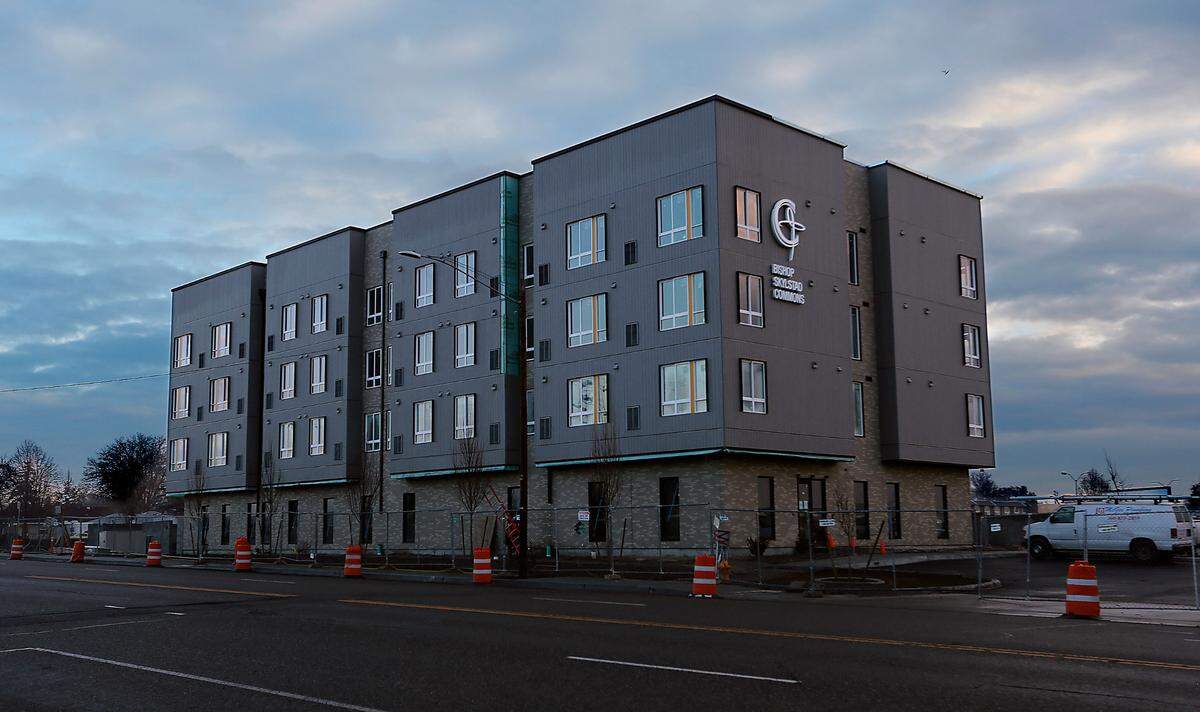
The $16 million building at the corner of Lewis Street and 20th Avenue in Pasco will house 60 people who’ve faced chronic problems finding somewhere to live.
The apartments in the Bishop Skylstad Commons will start filling up in February, said Jonathan Mallahan, the chief housing officer for Catholic Charities for Eastern Washington.
Almost 4,000 people in the greater Tri-Cities area are listed as being homeless by the Homeless Management Information System. That number is growing while the number is decreasing in the state as a whole.
The rate of people homeless in the Tri-Cities consistently has outpaced the rate in the state since 2016, according to a recent Community Health Needs Assessment for Benton and Franklin counties.
The Pasco program aims to serve people who are chronically homeless, many of them have mental health issues or substance abuse troubles.
New residents at the complex will be greeted by a host of services including behavioral health, substance use disorder treatment and employment counseling.
They’ll also receive health and wellness classes, adult education and food preparation lessons — all with the goal of helping them become self-sufficient.
“The best part of my job is welcoming people into their new home,” Mallahan told the Herald. “They’re going to be able to step into a new apartment that can be their forever home if they need it to be. It’s going to reduce the burden of homelessness (on the community.)“
Those with the most urgent need are being identified by Benton County Human Services, which helps people without housing in Franklin County, along Catholic Charities and input from other service providers.
The organization predicts about 10 percent of the residents each year will be able to move out into other housing, but it really measures success by how well they succeed in staying housed and their general improvement in life.
Mallahan said people who live in supportive housing projects like this often develop better health, more employment and income opportunities, less reliance on emergency services and better relationships.
“It gives them more resources to be self-sustaining and to achieve their goals in life,” Mallahan said.
It may be a first for Tri-Cities, but Catholic Charities operates several similar housing units across Eastern Washington. Two include St. Michael’s Haven in Walla Walla and Buder Haven in Spokane.
Catholic Charities for Eastern Washington is a religious nonprofit that is not associated with the Diocese of Spokane. The organization as a whole has more than 2,600 affordable housing units and 600 units in a supportive environment.
“We’re well experienced with providing this sort of housing and serving people with this level of need,” Mallahan said.
While drug use is not allowed in the building, Mallahan said it won’t get someone immediately kicked out. They work with people to help them succeed, though there’s no tolerance for aggressive behavior that puts others in danger, he said.
First Pasco site rejected
The project is more than three years in the making.
Pasco, like other communities, is struggling with increasing housing prices and a lack of available places for people to live.
While Pasco and Franklin County officials have said the project fills a much needed hole, an initial proposal to buy city land for the facility at East Lewis and East A streets was rejected by the Pasco City Council.
The organization turned to a private seller and bought a different site.
Catholic Charities is supported by a combination of government funding, contributions and community support and service fees.
Mallahan said the project wouldn’t have been possible without support from Benton County Human Services, Greater Health Now and other leaders in the area.
Carol Moser, the former head of Greater Columbia Accountable Communities of Health, now known as Greater Health Now, called the project a boon for the area when it started in 2020.
“I think we are seeing an increased number of homeless people in our community,” Moser previously told the Herald. “The important element is treatment and supportive services that accompany this project.”
Staying homeless longer
The Community Health Needs Assessment found that people in Tri-Cities are homeless for longer than in the past.
In 2016, 39 days was typical and that increased to 82 in 2019, the assessment said.
Those who are homeless include not only those people who live on the streets or camp in tents, but people who live in cars and other vehicles, moving them from place to place, and people who move from house to house of friends and family to sleep on couches.
“Homelessness is a symptom,” said one person who commented for the assessment. “It’s a symptom of issues that have occurred, probably over time, that we really need to keep focusing in my view on the upstream, which is mental health, substance abuse disorder, health care.”
Reporter Annette Cary contributed to this report.