Tri-Cities first Latina Superior Court judge ready to ‘step up’
Diego Rivera reprints decorate the walls of Norma Rodriguez’s Kennewick law office, their colors accentuated by a stream of sunlight through the window.
Children carry candles in “Los Niños Pidiendo Posada” as they parade door to door during a popular Latin Christmas tradition.
And two agricultural laborers toil in the fields in “Peasants” — an honest reflection of Mexican culture, work and struggle.
Both offer fond memories for the daughter of seasonal asparagus and hops workers, reminders of her upbringing.
Though her parents kept her away from field work, it was never too far.
“(My mom) converted one of those asparagus boxes into one of our cribs, those were our cribs. And she would just tie four ropes to it, hang it from the ceiling and rock us in that crib,” said the 56-year-old Tri-Cities defense attorney.
“We made do. She made do. We learned to do that growing up: Problem solve, whenever you need to,” she told the Tri-City Herald during an interview last week.
And she remembers always being told that some day she’d be a lawyer.
Now, after practicing law for nearly 30 years, she will become the first Latina judge for Benton-Franklin County Superior Court. She’ll be sworn in at 3:30 p.m. April 1 at the Franklin County Courthouse in Pasco.
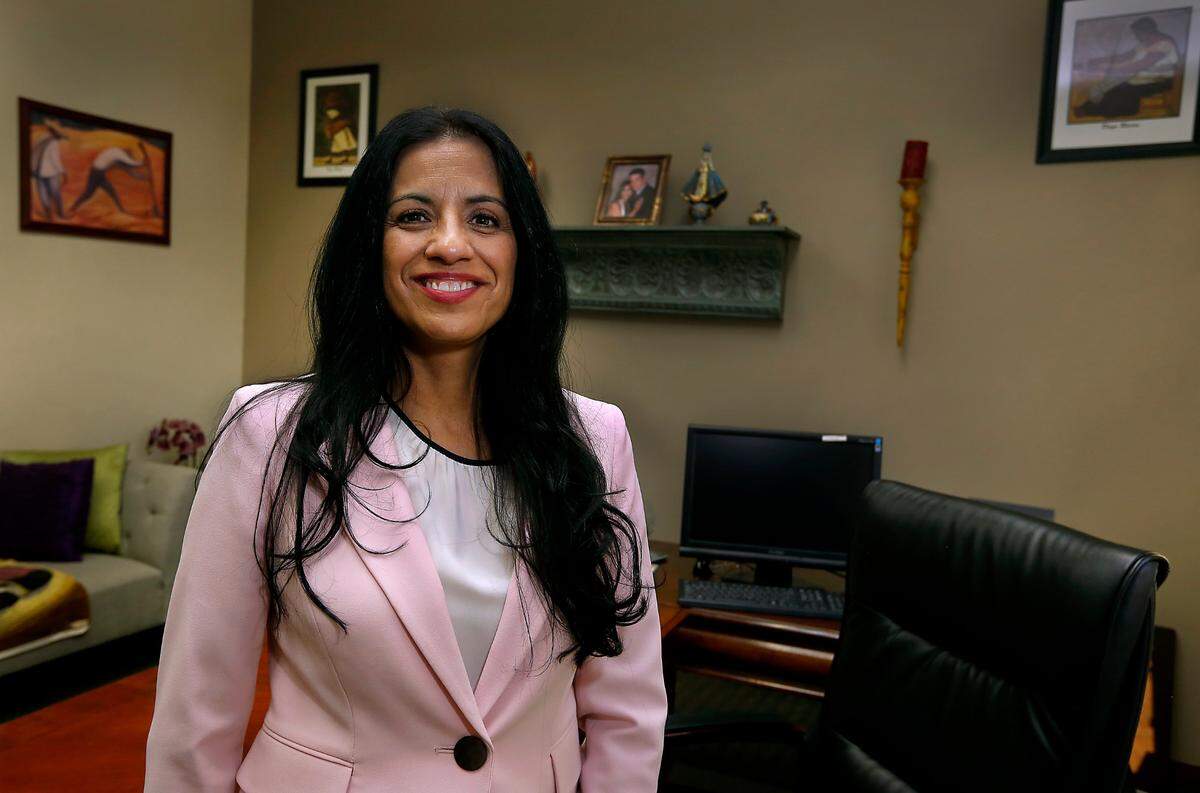
“I think it’s an honor and a privilege to represent the Latinos here in our area — and I think not just in our area, but in our state. There’s very few Latina attorneys,” she said. “I didn’t have somebody to look up to and say, ‘Oh, yeah. I want to do that.’ I was guided by my parents.”
Rodriguez is replacing Judge Cameron Mitchell, the court’s first Black judge who retired March 11 after 18 years on the bench. The seven-judge, bi-county court will soon have three women judges.
The Superior Court judges handle felony criminal cases, along with divorce, paternity and custody issues in the two counties.
As a judge, Rodriguez said she will advocate for the expansion of justice by helping families and defendants navigating the legal system.
Answering the call
“When Judge Mitchell stepped down, and we lost the only minority judge that we had, basically I had to step up — and I wanted to step up and fill that vacancy, because I do feel there is a need to have the demographics of our community represented,” she said, as she talked about her career, growing up in the Tri-Cities and what the new opportunity means to her.
For years now, Rodriguez’s name has been floated as a possible Superior Court pick. But as vacancies and elections came and went, the timing never seemed right for the 1984 Pasco High grad.
But after Mitchell announced his retirement, and Rodriguez and six other applicants applied for the position, Gov. Jay Inslee selected her last month to finish his term. She will have to run for re-election in 2024.
There was a lot in her personal life that the mother of five had to consider leading up to that moment.
In August, Rodriguez’s 83-year-old father struggled with a cardiac arrest that has since severely impacted his health.
“He was here in Kadlec (hospital), and after about a week they were able to get him off the ventilator but he wasn’t weaned properly, so he had another incident. So, he arrested again,” she said. “So, my dad’s died about five times already, and he’s come back. He’s pretty tough.”
Tri-City doctors originally didn’t believe that her father would make it. In September, he was transferred to a hospital in Phoenix because there were no beds available for him in the Tri-Cities because of the COVID pandemic.
Rodriguez has had to take time away from her practice to help her mother, who’s now 80.
She hopes her father can be weaned off the ventilator in time to return to the Tri-Cities to attend her swearing-in, but it’s too soon to tell.
Ag worker roots
Rodriguez was born in the small town of Floydada in the Texas panhandle. But by the time she was 2, her parents were already traveling to Washington.
“They came here for work. They had relatives here that were also traveling for the work, but they definitely came up to Washington as seasonal workers to work the asparagus and the hops. I think eventually they were working cherries and apples, strawberries in Mount Vernon,” she said.
She recalled the small strip of apartments for laborers in Mabton, where her family lived for a while, with their communal bathrooms and close proximity to the asparagus fields. She grew up alongside six siblings.
She worked hard in high school, earning straight-As, eventually earning both her bachelor’s and law degree from Gonzaga University in Spokane.
“I think they wanted all their children to be professionals just because they felt that we had the opportunity that they did not. Both my parents were orphaned. My mom didn’t have any schooling other than first grade, dad got to eighth grade. But both of them are very bright,” she said.
Tri-City trailblazing
Rodriguez has practiced law since 1992.
In 1994, she began operating her own law practice in Kennewick, and she founded her own general practice firm Rodriguez Interiano Hanson and Rodgers in 2015, which largely deals with criminal defense, personal injury and Labor and Industries disputes.
She’s also served as a Benton-Franklin Legal Aid board member, a Youth and Justice Forum committee member and on the nonprofit board for the Circle of Hope Foundation, which helps provide funding for portions of the Benton-Franklin Counties Adult Drug Court.
“I think she really exemplifies what we always hope for in a judge, and she’s had a lot of experience,” said retired Superior Court Judge Dennis Yule, who served as the drug court’s first judge.
Yule said the formation of the intensive treatment and accountability program and court was the “highlight of his 23 years” on the bench. Rodriguez worked in that court as a team member, helping those charged with drug-related crimes at often the lowest points in their lives.
“Judge Mitchell retiring, I’m happy for him retiring but he leaves big shoes to fill,” Yule said. “I told the governor, I don’t think there’s anyone more qualified to succeed Judge Mitchell than Norma Rodriguez.”
Rodriguez said it would be nice to establish a diversion program, too, in Benton County, similar to the one offered in Franklin County.
And addressing the COVID pandemic-caused backlogs for trials and court hearings will be one of the court’s biggest challenges, she said.
“And not just the criminal cases, but all of the civil, domestic, the family law cases. I mean, you can imagine how many people are waiting for their divorces. How many people are waiting for personal injury cases. I just can’t imagine what they’re going through,” Rodriguez said.
High profile case
Rodriguez over the years has been involved in a number of high-profile cases, usually as a defense attorney.
One of them was the case of Donald Schalchlin, a Benton City teen whose sister and mother were murdered in 2007 by Joshua Tucker.
“I’ll never forget going to the crime scene. It was a horrible crime,” said Benton County Prosecutor Andy Miller, who has known Rodriguez since soon after she passed the bar exam in the mid ‘90s.
Over the years they have been on opposite sides of the courtroom on some difficult cases.
“She was a fierce advocate, but her advocacy for the client never affected her professionalism,” he said. “She maintained that professionalism in her advocacy and was always prepared for her cases, and she was respected too.”
Tucker was sentenced to 41 years for the murders, though there was some question about Schalchlin’s involvement and his ability to stop his friend.
In a rare precedent for such a case, Rodriguez and her defense team entered into a mediation process with the judge. Consecutive negotiations led to an agreed 9 1/2-year sentence for Schalchlin, avoiding a likely expensive and time-consuming trial.
As an advocate for her client, and looking back now, Rodriguez praised the process, while Miller still had questions about Schalchlin’s ability to prevent the murders.
“That was a very tense, adversarial situation,” Miller said. “And Norma and I both maintained our professionalism throughout the process and ended up with respect for each other.”
“I was happy. I wrote a letter to the governor for her and I wrote another letter for another candidate. ... I think she’s going to be a good judge,” he said.