‘It’s terrorism, it’s genocide.’ Tri-City Ukrainians who escaped persecution now fear the worst
The last week has been full of prayers and struggles for Olga Strand.
The Richland mother is hoping for peace and a ceasefire even as Russian troops advance into the Southern Ukrainian community where she grew up. She’s been hoping for the safety of her mother, relatives and friends who still live there.
To cope with uncertainty, Strand, 37, has turned to action.
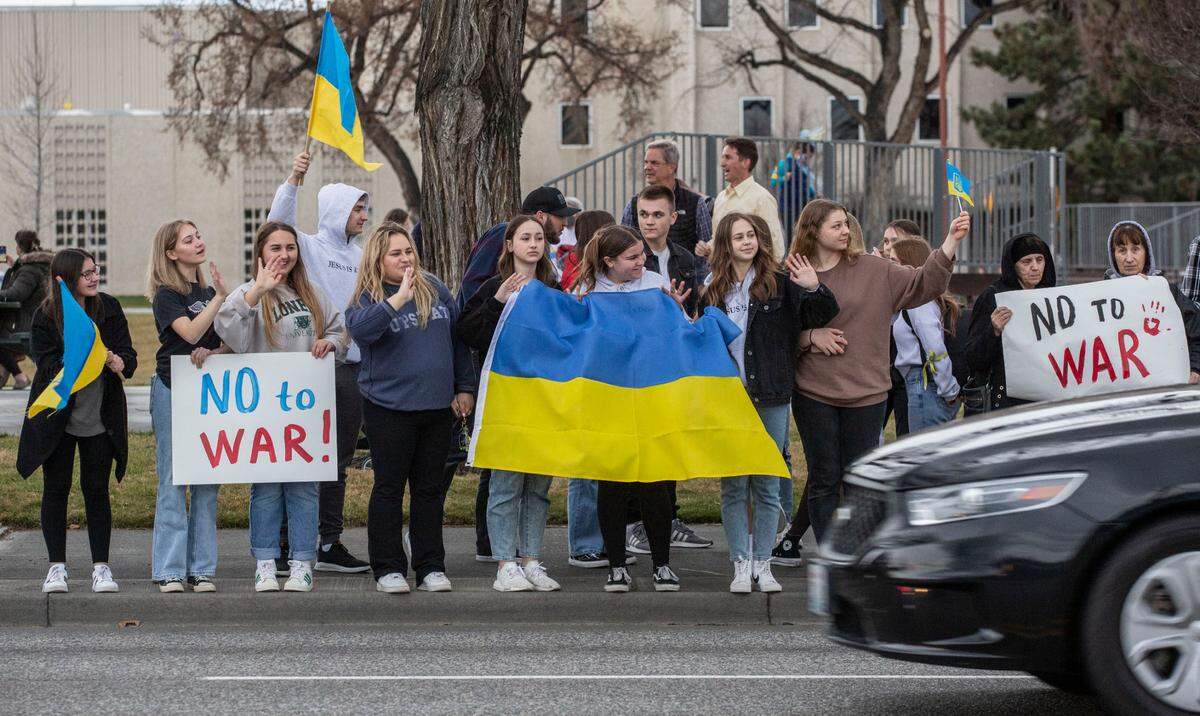
On Tuesday, she helped organize a Richland protest that drew about 300 Tri-Citians. She’s also planning a fundraiser to help American Red Cross response efforts.
Strand’s nightmare is what many of the several thousand Tri-City Ukrainians are living with, since Russia launched a large-scale invasion on the Soviet nation of 44 million.
One Tri-City pastor has raised hundreds of thousands of dollars for relief, and local Soviet experts argue the conflict could affect every corner of the U.S. — including the Tri-Cities.
“I know more people need to know about this because it’s not just a war – it’s terrorism, it’s genocide. Citizens are being killed on the streets,” Strand said.
She heard just this week about a family of five near where her mother lives who were killed by Russian troops as they tried to evacuate.
Worries for their families
For Kennewick’s Zhenya Prishchenko, keeping in touch with family has been difficult.
Born in the Eastern Ukraine city of Dnipro, located north of the Crimean peninsula, Prishchenko came to the Tri-Cities six years ago, following his wife, Stasia.
Prishchenko has been speaking with his mother who’s been locked in her apartment in Kyiv, Ukraine’s capital city. His father is about an hour outside of the city in his rural home.
After more than 72 hours without hearing from his dad, Prishchenko began to fear the worst. But his elderly father reconnected with him this week, though he’s sick with the flu, and is low on food and other necessities.
“There is really nothing we can do, effectively, to try and resolve this whole situation,” said Prishchenko, 35. “It’s not just about our families and our friends. A whole independent nation is suffering an attack, and not a whole lot of people outside of Ukraine seem to know or care about it.”
More than a million have fled the embattled country since last week’s invasion, as Kremlin troops continue their advancement from the east.
“I cried. I was very anxious. We didn’t stop watching the TV, news. It’s painful, watching people suffering,” said Stasia Prishchenko, 37.
Tatyana Polyukh works as a second-grade teacher at Three Rivers Elementary in Pasco, where she’s helped develop the district’s Russian bilingual-language program and currently teaches 17 Ukrainian students.
Though she immigrated to the states in 1992, most of her family remains back in Kyiv. Her brother had a close call when a Russian missile struck his apartment complex’s courtyard about five days ago while he was on the balcony. He crouched down for cover, but was covered in ash.
“At this point in the invasion, it’s becoming more common for civilians to have these sorts of encounters. These are fear tactics meant to intimidate the Ukrainian population that’s holding strong so far,” Polyukh said Thursday in a text message.
She and her family are taking the day, minute by minute and hour by hour. Some have fled west, but others spend their days and nights in bomb shelters.
“With the global response to this tragedy, this is no longer a Ukrainian versus Russian war, but a war for all people,” she said.
A united Ukraine
“People in Ukraine or from Ukraine are more united now than ever,” said Zhenya Prishchenko.
But never before have Russians and Ukrainians — two countries so geographically and culturally close — been so divided on the facts.
For many East Ukrainians, national dialogue on both sides has split families down the middle.
Russian President Vladimir Putin’s case for invasion rests on an bid to “denazify” Ukraine and liberate its people. The longtime president has also called the breakup of the USSR the 20th century’s “greatest geopolitical catastrophe.”
But Ukrainians aren’t buying it.
Prishchenko said many Russians are being “brainwashed” by state propaganda, especially when it comes to the reason behind the country’s attack.
“They live in their alternative reality,” he said.
Stasia Prishchenko said the schism has made it almost impossible for her to speak to her Russian relatives in recent years. The recent conflict has also sowed seeds of division between the Ukrainian and Russian attendees at the couple’s church. Disagreements on social media have also gotten heated, too.
“Every time we post on something, they almost try to attack us,” Zhenya Prishchenko said. “Some Russians. Not all.”
Taking action
Vlad Savchuk recounts the date without a second thought: Dec. 6, 1999 — the day he immigrated to the U.S. as a 13 year old.
He and his family came across the Atlantic after many years of being persecuted for their anti-communist beliefs and ties to the minority Baptists.
Savchuk’s earliest memories of his home nation were of being verbally berated by students and the communist teachers for his views.
“We were bullied on a regular basis. Students were encouraged to think of us as a plague or a cancer in the society,” he said.
Today, Savchuk leads the Hungry Generation in Pasco, a church founded by his uncle.
About a third of the congregation are Soviet immigrants, and they’re worried about Ukraine. He and his congregation have been busy turning “worry to prayer.”
“To me this is not political. It’s personal, this is my home,” Savchuk said. “When innocent people are being killed, it’s not political. It’s human life we’re talking about.”
He’s finding ways to take action, though — both big and small.
Savchuk on Sunday is flying out to the Polish-Ukrainian border to assist with the refugee crisis. His nonprofit, Vlad Savchuk Ministries, has already raised more than $200,000 to help nonprofits dealing directly with refugees and for other resources.
He has also begun to speak about the topic on his own YouTube channel, which has more than 254,000 subscribers.
Local experts weigh in
Tri-City residents are already feeling the impact from the Ukraine-Russia conflict.
Oil prices have surged since the invasion, said Brigit Farley, an associate professor of Russian history at Washington State University Tri-Cities in Richland, and prices at the pump will likely continue to be impacted.
Ukraine is also a major exporter of grain and wheat, which could affect the world’s food prices.
Farley, who has been involved in Russian and Eastern Ukraine studies since 1974, said the conflict could also indirectly impact how the U.S. conducts business with Europe over the next century.
“For me, what’s disturbing is I thought this was a new dawn,” Farley said. “I really thought this century, the 21st century, would be a century of peace and prosperity in Europe.”
It’s also very likely the refugee crisis could spill over into the states.
“What matters right now is that the international law and world order has been so blatantly violated. We really are in uncharted territory,” said Volha Isakava, an associate professor of Russian at Central Washington University and a Belarusian native, whose research centers on post-Soviet pop culture.
This story was originally published March 5, 2022 at 5:00 AM.